


A one-hour programme at 25 frames per second contains 90,000 frames. Sample it once per second and the model receives 3,600: 4% of the source frames. A brief insert can sit entirely between those samples.
That is the first question to ask about VLMs for broadcast content compliance: what did the system actually inspect?
A vision-language model (VLM) interprets images or video alongside text. It can help build a review queue, suggest descriptive metadata, or identify a moment worth checking. Its answer does not establish that a programme is cleared for a particular audience, territory or transmission time.
This guide separates useful pilot applications from claims a broadcaster should demand evidence for. Model details, licences and research were checked on August 30, 2026.

AI-generated editorial illustration. The scene is fictional and does not depict an Amira product interface or customer installation.
What can VLMs actually flag in broadcast video?
VLMs are candidates for finding visible events and preparing evidence for a reviewer. Whether a particular model reliably finds your events needs testing on your material.
Start by defining the output you want. A timecoded observation such as “a handgun appears on the table” is easier to verify than a verdict such as “this programme violates policy.” The latter requires facts beyond the pixels.
These are proposed pilot uses, not certified capabilities of every model:
Task | Useful candidate output | Check still required |
|---|---|---|
Content screening | Clip and timestamp containing suspected violence, nudity or an offensive visual symbol | What happened, whether the flag is correct, and whether the editorial context permits it |
Descriptive metadata | Scene tags, visible objects and extracted on-screen text | Correct names, exact wording, relevance and unsupported inferences |
Advertising review | Possible bumper, sponsor card or change into advertising-like material | Actual break boundaries, signalling and playout records |
Audio-description preparation | Draft observations about visually important events | Narrative relevance, accuracy, timing and the listener's experience |
For a producer, the value is reaching the relevant clip sooner. For master control, the value depends on whether the alert arrives with enough time and evidence to act. For a buyer, the test is whether the workflow reduces review effort without hiding missed content.
Keep those outcomes separate. An attractive scene summary proves little about a system's ability to catch a two-frame insert.
Why is flagging content different from clearing it for air?
Broadcast clearance requires editorial and distribution context that a visual observation cannot supply on its own.
The UK provides a concrete example. Ofcom's current Broadcasting Code, Rule 2.3, requires potentially offensive material to be justified by context. Its definition considers the programme, service, scheduling, likely audience expectations and warnings, among other factors. Recognising a weapon or a distressing scene is only one input to that decision. This is a UK example, not a universal rule for international distribution. Ofcom: harm and offence
Our recommended review record separates the observed event from the applicable policy. Include the source clip, timestamp, model observation, proposed policy category and the human decision. Record the relevant territory and version of the policy separately.
Preserve disagreement. A reviewer should be able to reject a flag without erasing the evidence that generated it.
Also distinguish “no finding” from “not reviewed.” A decoder failure, queue timeout or unsupported input must remain visible as a coverage gap. An empty result from an incomplete job should never become a clearance decision.
Which open-weight models should a broadcast team evaluate?
Use a small, explicitly licensed shortlist representing different resource requirements, then test each model against the same labelled material.
The following checkpoints are useful evaluation candidates, not a ranked list of broadcast-compliance products. Their cards describe general image or video capabilities; those descriptions do not validate your moderation taxonomy.
Exact checkpoint | Licence checked August 30, 2026 | Reason to include in a pilot |
|---|---|---|
SmolVLM2-2.2B-Instruct | Apache-2.0 | A smaller English-language baseline for low-risk scene descriptions and metadata experiments. Its card warns against critical decisions. |
Qwen3-VL-8B-Instruct | Apache-2.0 | A baseline for video questions and reading visible text, with a smaller checkpoint than the 27B option below. |
Qwen3.8-27B | Apache-2.0 | A newer image/video-capable candidate for testing whether additional capacity improves your difficult cases. Released August 14, 2026. |
Sources: Hugging Face's SmolVLM2 card, Qwen3-VL-8B card, Qwen3.8-27B card and Qwen's release record.
Check the exact checkpoint licence. Qwen3.8-Flash-Next uses the Qwen Community License 1.0, while the 27B checkpoint above uses Apache-2.0. A shared family name does not establish identical deployment terms. Have your procurement team review the actual licence and intended use. Qwen3.8-Flash-Next model card
Pin the checkpoint revision, preprocessing settings and inference software in the evaluation record. Otherwise, a result measured this month may describe a different system from the one deployed next month.
How much GPU memory does video review need?
The answer depends on the checkpoint, input resolution, frame count, context length and concurrent jobs. A model's name is insufficient for sizing.
Consider two concrete storage figures checked on August 30. The original Qwen3-VL-8B-Instruct checkpoint index lists 17,534,247,392 tensor bytes, or 17.53 GB in decimal units. The Qwen3.8-27B index lists 55,562,855,904, or 55.56 GB. These are checkpoint tensor-storage totals, not measured peak GPU memory. 8B checkpoint index, 27B checkpoint index
Hugging Face separately reports 5.2 GB of GPU RAM for SmolVLM2 video inference. That is a vendor-reported runtime figure, not a universal ceiling or an Amira measurement. It should not be compared directly with the checkpoint-storage figures above. SmolVLM2 model card
Budget for more than loaded weights. Visual processing, stored context, decoding buffers and simultaneous requests consume additional resources. Quantisation can reduce weight memory, but the specific quantised model needs its own accuracy and workload test.
For procurement, request measured peak memory and completed programme-hours per wall-clock hour at your chosen resolution, sampling policy and concurrency. Include long clips and busy scenes. Record failures as well as throughput.
The broadcast AI GPU buyer's guide covers the broader hardware decision. For video review, the workload definition belongs beside every hardware figure.
What can frame sampling miss?
Frame sampling can miss an entire event, even when a model would recognise that event if shown the right frame.
Our opening arithmetic assumes progressive 25 fps video: 25 × 3,600 = 90,000 source frames per hour. At one sample per second, 3,600 frames reach the model. The resulting 4% is a frame-count ratio. It is neither a measure of retained meaning nor a detection probability.
Imagine an event lasting 200 milliseconds, from 1.30 to 1.50 seconds. Samples at exactly 1 and 2 seconds both miss it. The illustration below shows that timing relationship.
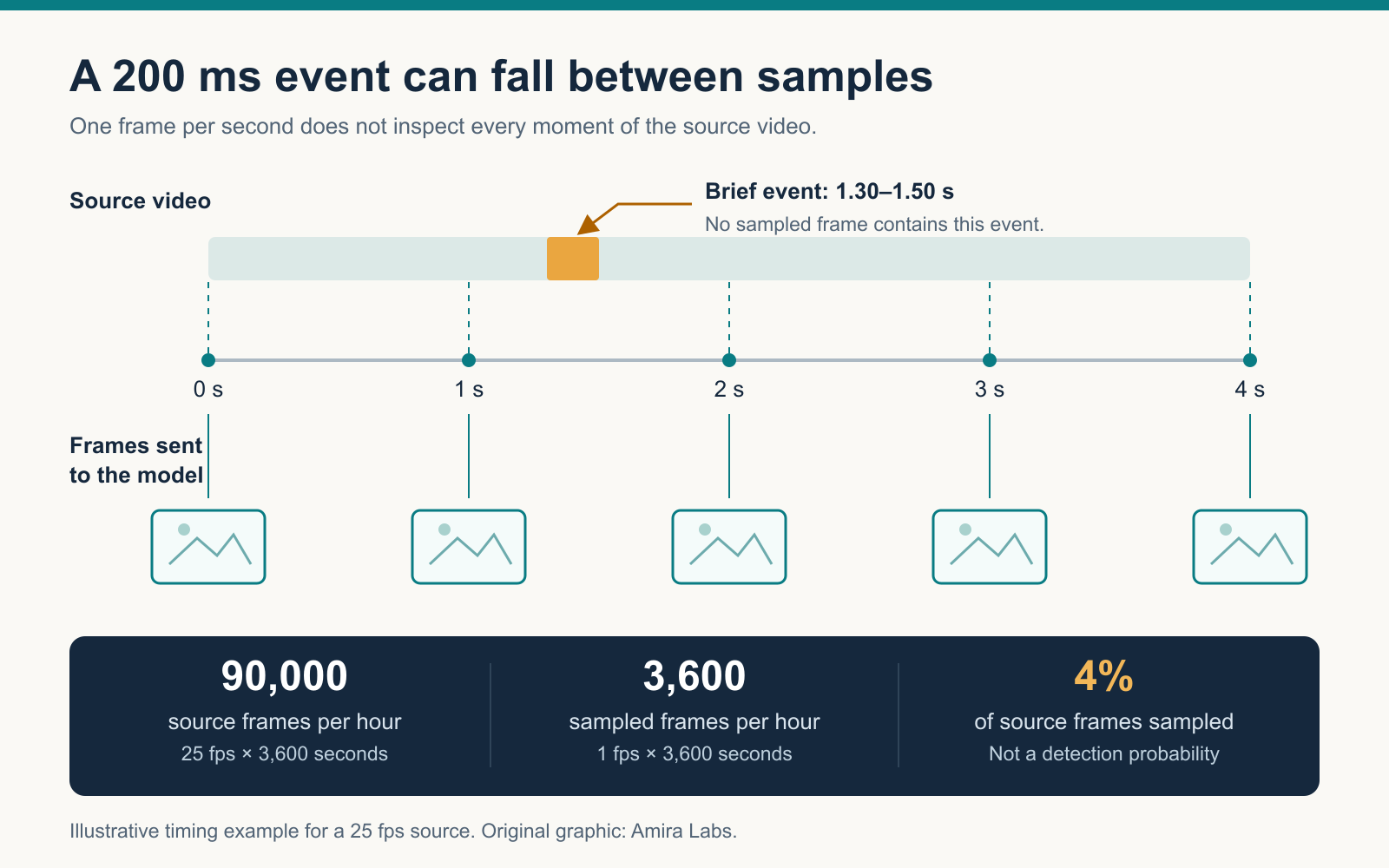
Original Amira Labs diagram. Hypothetical timing example at 25 fps; the 4% figure is not an accuracy estimate.
More sampling increases temporal coverage, but the pilot must also test reduced resolution, small text, picture-in-picture elements, graphics overlays and cuts near clip boundaries. A system can receive the right frame and still lose the relevant detail during resizing.
Scene-change sampling may help select interesting frames. It does not establish that every relevant event causes a scene change. Test short inserts and changes within a continuous shot explicitly.
Preserve the relationship between each finding and the original media timestamp. A sampled-frame index is not a programme timecode. Overlap adjacent analysis clips where context may cross a boundary, and retain the original excerpt for human replay.
Finally, a frame-only review has not listened to the programme. Spoken language and sound need their own analysis and review path. The broadcast ASR model-selection guide addresses speech recognition; a transcript still needs to be interpreted alongside the picture and surrounding context.
What do video benchmarks actually prove?
A benchmark measures performance on its own tasks and dataset. It does not establish broadcast clearance accuracy.
Video-MME's authors describe 900 videos, 254 hours of material and 2,700 human-annotated question-answer pairs. That makes it useful evidence about general video understanding. It does not directly measure the recall of brief prohibited events under a broadcaster's policy. Video-MME author repository
More specialised research is emerging. In the August 21, 2026 revision of the SafeLens paper, the authors report 76.7% average class accuracy and a macro F1 score of 75.3 on a 0–100 scale for the full framework on SafeWatch-GenAI. Macro F1 gives each category equal weight when combining precision and recall. These are the researchers' dataset-specific results, not independently established broadcast performance. SafeLens combines initial screening with additional analysis where needed; the paper does not certify a production broadcast workflow. SafeLens, revised August 21, 2026
For acceptance testing, replace the single headline score with operational questions:
- Event recall by category: of the relevant events in the labelled test set, how many were found?
- Short-event performance: which event durations, overlays and cuts were missed?
- False alerts per programme-hour: how much unnecessary work reaches the review desk?
- End-to-end delay: how long from receiving the relevant media to presenting playable evidence, including queueing?
- Coverage failures: how much material was dropped, timed out or left unreviewed?
- Human review effort: how much time does adjudicating each real or false finding take?
Separate severe misses from harmless mislabelling. A combined average can conceal a weak category. For rare events, report the number of examples tested alongside the percentage.
Treat a model's self-reported confidence as uncalibrated until it has been checked against labelled outcomes. Confident prose is not an error bound.
Can VLMs generate finished audio description?
VLMs can be evaluated as drafting assistants, but visual descriptions still need accessibility-focused editorial review before becoming an audio-description track.
Audio description adds relevant visual information for people who are blind or have low vision. It must work with the existing soundtrack. A frame-by-frame inventory of visible objects is a poor substitute for deciding what a listener needs at a particular moment.
Ofcom's access-services guidelines address plot-relevant visual information, intelligibility, timing and the relationship with dialogue and sound. They also caution against introducing information, such as a character's identity, before the programme reveals it. These are editorial decisions that require more than object recognition. Ofcom access-services guidelines
Recent research reinforces the importance of editorial convention. A study submitted August 10, 2026 compares British and American human-authored audio description for 206 movies, examining differences in language, character introductions and timing relative to dialogue and music. It studies human descriptions; it does not demonstrate the quality of AI-generated tracks. Sterner, Lascarides and Keller: comparing British and American audio description
A useful pilot gives an audio-description editor candidate observations and lets them choose, correct and time the script. Evaluate the result with blind and low-vision listeners. Keep draft observations separate from approved narration.
Where should a VLM not be used alone?
A generic VLM should not be the sole control for technical safety, rights clearance or irreversible on-air decisions.
Flashing-image risk is a clear boundary. Ofcom Rule 2.12 requires broadcasters to take precautions to maintain a low risk to viewers with photosensitive epilepsy. A sparse frame summary does not establish that this temporal risk was measured. Keep purpose-built flashing-image assessment in the workflow. Ofcom Rule 2.12
Advertising boundaries need similar discipline. AWS's MediaLive documentation describes SCTE-35 messages carrying ad-availability and other event information. A VLM's observation of an advertising-like scene is a different kind of evidence. Check it against signalling, playout records and frame-accurate media review before using it to explain a break. AWS: SCTE-35 message processing
Keep dedicated measurements for technical quality-control tasks such as loudness and freeze detection. Visible material also cannot establish ownership rights or prove the truth of a factual claim.
For live services, run an initial pilot in shadow mode: the system observes and records findings while existing operational controls remain unchanged. Any later path to holding, replacing or interrupting output needs separate approval, tested timing and an explicit failure policy.
What should broadcast teams do this week?
Choose one bounded review task and write the acceptance test before choosing the winning model.
- Define one policy category and its evidence. Specify the territories, programme types and decisions in scope. Agree which findings require human judgement and who owns that decision.
- Build a labelled evaluation set. Use material you are authorised to process. Include short events, small overlays, benign lookalikes and examples whose meaning depends on surrounding footage. Separate tuning examples from the final test set.
- Run a shadow trial. Keep existing controls in place. Review missed events as carefully as successful detections, and inspect a sample of no-alert material so silence does not escape scrutiny.
- Make a workload-specific go/no-go decision. Record the exact model revision, licence, sampling settings, peak memory, queue behaviour, review effort and category-level errors. Keep an explicit state for unfinished review.
Ask any supplier to demonstrate a known miss, a benign false alarm and a processing failure on your material. Ask where the original evidence is retained and how a reviewer corrects the result.
A team that can answer those questions has a testable review workflow. A team with only a fluent video summary still has an experiment.
Sources
- Hugging Face: SmolVLM2-2.2B-Instruct model card and licence
- Qwen: Qwen3-VL-8B-Instruct model card and licence
- Qwen: Qwen3-VL-8B-Instruct checkpoint tensor index
- Qwen: Qwen3.8-27B model card and licence
- Qwen: Qwen3.8 release record
- Qwen: Qwen3.8-27B checkpoint tensor index
- Qwen: Qwen3.8-Flash-Next model card and licence
- Video-MME: author-maintained benchmark repository
- SafeLens: research paper, revision dated August 21, 2026
- Ofcom: Broadcasting Code, Section Two, harm and offence
- AWS: SCTE-35 message processing in MediaLive
- Ofcom: guidelines on providing television and on-demand access services
- Sterner, Lascarides and Keller: Comparing British and American Audio Description of Movies, August 10, 2026