

A $16,000 GPU can be the cheaper card. A $4,699 desktop can be the expensive one. For a broadcast AI GPU, acquisition cost matters less than how many hours of audio or video it processes inside the latency target before a stream stalls, drifts or gets dropped.
That is why tokens per second is the wrong headline metric for broadcast procurement. A newsroom assistant may wait between requests. A captioning service receives another second of audio every second, all day. The useful unit is cost per hour of processed media at a tested concurrency, with enough reserve for failover.

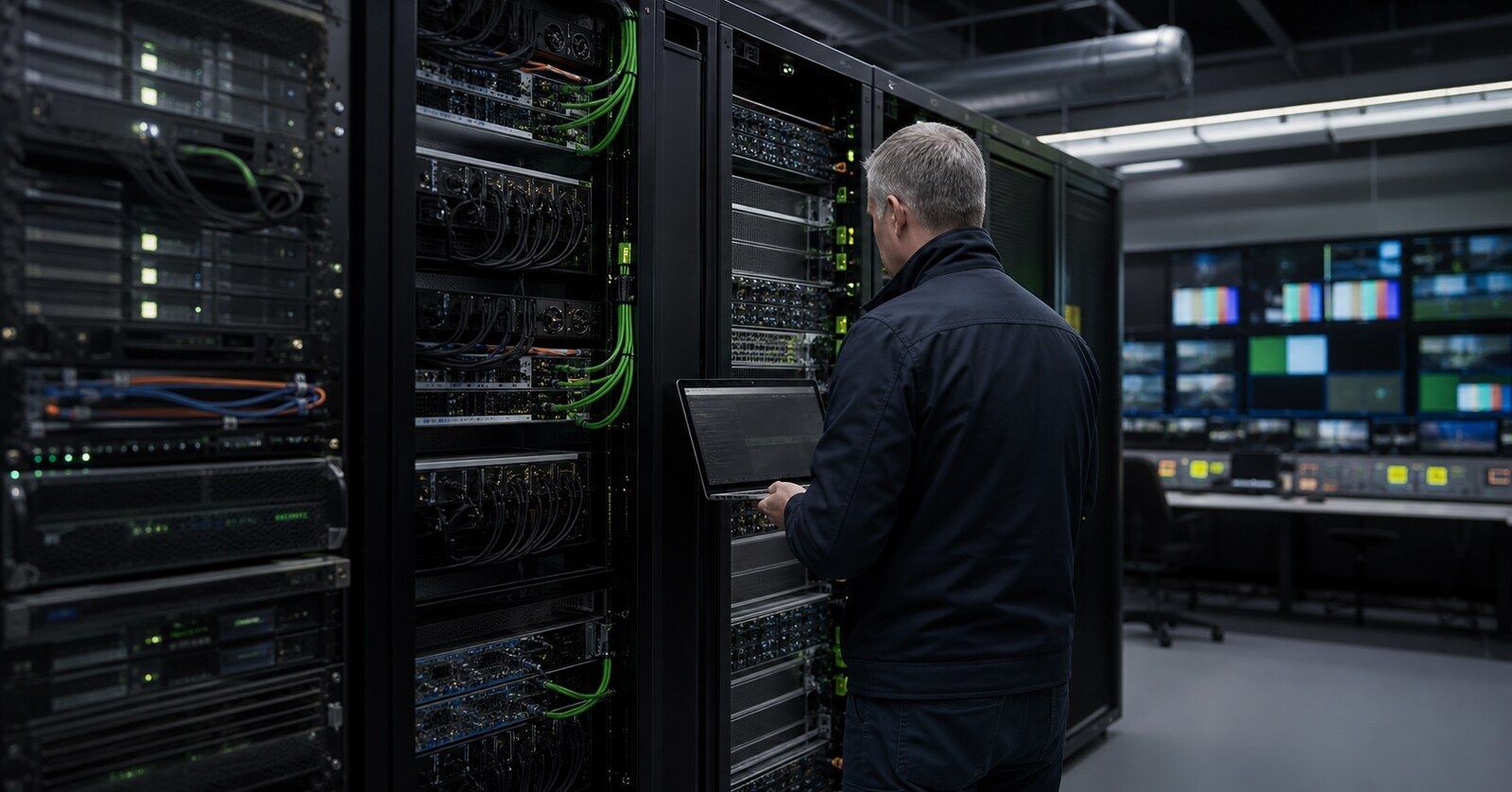
A broadcast AI node has to fit the model, the media pipeline and the operational envelope. GPU memory alone does not answer the buying question. Image: Amira Labs.
The specifications and US price listings below were checked on August 29, 2026. Prices are unusually volatile. Treat them as a dated procurement snapshot, not a rate card.
What should a broadcaster buy in 2026?
Most broadcast AI purchases should start at 24 GB of error-correcting GPU memory, move to 48 GB when several models or video workloads share a node, and use 96 GB only when model size or consolidation justifies the jump. DGX Spark belongs in the lab when its 128 GB unified memory solves a development problem. It is not the automatic choice for sustained production concurrency.
The shortlist is simpler than the product catalog makes it look:
- NVIDIA L4 is the low-power server choice for continuous ASR, metadata and modest video inference when 24 GB is enough.
- RTX PRO 4000 Blackwell is the active-cooled workstation alternative at the same 24 GB capacity, with much more memory bandwidth and current-generation media engines.
- RTX PRO 5000 Blackwell or L40S is the 48 GB tier for heavier vision-language models, multiple resident models and higher-density media processing. Choose between them by chassis, support and duty cycle rather than by the memory number.
- RTX PRO 6000 Blackwell is the 96 GB single-card tier. It earns its price when 48 GB forces model compromise or additional nodes.
- DGX Spark is a compact Arm development system with 128 GB of shared CPU-GPU memory. It fits models that discrete workstation cards cannot, but fit is not throughput.
The right card is the smallest supported configuration that clears your acceptance test with reserve capacity. Buying one tier above a measured need can be sensible. Buying two tiers above an unmeasured guess usually is not.
How much GPU memory does each broadcast workload need?
Memory capacity sets the first gate, but the production floor includes model weights, runtime workspace, caches, media buffers and overlapping requests. Leave 25% to 30% free during the worst representative run rather than sizing to a successful cold start.
Workload | Practical starting tier | Why | What can move the floor |
|---|---|---|---|
One ASR model for live captions or transcripts | 16–24 GB | OpenAI lists about 10 GB for Whisper large and 6 GB for turbo; NVIDIA says Parakeet TDT 0.6B v3 needs at least 2 GB to load | Concurrent feeds, diarization, translation, long buffers and duplicate models for rolling updates |
Dense ASR service with several models or languages resident | 24–48 GB | More memory reduces model swapping and allows independent workers | Decoder settings, batch policy, timestamps, language routing and failover reserve |
7B–14B newsroom LLM or small vision-language model | 24–48 GB | An 8B model alone is roughly 16 GB in 16-bit weights or 4 GB at 4-bit before cache and runtime overhead | Context length, image resolution, simultaneous users and quantization quality |
30B–70B text or vision model | 48–96 GB | A 70B model is roughly 35 GB at 4-bit or 70 GB at 8-bit before overhead | Context cache, video frames, batching and whether the runtime can split cleanly across GPUs |
Models above the 96 GB discrete-card ceiling | 128 GB unified memory, multiple GPUs or cloud | Capacity becomes the immediate constraint | Memory bandwidth, interconnect, software support and the latency target |
These are shortlist ranges, not channel-count promises. The current Amira Labs ASR model comparison shows why exact checkpoints and streaming modes matter. For example, the Qwen3-ASR 1.7B repository contains about 4.7 GB of model files, but that file size does not include the serving runtime or simultaneous sessions.
Which GPU fits each operational tier?
The table below maps current NVIDIA options to broadcast constraints. Peak AI TOPS are omitted because precision, sparsity and software paths make cross-product headline numbers easy to misuse.
Platform | Memory and bandwidth | Published power | Media engines | Best initial fit | Operational caveat |
|---|---|---|---|---|---|
NVIDIA L4 | 24 GB GDDR6 ECC, 300 GB/s | 72 W board TDP | 2 NVENC, 4 NVDEC | Low-profile servers for 24/7 ASR and efficient mixed media inference | Passive card; requires qualified chassis airflow; no public card price |
RTX PRO 4000 Blackwell | 24 GB GDDR7 ECC, 672 GB/s | 145 W board power | 2 NVENC, 2 NVDEC | Single-slot workstation or compact active-cooled node | Workstation packaging and support may not match a facility's server standard |
RTX PRO 5000 Blackwell | 48 GB GDDR7 ECC, 1,344 GB/s | 300 W maximum | 3 NVENC, 3 NVDEC | Heavy VLM work, several resident models, live-media workstation | Dual-slot active cooling; price and availability are moving targets |
NVIDIA L40S | 48 GB GDDR6 ECC, 864 GB/s | 350 W maximum | 3 NVENC, 3 NVDEC | Qualified 24/7 data-center servers, video plus AI, vGPU estates | Passive dual-slot card; NVIDIA says it does not support MIG or NVLink |
RTX PRO 6000 Blackwell | 96 GB GDDR7 ECC, 1,792 GB/s | 600 W workstation; 300 W Max-Q | 4 NVENC, 4 NVDEC | Large single-GPU models, dense multimodal nodes and consolidation | The workstation, Max-Q and passive server editions are different thermal products |
NVIDIA DGX Spark | 128 GB LPDDR5x unified, 273 GB/s | 233.2 W measured regulatory maximum; 38 W idle | 1 NVENC, 1 NVDEC | Local prototyping, model evaluation and development above 96 GB | Arm64 platform, shared memory and much lower bandwidth than RTX PRO 6000 |
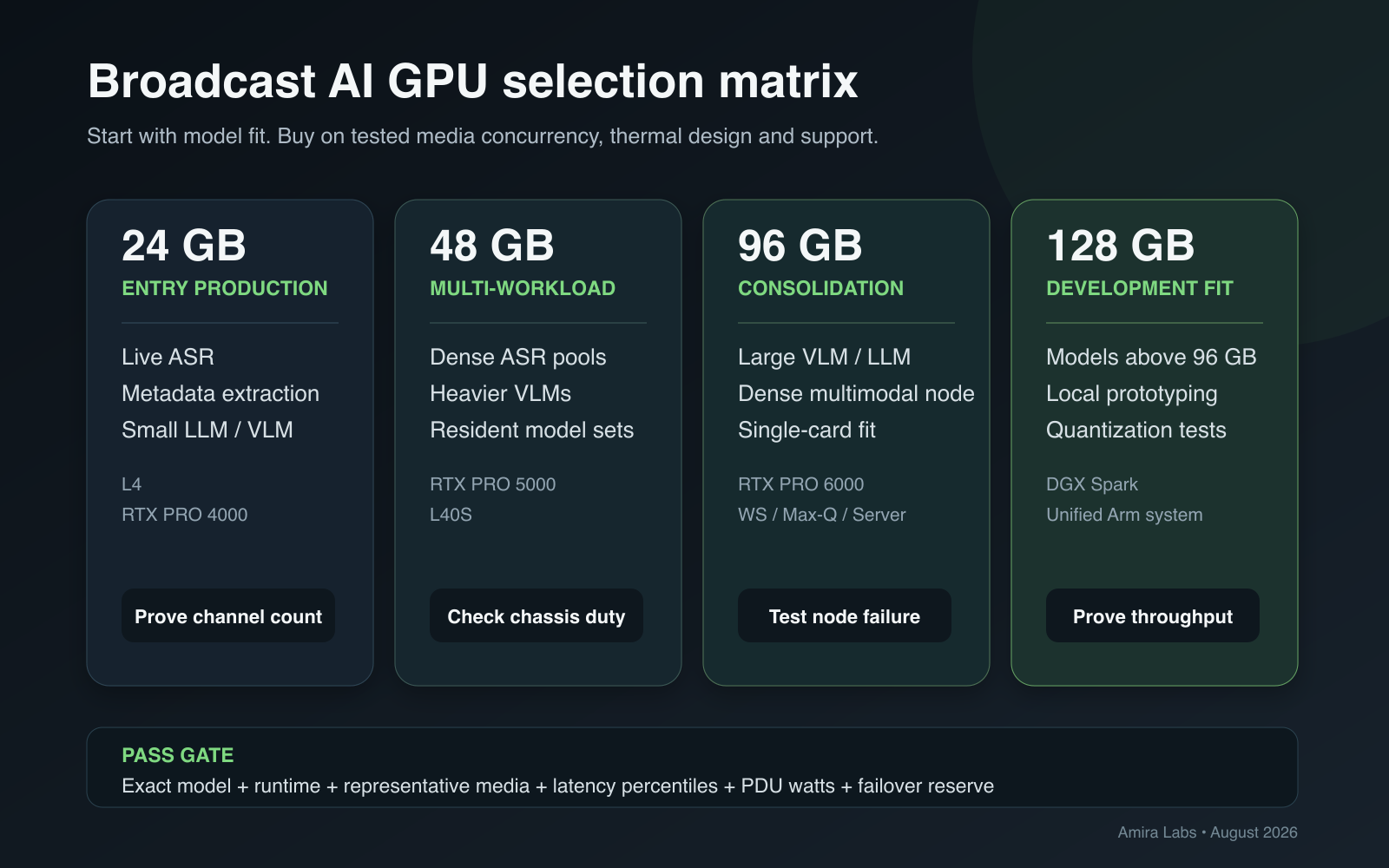
Choose by the smallest capacity tier that passes the soak test. Thermal design, media engines and support determine which product in that tier belongs on air. Graphic: Amira Labs.
What do 2026 GPU prices actually look like?
The honest price answer is a range plus a date. On August 29, 2026, NVIDIA's own US marketplace showed conflicting RTX PRO 6000 figures: the individual NVIDIA product page listed $16,000, while the workstation catalog snapshot exposed $13,250 for the NVIDIA card and $11,359.99 for a PNY version. The same catalog marked the listings out of stock.
Product | Public US listing checked August 29, 2026 | What the number means |
|---|---|---|
RTX PRO 4000 Blackwell, PNY | $2,029.99 | NVIDIA marketplace partner listing, out of stock in the captured result |
RTX PRO 5000 Blackwell, NVIDIA / PNY | $6,550 / $5,929.99 | Two listings for the same 48 GB tier, both out of stock in the captured result |
RTX PRO 6000 Blackwell workstation | $11,359.99–$16,000 | Partner, catalog and individual-product pages disagreed; availability was constrained |
DGX Spark Founders Edition | $4,699 | NVIDIA direct listing; MSRP was raised from $3,999 in February 2026 |
L4 and L40S | Quote with a qualified system | NVIDIA directs buyers to partners; loose OEM part listings are not comparable to a supported server quote |
NVIDIA attributed the $700 DGX Spark increase to worldwide memory-supply constraints and said there was no hardware change. The conflicting RTX PRO 6000 listings show why a purchase request that names only a GPU model is incomplete. Record the manufacturer part number, card edition, seller, support term, host system and quote expiry.
Do not compare a loose passive L40S from an OEM parts channel with an active workstation card as though both prices buy the same thing. A passive card needs server airflow. A broadcast facility also needs the host CPU, RAM, storage, power supplies, rails, management, warranty and a tested recovery path.
How should cost per processed media hour be calculated?
Divide the node's fully loaded wall-clock cost by the number of simultaneous real-time streams it sustains inside the service-level objective. Then apply the utilization you can actually schedule.
media-hour cost = (amortized hardware + power + support + facilities per wall hour) ÷ passing real-time streams
The table below is an original normalization, not a performance benchmark. It assumes three years of continuous service (26,280 hours), $0.15 per kWh, a 1.3 facility-power factor and the public prices above. It excludes the host, support, financing and storage. GPU board power is used for the workstation cards; DGX Spark uses NVIDIA's published 233.2 W maximum system power.
Platform | Hardware plus rated-power cost per wall hour | If testing proves 8 streams | If testing proves 32 streams |
|---|---|---|---|
RTX PRO 4000 Blackwell at $2,029.99 | about $0.11 | about $0.013 per media hour | about $0.0033 per media hour |
RTX PRO 5000 Blackwell at $6,550 | about $0.31 | about $0.038 per media hour | about $0.0096 per media hour |
RTX PRO 6000 Blackwell at $11,359.99–$16,000 | about $0.55–$0.73 | about $0.069–$0.091 per media hour | about $0.017–$0.023 per media hour |
DGX Spark at $4,699 | about $0.22 | about $0.028 per media hour | about $0.0070 per media hour |
The stream columns are deliberately conditional. They do not assert that every platform passes either load. Replace them with the concurrency from your own long-running test. A card that costs twice as much and sustains four times the accepted load has the lower media-hour cost.
This arithmetic extends the earlier Amira Labs analysis of cloud ASR versus on-prem GPU captioning. The break-even case depends on duty cycle. A GPU that sits idle most of the week can lose to a metered API even when its full-load unit cost looks excellent.
Why is DGX Spark a development appliance first?
DGX Spark optimizes for local model capacity and developer access. NVIDIA's current guide describes a 20-core Arm processor, 128 GB of unified memory, 273 GB/s of bandwidth, one encoder and one decoder, and support for models up to 200 billion parameters. That is a remarkable amount of addressable memory in a small desktop.
The same figures explain the production caveat. RTX PRO 6000 publishes 1,792 GB/s of dedicated memory bandwidth, about 6.6 times DGX Spark's figure, and carries four encoders and four decoders. NVIDIA's own Spark performance article reports a dual-Spark system generating a 235B Qwen3 model at 11.73 tokens per second. The model fits; the result is still a developer-scale interactive rate, not evidence for dense continuous media service.
Arm64 also changes the qualification burden. NVIDIA maintains a porting guide because software, containers and binary dependencies built for x86 systems can require different images or validation. The July 2026 release notes improved out-of-memory handling, and the known-issues guide says nvidia-smi does not report memory usage in the usual discrete-GPU way.
Spark is a good machine for evaluating a large model locally, testing quantization and keeping sensitive material off a third-party API. Put it on air only after the same soak, telemetry, failover and support review you would demand of any other node. Capacity is the reason to buy it. Concurrency has to be proven.
What does real power draw mean in a facility?
Real power is what the complete node pulls at the power distribution unit during the actual workload. GPU TDP or maximum board power is a thermal design input, not the wall measurement.
NVIDIA lists 72 W for L4, 350 W for L40S, 145 W for RTX PRO 4000, 300 W for RTX PRO 5000 and up to 600 W for the RTX PRO 6000 workstation edition. Those figures exclude some or all host consumption. CPU load, RAM, storage, fans, power-supply losses and cooling still appear on the electric bill and in the rack heat budget.
DGX Spark provides a useful example because NVIDIA publishes both component and regulatory system figures: 140 W for the GB10 system-on-chip, a 240 W external supply, 233.2 W maximum system power under the EU test and 38 W idle. One product can therefore have several valid power numbers. Use the one that matches the question.
Measure at idle, one accepted stream, the planned load and overload. Capture watts alongside latency and error rate. A power cap that reduces throughput can increase the cost per media hour even while the rack draws less.
Where does the buying argument stop working?
On-prem GPU ownership is weak when the workload is rare, bursty, unsupported on the proposed runtime or too important for a single local failure domain. Cloud capacity also wins when a facility needs a large model for two hours per month or has no staff to maintain drivers, containers and security updates.
Consumer GPUs can be rational for experiments. They can also offer excellent raw performance per dollar. The production objection is operational: board design, ECC behavior, cooling, warranty, driver lifecycle, remote management and qualified-server support matter more at 03:00 than benchmark rank. If a consumer card is proposed for air, put those gaps in the risk register instead of hiding them behind its purchase price.
L4 is not automatically the cheap answer either. Its 24 GB ceiling may force extra nodes or narrower models. RTX PRO 6000 is not automatically wasteful if one 96 GB card replaces several smaller hosts and passes failover requirements. Consolidation only counts after a failure test shows what happens when that large node disappears.
What should a broadcast team do this week?
- Freeze the workload. Name the exact model revision, precision, runtime, input format, latency percentile and output requirement. “AI inference” is not a sizing specification.
- Create a representative 24-hour corpus. Include silence, ad breaks, remote contribution, overlap, language changes, long programs and bad audio or video.
- Borrow before buying. Run the same container on a partner system or cloud equivalent. Increase concurrent real-time feeds until latency, accuracy or stability misses the target.
- Measure the whole node. Log GPU memory, utilization, thermals, PDU watts, restarts and dropped media. Repeat after one worker fails.
- Normalize the bids. Ask every supplier for the complete node, support term, delivery date, quote expiry and measured cost per accepted media hour. Reject comparisons based only on GPU MSRP or peak TOPS.
The purchase decision should end with a capacity certificate: this exact system, on this exact runtime, passes this many representative streams with this much reserve. Everything before that is a shortlist.
Sources
- NVIDIA L4 Tensor Core GPU specifications
- NVIDIA L40S specifications
- NVIDIA RTX PRO 4000 Blackwell datasheet
- NVIDIA RTX PRO 5000 Blackwell specifications
- NVIDIA RTX PRO 6000 Blackwell family specifications
- NVIDIA RTX PRO 6000 US marketplace product listing
- NVIDIA professional workstation marketplace listings
- NVIDIA DGX Spark hardware guide
- NVIDIA DGX Spark US marketplace listing
- NVIDIA February 2026 DGX Spark price-change announcement
- NVIDIA DGX Spark performance benchmarks
- NVIDIA DGX Spark release notes and known issues
- OpenAI Whisper model memory table
- NVIDIA Parakeet TDT 0.6B v3 model card
- Qwen3-ASR 1.7B repository