Four open model families can all transcribe speech. Only two publish a credible path to live streaming, one is the better translation tool, and one remains the safest compatibility baseline.

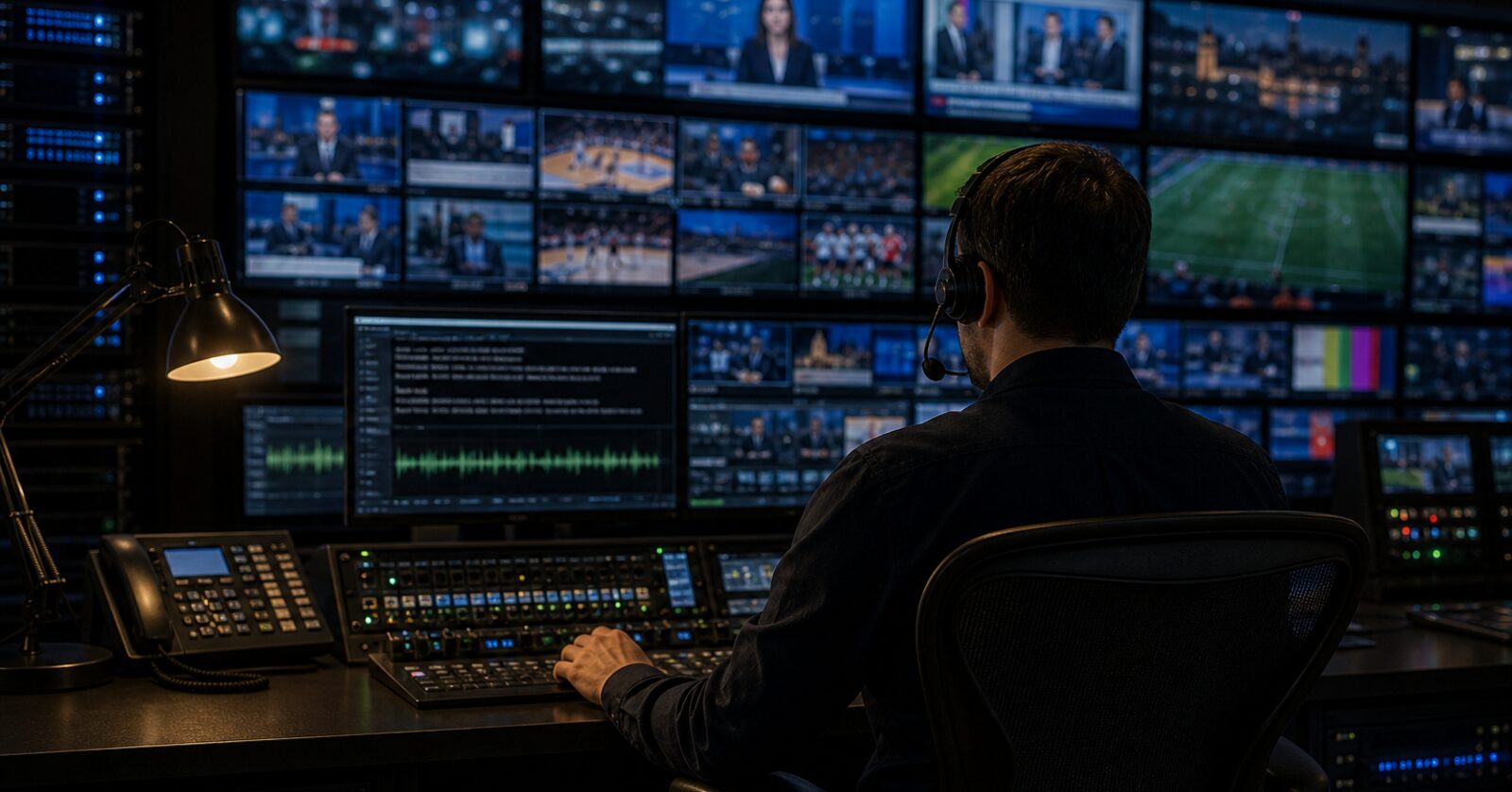
A broadcast ASR model has to survive the complete production chain, not a short audio demo. “Television News Control Room” by Asterzenback, cropped and resized from the original, CC0 1.0, via Wikimedia Commons.

Put the same clean English clip into Whisper, Parakeet, Canary and Qwen3-ASR and all four can produce a convincing transcript. Put them on a 24/7 news feed and the differences become operational.
A broadcast ASR model comparison has to account for partial-result stability, end-to-end delay, language coverage, timestamps, GPU headroom, failure recovery and commercial rights. Word error rate still matters. It is one column in the decision, not the decision itself.
The short answer as of August 28, 2026 is:
- Start with NVIDIA Parakeet TDT 0.6B v3 for high-throughput live transcription across its 25 European languages.
- Test Qwen3-ASR 1.7B first when accuracy or Asian-language coverage matters more than maximum throughput, while accounting for its streaming timestamp limitation.
- Use NVIDIA Canary 1B v2 when speech-to-text translation between English and 24 European languages is a core requirement.
- Keep OpenAI Whisper large-v3 or turbo in the bake-off when ecosystem maturity, broad language coverage and deployment portability matter, but treat live use as an integration project.
Those are starting points. The production winner is the model that meets the service-level objective on your audio, your hardware and your caption renderer for days at a time.
What does the current model-selection matrix say?
The table below uses exact checkpoint names. That detail matters because an older Canary checkpoint carries a different license, and “Whisper” can mean models with very different memory and speed profiles.
Exact checkpoint | Best initial fit | Mean English WER ↓ | RTFx ↑ | Live path | Language coverage | Timestamp path | Published load floor | License |
|---|---|---|---|---|---|---|---|---|
| High-density European live transcription | 6.32 | 3,332.74 | NVIDIA documents chunked streaming with 2-second chunks and 2-second right context | 25 European languages | Native word and segment timestamps | At least 2 GB RAM to load; production GPU memory is not specified | CC BY 4.0 |
| Accuracy and broader international coverage | 5.76 | 147.93 | Streaming through the vLLM backend | 30 languages plus 22 Chinese dialects | Streaming does not return timestamps; offline alignment requires | No official production GPU-memory floor | Apache 2.0 |
| European ASR plus speech translation | 7.15 | 749.00 | Current card documents long-form chunking, not a live streaming recipe | 25 European languages; translation between English and the other 24 | Native word and segment timestamps in current NeMo path | At least 6 GB RAM to load; production GPU memory is not specified | CC BY 4.0 |
| Broad-language compatibility baseline | 7.44 | 145.51 | Official implementation processes sliding 30-second windows; live systems use third-party buffering or modified runtimes | 99 languages | Segment and optional word timestamps, runtime dependent | About 10 GB VRAM in OpenAI's reference table | MIT |
| Faster Whisper-compatible transcription | 7.83 | 200.19 | Same integration caveat as large-v3 | 99 languages | Segment and optional word timestamps, runtime dependent | About 6 GB VRAM in OpenAI's reference table | MIT |
The WER and RTFx values are current Open ASR Leaderboard results exposed on the model cards. The leaderboard evaluates short-form English across public datasets on reproducible hardware. RTFx is a throughput measure: more audio processed per unit of compute is better. It is not glass-to-glass caption delay, partial-result stability or a guaranteed number of channels per GPU.

The practical shortlist changes with the feed. Use benchmark data to choose candidates, then select with long-running tests on representative program audio. Graphic: Amira Labs.
Why is Parakeet the live European starting point?
Parakeet TDT 0.6B v3 pairs the strongest throughput result in this group with an official chunked-streaming path. NVIDIA's current model card documents 600 million parameters, automatic language detection, punctuation, capitalization, word and segment timestamps, and 25 European languages. Its reference streaming command uses two seconds of audio per chunk and two seconds of right context.
That makes Parakeet the most credible first candidate for a facility that needs many English and European caption channels on a bounded GPU estate. It does not prove the on-air delay will be acceptable. The reference context alone shows why an operator must measure when words first appear, when they settle and how often they are revised.
Language count also hides a large quality range. NVIDIA's own multilingual tables show strong results for languages such as Spanish and Italian, with much higher error rates for some lower-resource languages, including Slovenian and Latvian on specific test sets. A package saying “25 languages” does not establish a common quality floor across all 25.
The deployment recommendation is therefore specific: shortlist Parakeet for European live transcription, then certify each language and program class separately. News, parliament, sports, unscripted entertainment and call-in radio should not share one acceptance result.
When should Qwen3-ASR lead the bake-off?
Qwen3-ASR 1.7B posts the lowest mean English WER in this comparison and supports a wider international set. The official Qwen3-ASR card lists 30 languages plus 22 Chinese dialects, including Arabic, Hindi, Indonesian, Japanese, Korean, Thai, Turkish and Vietnamese. Those languages are outside the European-focused Parakeet and Canary lists.
The family unifies offline and streaming inference, but the operational fine print matters. Streaming currently requires the vLLM backend, does not support batch inference and does not return timestamps. Offline timestamps require the separate Qwen3-ForcedAligner-0.6B, which supports up to five minutes of audio across 11 languages.
For a search index or delayed transcript, that split may be fine. For live captions, word timing feeds cue construction, roll-up behavior, speaker changes and synchronization. A caption system can create its own cue timing around arriving tokens, but that becomes part of the system to validate. The model alone is not delivering the complete timed-caption object.
Qwen's vendor-authored evaluation also shows a measurable offline-to-streaming accuracy change. For the 1.7B model, the average across four published test slices rises from 2.69 WER offline to 3.33 in streaming mode. That is normal enough for a lower-latency path, and it is exactly why an offline leaderboard score should not be pasted into a live-caption proposal.
Choose Qwen3-ASR when its language reach or accuracy justifies the additional integration and capacity work. Include the 0.6B checkpoint in a constrained-hardware bake-off: its current Open ASR result is 6.42 mean WER, close to Parakeet, although its reported throughput is far lower in that benchmark.
Where does Whisper still fit?
Whisper is still the most useful control in a model evaluation. The ecosystem is broad, many teams already operate it, and the official repository releases the code and model weights under MIT. OpenAI lists approximately 10 GB of VRAM for the 1.55-billion-parameter large model and 6 GB for the 809-million-parameter turbo model. Turbo is about eight times the reference speed of large and trades away some accuracy.
Whisper's breadth is real. The large-v3 and turbo model pages list 99 languages. Broad support should still be separated from equal support. OpenAI's own breakdown shows language-dependent performance, and any priority language needs its own acceptance set.
The live caveat is architectural. OpenAI's reference transcribe() method reads the file and processes audio in sliding 30-second windows. Third-party servers create pseudo-streaming by chunking, retaining context and revising hypotheses. Those systems can work well, but “Whisper supports streaming” describes the surrounding runtime more than the reference model path.
There is another checkpoint distinction: turbo is not trained for speech translation. If translation to English is required, OpenAI directs users to the multilingual models such as large rather than turbo.
Whisper remains valuable when portability, existing integrations or a long tail of languages outweigh density. It is also an excellent baseline. If a newer model cannot beat the Whisper system already in production on real audio and recovery behavior, the migration case is weak.
When is Canary the right model?
Canary 1B v2 should be evaluated as a multilingual transcription-and-translation model. NVIDIA's current card supports ASR in 25 European languages and speech translation from English into the other 24, and back into English. It includes punctuation, capitalization, and word or segment timestamps.
That makes Canary relevant for a broadcaster producing translated text tracks, newsroom transcripts or multilingual clipping from one speech model. Its current Open ASR English result trails Parakeet and Qwen3-ASR, and the official card does not present a live-streaming recipe comparable to Parakeet or Qwen. The documented long-form path uses chunking for audio beyond 40 seconds.
The practical decision is straightforward. Choose Canary for translation-led workflows. Do not assume the shared NVIDIA parentage makes it a drop-in substitute for Parakeet in a low-latency caption service.
Which license traps can block a commercial deployment?
Model family names are not license identifiers. Record the repository, revision or immutable hash, license text and notices for every deployed artifact.
Three traps deserve a procurement check:
- Old Canary is not Canary v2.
nvidia/canary-1b-v2is CC BY 4.0 and its card says it is ready for commercial use. The oldernvidia/canary-1bis CC BY-NC 4.0 and limited to four languages. - Meta's broad language counts do not equal commercial clearance.
facebook/mms-1b-allandfacebook/seamless-m4t-v2-largeare published under CC BY-NC 4.0. The license prohibits commercial use. - CC BY is permissive with obligations. Parakeet and Canary v2 can be used commercially under CC BY 4.0, but the license requires appropriate credit, a license link and an indication of changes. Maintain an attribution manifest with the deployed product and distribution package.
Whisper's official repository states that its code and model weights use MIT. Qwen3-ASR uses Apache 2.0. Both still require license-notice handling. Fine-tunes, quantizations, adapters, tokenizers and container images can introduce other terms, so legal review belongs on the complete software bill of materials.
What does a 24/7 broadcast test need to catch?
Short clips hide the faults that put captions off air.
A useful bake-off runs long enough to encounter schedule changes, silence, ad breaks, multilingual guests, bad remote audio and GPU pressure. Score at least these dimensions:
- Semantic error. Track names, numbers, negation, profanity handling and domain terms, not only aggregate WER.
- Displayed latency. Measure from audio arrival to the first readable cue and to the stable final cue. Report percentiles, not just an average.
- Revision behavior. Count how often partial words change, how much text is retracted and whether the renderer exposes those changes cleanly.
- Cue quality. Check line length, reading speed, segmentation, punctuation, speaker changes and collision with on-screen graphics.
- Continuity. Measure missing-cue time, stuck sessions, duplicate text and recovery after audio or network interruption.
- Capacity. Increase simultaneous real-time channels until latency or error rises, then preserve failover headroom.
- Language floor. Test every contracted language, accent and code-switch pattern. An average across languages is not an acceptance threshold.
- Evidence. Log exact model revision, runtime, GPU, audio source, hypotheses, final cues, alarms and operator action on program time.
The caption output should also be checked after packaging, ad insertion, origin, CDN and player rendering. As the Amira Labs guide to broadcast caption compliance in 2026 explains, a correct transcript can still fail as a caption when the track drifts, drops or renders incorrectly.
How should a facility make the decision?
Use a gated selection process rather than a beauty contest.
- Write the service-level objective first. Specify languages, channel count, latency percentiles, maximum outage, cue format, timestamp need, recovery time and retention rules.
- Freeze exact candidates. Pin the checkpoint revision, inference runtime, precision, decoder settings and audio preprocessing. “Latest” is not a reproducible configuration.
- Build a representative corpus. Include clean studio speech, remote contribution, overlap, music beds, breaking news, sports names, phone audio and known failure cases.
- Run live and offline separately. Batch WER informs the shortlist. Streaming accuracy, cue stability and delay determine live suitability.
- Soak under realistic concurrency. Run for days with GPU telemetry, automatic restarts, failover and loss of dependencies. Establish the safe channel count with reserve capacity.
- Review the complete license stack. Check base weights, derivatives, runtime, containers and notices before procurement approval.
- Keep a fallback. A second model or caption path should be operationally independent enough to survive a bad release or runtime failure.
Teams comparing infrastructure choices should pair this model evaluation with the Amira Labs analysis of cloud ASR versus on-prem GPU captioning. The cheapest inference result has little value if the design cannot meet the operational target or prove what aired.
What should go into the procurement specification?
A buyer does not need to mandate one model. The specification should require evidence that allows the facility to replace one.
Ask vendors to provide:
- exact model and runtime versions, including a change-control policy;
- per-language results on customer-supplied audio;
- first-token, stable-token and displayed-cue latency percentiles;
- concurrent-channel capacity on the proposed hardware with failover reserve;
- timestamp and partial-result behavior in the actual streaming mode;
- support for vocabulary, names and inverse text normalization;
- license, attribution and software-bill-of-materials documentation;
- offline operation, media retention and data-residency behavior;
- alarms, logs and program-time evidence export; and
- rollback time after a failed model or runtime update.
The best broadcast ASR model is the one whose limitations are measurable, whose rights are clear and whose failure can be recovered without taking the caption service off air.
Frequently asked questions
Which model has the lowest WER?
In the current Open ASR Leaderboard results used here, Qwen3-ASR 1.7B has the lowest mean English WER at 5.76. Parakeet TDT 0.6B v3 follows at 6.32. These are short-form benchmark results, not a forecast for a specific live channel.
Which model is fastest?
Parakeet has the highest reported RTFx in this comparison by a large margin. RTFx measures throughput in the benchmark environment. Measure live latency and sustainable channels independently on the intended runtime and GPU.
Does Whisper support real-time captions?
The official Whisper implementation uses sliding 30-second windows. Real-time Whisper systems rely on third-party chunking and buffering around the model. Treat that runtime as part of the product you certify.
Can Parakeet and Canary be used commercially?
The exact current checkpoints nvidia/parakeet-tdt-0.6b-v3 and nvidia/canary-1b-v2 use CC BY 4.0, which permits commercial use with attribution and the other license conditions. The older nvidia/canary-1b checkpoint uses CC BY-NC 4.0.
Does Qwen3-ASR return timestamps while streaming?
No. The official card says its current streaming mode does not return timestamps. Offline timestamps require the separate Qwen3 ForcedAligner checkpoint.
Sources
- OpenAI Whisper repository and reference model table
- Whisper large-v3 model card and Open ASR evaluation
- Whisper large-v3-turbo model card and Open ASR evaluation
- NVIDIA Parakeet TDT 0.6B v3 model card
- NVIDIA Canary 1B v2 model card
- Qwen3-ASR 1.7B model card
- Qwen3-ASR 0.6B model card
- Hugging Face Open ASR Leaderboard methodology
- Creative Commons Attribution 4.0
- Creative Commons Attribution-NonCommercial 4.0
- Legacy NVIDIA Canary 1B model card
- Meta MMS 1B All model card
- Meta SeamlessM4T v2 Large model card