
Dek: Mediapro's NBA production work across Spain and Mexico exposes a familiar operational problem: international feeds need separately verified language, rights, timing and recovery handoffs.
Grup Mediapro announced on November 10, 2026 that it is supporting the production of more than 200 NBA games for Prime Video in Spain and Spanish-speaking markets across the Americas, including the United States. It is the second consecutive season of this collaboration. The company says coverage, production, reception and transmission of the feed are managed from studios in Spain and Mexico.
That is a concrete multi-market production footprint, but it is not a published network architecture. The announcement does not disclose contribution protocols, latency budgets, redundancy design or individual control-room responsibilities. An operator should not infer those details from the number of games or the two countries involved.
Why cross-market delivery gets complicated
An international game can have one common picture and several legitimately different audience experiences. The Spanish feed may need a particular commentary team, scheduled presentation, graphics and regional rights treatment; another market may need different selections. Two receivers showing an image does not prove both audiences received the intended program.
SVG Europe's November 11 report confirms the broad production scope and the Spain-Mexico coordination model. It does not specify a universal workflow for every event. The most useful lesson for other operators is to standardize a documented acceptance boundary between production, localization, packaging and platform delivery.
1. Declare the intended output. Give each market a signed-off manifest of event, start and stop window, commentary language, caption availability, rights territory, graphics version and destination. Separate a program feed from a clean feed and from a podcast or shoulder program.
2. Confirm what the receiver actually decodes. At the designated handoff, verify moving picture, audio channels and levels, selected language, captions or subtitles where applicable, timestamps and program identifiers. A green contribution transport metric is not proof of the right content.
3. Test language-to-picture pairing. Use a controlled rehearsal with clear speech or known cues and check that every regional audio path matches the intended game feed. For HLS destinations, Apple's authoring guidance specifies language attributes and properly defined alternative audio renditions. Those playlist rules matter where HLS is the actual delivery format; the Mediapro announcement does not say that its studio contribution uses HLS.
4. Rehearse a late programming change. Basketball runs long, production schedules change and feeds can roll into postgame coverage. Document who may extend the program window, who updates the downstream schedule and how each regional receiver verifies the intended change without relying on an informal message.
5. Simulate a partial cross-border outage. Take down a controlled upstream or regional path, then watch the receiving output. Record the last good frame, language continuity, on-air replacement behavior, operator acknowledgement and restoration. Avoid assuming the two studio locations automatically constitute independent disaster recovery.
6. Preserve one shared incident timeline. Link the source fault, affected market, corrective action, decoded evidence and final outcome under a common event identifier. If Spain has a clean picture and a Mexican-market receiver has the wrong commentary, the record should show the divergence rather than one blanket status of healthy.
The commissioning question
At more than 200 games, a repeatable acceptance test is more valuable than an impressive-looking architecture drawing. A practical starting point is one live-style rehearsal with two regional outputs, a deliberate language mismatch and a route failure. If operators can identify the wrong audience experience, name the responsible handoff and restore service using a common incident record, the process has been tested beyond simple signal presence.
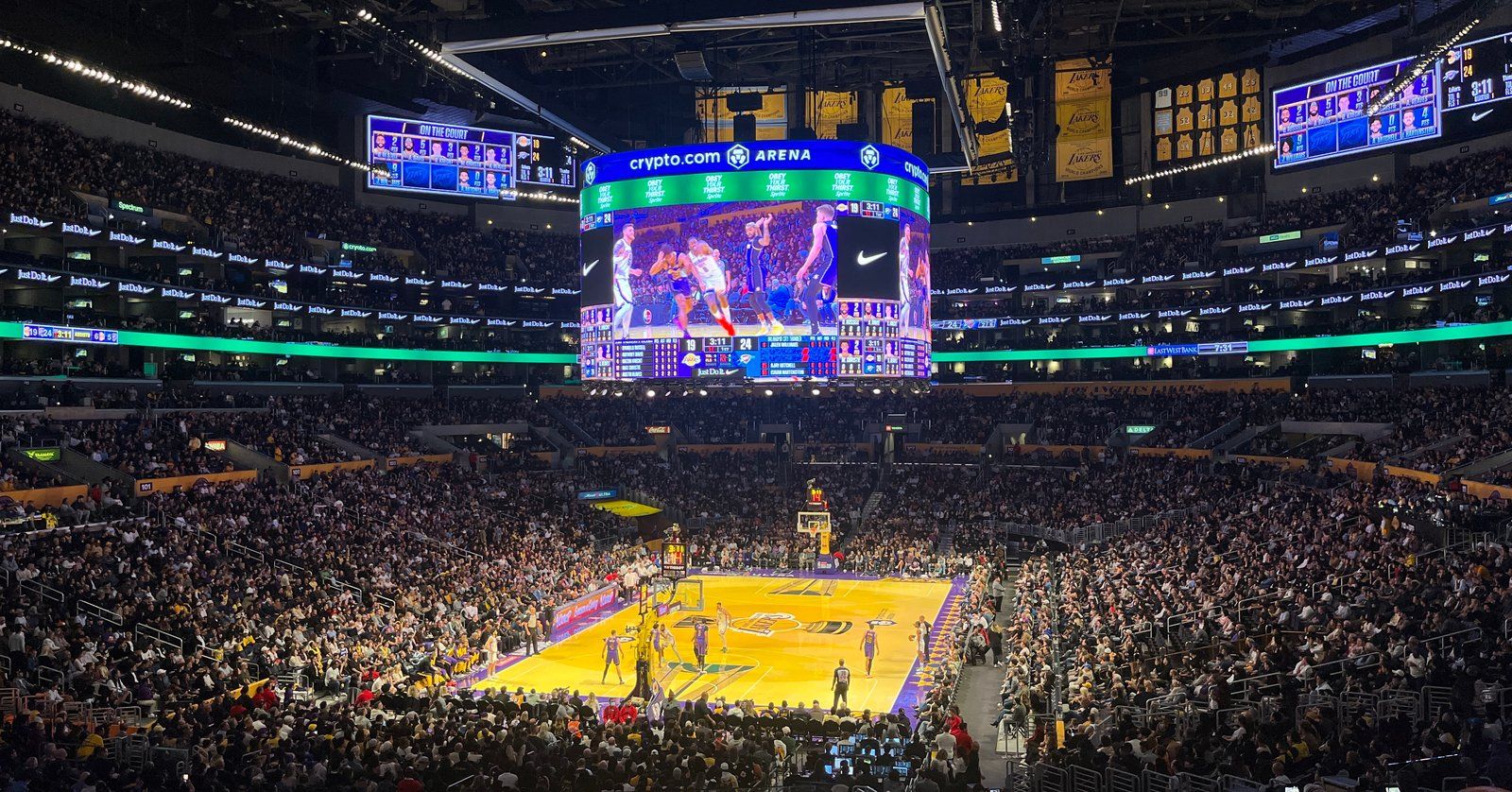
Photo: Troutfarm27, Crypto.com Arena during a 2024 NBA Cup game, CC BY 4.0. Authentic archival NBA photograph, not the 2026–27 Mediapro/Prime Video production. Credit and license must remain visible. For this CMS upload, the authentic photograph will be cropped, resized to 1600x838 and JPEG-recompressed below 1.5 MB; these adaptations must be disclosed alongside the photographer credit and license.