

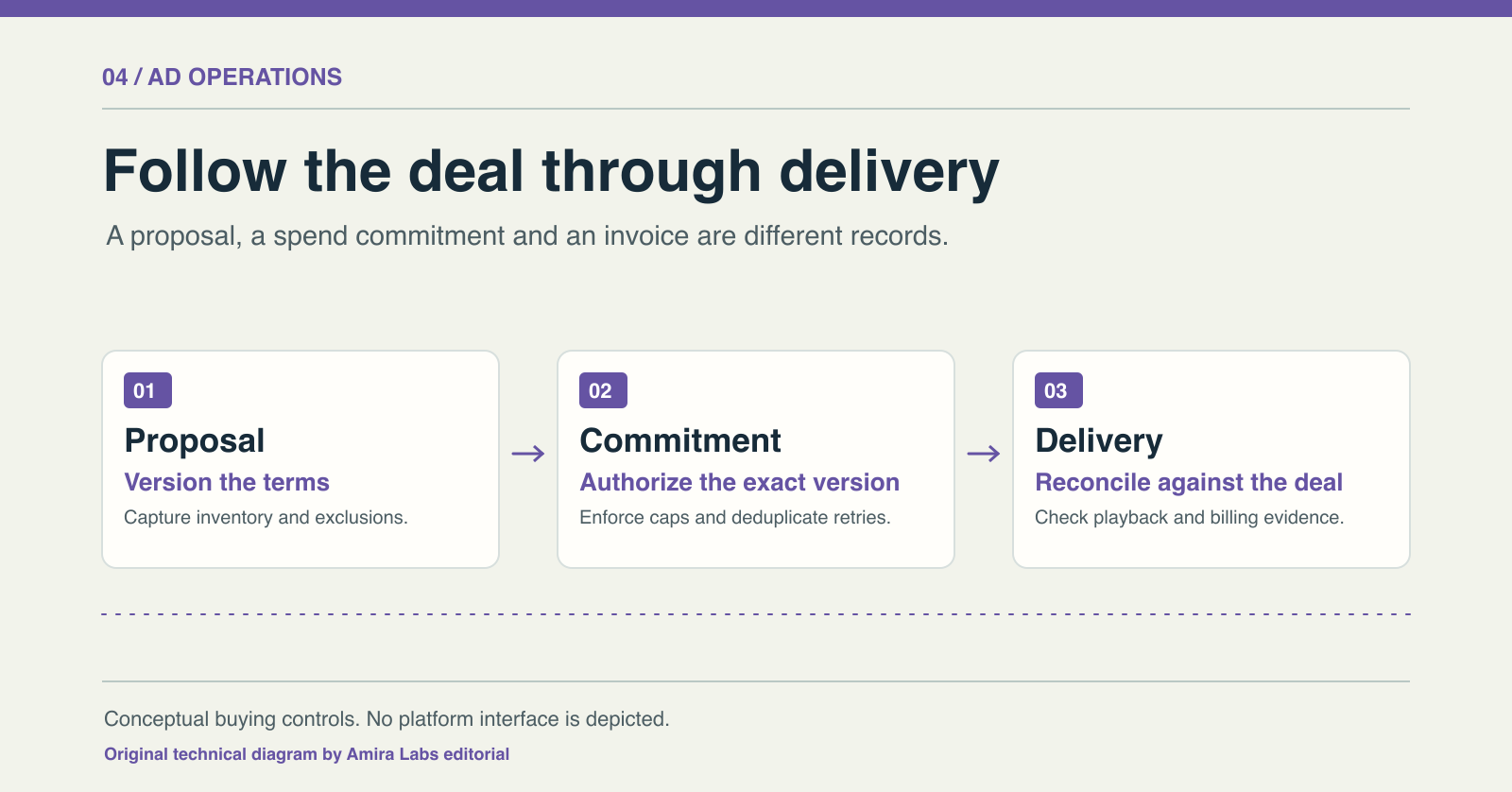
The proposal says the ads will run in live sports. The order has a deal ID and a spending cap. The invoice says the campaign delivered. A buyer who wants to check the bargain still has to connect those records to what appeared on a television. Agentic CTV advertising can move a proposal to an order faster. That makes it more important to preserve exactly what was sold as the deal moves through the systems that deliver it.
On September 22, 2026, IAB Tech Lab announced AAMP 3.0, the third major release of its Agentic Advertising Management Protocols framework. The release introduces OpenProposal, a proposed common way to express inventory and respond to a request for proposal. As of November 6, IAB Tech Lab’s announcement listed November 10 as the extended public-comment deadline. A buyer or seller can use the draft to rehearse a transaction today. Production support and the terms a partner will actually honor require separate verification.
What changes when agents negotiate CTV inventory?
The planning conversation can move into records that software on both sides can read and compare. A buyer can specify that it wants connected-TV (CTV) impressions during eligible live games, in approved markets, with defined exclusions. A seller can describe which products meet those constraints and where delivery depends on future inventory or rights. IAB Tech Lab positions OpenProposal between the brief and a buy commitment, alongside other standards including OpenDirect and the Deals API.
The boundary that matters is the transition from a proposal to an obligation. A seller might send an indicative price while availability is still changing. A buyer may want to run a few alternatives through a planner. Make the states visible to both systems. Draft, quoted, expired, authorized, accepted, and canceled should have meanings a buyer and seller can both explain. A buyer should be able to request a proposal without creating a reservation unless the parties deliberately authorize one.
Planning, delivery, and auction integrations can also live on different rails. IAB Tech Lab lists OpenRTB among its CTV specifications for programmatic transactions, and its Agentic Real Time Framework describes a model for agent services operating within a host platform’s bidstream processing. That is a distinct layer from OpenProposal’s pre-buy exchange. A partner who can return a structured proposal may still route delivery through a familiar deal, or may only support a subset of the fields a buyer requested. Ask the partner to demonstrate the complete path you plan to buy.
Which terms have to survive the handoffs?
Every term that affects payment or eligibility needs a definition, an owner, and an observation point. A label like live sports is too broad. Some suppliers may include studio coverage, reruns, highlights, or adjacent programming. Decide which qualify and what happens when the live event is rescheduled. Represent each critical exclusion explicitly. A blank field needs its own meaning, since a missing rule can be mistaken for permission.
Term in the buying brief | Proof to request before launch |
|---|---|
Eligible event and inventory | Canonical event and product IDs, dates, platforms, territories, and treatment of substitutions |
Placement and creative | Accepted format and creative ID, eligible devices, and a test response using the approved creative |
Spend and pacing | Currency, gross or net basis, campaign cap, expiration, and a ledger showing committed and settled amounts |
Counting and reporting | Billing event, time zone, reconciliation window, acceptable discrepancies, and available delivery evidence |
Exceptions | Named owner for conflicts, remediation choices, and terms governing credits or makegoods |
Send a proposal with one deliberate exception, such as an ineligible territory. A seller that cannot represent the exception should say so before booking. Then send a counterproposal that changes the price and expiration. Capture how both systems represent the new version. If the user interface shows one price while the service receiving the order references an older version, the approval needs to fail. It is cheaper to find the mismatch in a sandbox than after the sell side has reserved scarce live inventory.
Record which parts of the brief become enforceable deal constraints and which become reporting dimensions. A term can appear beautifully in a PDF and be unavailable to the ad decision system at run time. Give each critical requirement a proof point. If nobody can say where the constraint is checked, keep the transaction in a mode where an operator can inspect it before any money moves.
How do you keep retries from turning one buy into two?
Use one stable identifier for an authorized commitment, and reconcile its status before retrying an uncertain result. An agent may send a valid order and time out while waiting for the response. The seller may have accepted the order anyway. Retrying with a new identifier could create a second obligation. Make the buyer and seller agree on how long a repeated key is recognized, what result a repeated request returns, and which system can definitively say whether the obligation exists.
Take an illustrative deal for 250,000 impressions at a $24 net cost per thousand. The maximum for that volume is $6,000 before any separate fees. If a request is accepted twice, two valid-looking deal records can put $12,000 in play. A check that each individual request is under $6,000 allows both through. The transaction service needs to reserve or account for spend across commitments using the same budget, with a consistent result if two requests arrive together.
Bind authorization to the terms a person or policy actually approved. A practical record includes buyer identity, seller, proposal version, currency, maximum obligation, expiration, and the permitted scope of any modification. Keep the record through amendments. If the agreed rate or inventory changes, release or amend the original commitment according to its terms and capture the new authorization. A pause can stop future delivery. Canceling a reservation or settling a charge is a separate operation whose behavior should be agreed in advance.
Rehearse a lost acknowledgment, an expired proposal, and two concurrent requests against the same cap. Run the exercise from both sides. The useful result is a matching set of books even when the caller gets an ambiguous response. An audit log should show the intent and the resulting state with enough detail for an operator to recover without reconstructing a conversation from memory.
What would prove the ad ran under the deal that was bought?
Reconcile the deal across the request, the ad decision, playback evidence, and billing. Use identifiers that survive those boundaries, such as the deal ID, approved creative identifier, service or program ID, and the event time. A response showing that a server selected a creative is useful delivery evidence, but it answers a different question from whether an eligible device played the spot. Agree in advance on the event used for billing and how the parties settle disagreements.
IAB Tech Lab’s Video Ad Serving Template (VAST) specifies a structure for delivering video ad information and tracking. Its CTV standards list also includes Open Measurement. Ask which signals your partners can actually emit and share for the relevant device and insertion method. On a server-side insertion path, request a controlled break so the buyer can compare the selected ad, the stitched media, and what a test player decoded. The Amira Labs guide to SSAI and SGAI monitoring describes the evidence to collect around the break itself.
Consider a live match that goes into extra time. A planned postgame break may now land during play, or the planned break may disappear. An agent watching aggregate pacing could move spend into a different program to reach its target. If the brief covers only that match, substitution is a commercial exception. The right response depends on the contract: suppress delivery, request a makegood, or ask for an authorized amendment. Test that the exception is visible in reporting and that each side classifies the result the same way.
Give finance the same keys that ad operations uses. In a practice invoice, introduce a late report, a duplicate impression record, and a credit for an ineligible placement. The team should be able to explain each adjustment from a dated record. If the invoice aggregates several deals into one line, request a breakdown or an export that maps each adjustment back to its underlying commitment. Otherwise the accounting team may be able to balance the invoice without confirming which campaign received the credit.
Build a narrow reconciliation sample before scaling. Follow a handful of impressions through the available logs without exposing household identifiers unnecessarily. When a record cannot be joined, classify why. The seller may have omitted a field, an intermediary may have transformed it, or the buyer may have expected an ID that is unavailable on the device. Unmatched evidence should remain an explicit bucket, so finance can distinguish a measurement gap from a confirmed delivery failure.
Where does agentic buying earn its keep?
The first gains are likely to come from repeatable work with stable rules, such as normalizing offers from several sellers or flagging proposal terms that differ from a standing agreement. These workflows produce something a person can inspect and correct cheaply. They also make the automation’s errors visible before a contract depends on it.
High-value inventory with changing rights and bespoke substitution terms takes more preparation. If each seller represents exclusivity, makegoods, or proof of performance differently, automation may accelerate the exchange while leaving the most important judgment to a person. Keep the spend path narrow until both parties can show what their systems do with an exception. The public-comment status of OpenProposal is another reason to record the version used in a pilot and avoid treating sample integrations as a production commitment.
What should a buyer and seller test before the first live deal?
Use one eligible service, one creative, and a deliberately small commitment. Prepare a valid proposal, an expired proposal, and a version containing a term the seller cannot meet. Have both parties confirm when a record becomes binding. Set the maximum exposure and retain the ledger entries that prove it was enforced.
Then simulate the lost response and the unscheduled break. Ask separate operators to reconstruct the deal from the logs. If their answers differ on spend, eligibility, or what played, fix the contract or the handoff that produced the discrepancy. Repeat the same test after a change to either side’s integration. A fast proposal only matters when the resulting delivery can still be accounted for.
Sources
- IAB Tech Lab, AAMP 3.0 and OpenProposal announcement, September 22, 2026, including the extended public-comment deadline
- IAB Tech Lab, Agentic Real Time Framework, updated August 12, 2026
- IAB Tech Lab, connected-TV standards and specifications, checked November 6, 2026
- IAB Tech Lab, Video Ad Serving Template, checked November 6, 2026