
Dek: The European Athletics Championships host broadcast reported a lower-than-estimated footprint, but broadcasters need to inspect the measurement boundary and backup power design before copying its methods.
On November 10, 2026, SVG Europe reported that Actua's official host production for the Birmingham 2026 European Athletics Championships had earned BAFTA Albert certification. The reported host-broadcast footprint was 225 tonnes of CO2, 10% below the initial estimate.
The production report describes more than 95,000 passenger-kilometres travelled by rail, no UK domestic flights, a 74% reduction in car travel, renewable mains electricity, grid-connected battery UPS, rechargeable batteries across suppliers, and local sourcing of crew and equipment. Those are reported project measures. They are not independently established carbon savings that another event can simply multiply by its number of cameras.
Certification is evidence, not zero emissions
BAFTA Albert describes production certification as a framework for calculating, reducing and evidencing the environmental footprint of film and television work. Its updated toolkit supports more auditable carbon reporting and distinguishes direct and supply-chain impacts.
The 225-tonne figure is a footprint for the reported host production, not for every activity around the championships. Without an itemized boundary, a reader should not assume it includes all audience travel, venue construction, worldwide consumer streaming or separately commissioned rights-holder coverage. Likewise, being 10% below a forecast does not prove a 10% year-over-year reduction against a comparable production.
1. Draw the carbon reporting boundary. Show which trucks, generators, electrical feeds, crew travel, temporary facilities, cloud workloads and third-party suppliers belong inside the estimate. List exclusions explicitly. A comparison with last year's production needs a consistent boundary or a reconciliation showing what changed.
2. Audit the actual electrical source. Renewable mains supply, a grid-connected battery UPS and charging infrastructure can reduce dependence on combustion generators. Record meter readings, supplier tariff evidence, battery charge cycles and any backup generation. Renewable electricity procurement claims should not be confused with measured zero emissions at every hour.
3. Prove that lower-carbon backup is still broadcast-grade. A UPS is only useful when it sustains the specified equipment for the required interval. In a rehearsal, isolate the primary feed and confirm clean video, audio, contribution links, intercom, monitoring and return to normal. Record recovery time, battery behavior and operator actions. Do not trade away known redundancy because a component is labeled sustainable.
4. Reconcile travel against actual delivery. The reported train-first approach and reduced car travel matter most when supplier itineraries, hotel nights and transport manifests are counted consistently. One missed subcontractor or duplicate passenger-distance entry can distort the estimate. Collect evidence at procurement rather than reconstructing it after the event.
5. Connect procurement to live service outcomes. Prefer local rental, energy-efficient equipment and reusable power systems when they meet the same production specification. Demand acceptance results for each substitute. A smaller truck fleet is only a win if planned camera positions, signal paths, comms and spare capacity still pass the live-show test.
What facilities can copy today
Start with one event-day ledger that pairs equipment power and travel records with operational readiness evidence. The BAFTA Albert resource hub offers carbon-calculator guidance and supplier resources. Build the carbon estimate alongside the runbook, not as a separate retrospective slide.
Then rehearse one failure that crosses the sustainability choices: grid loss, UPS discharge, contribution failover or a late crew substitution. A credible production can show both what was avoided and what remained reliable. The question is not simply whether it ran on renewable power, but whether the footprint calculation and the on-air recovery record are independently understandable.
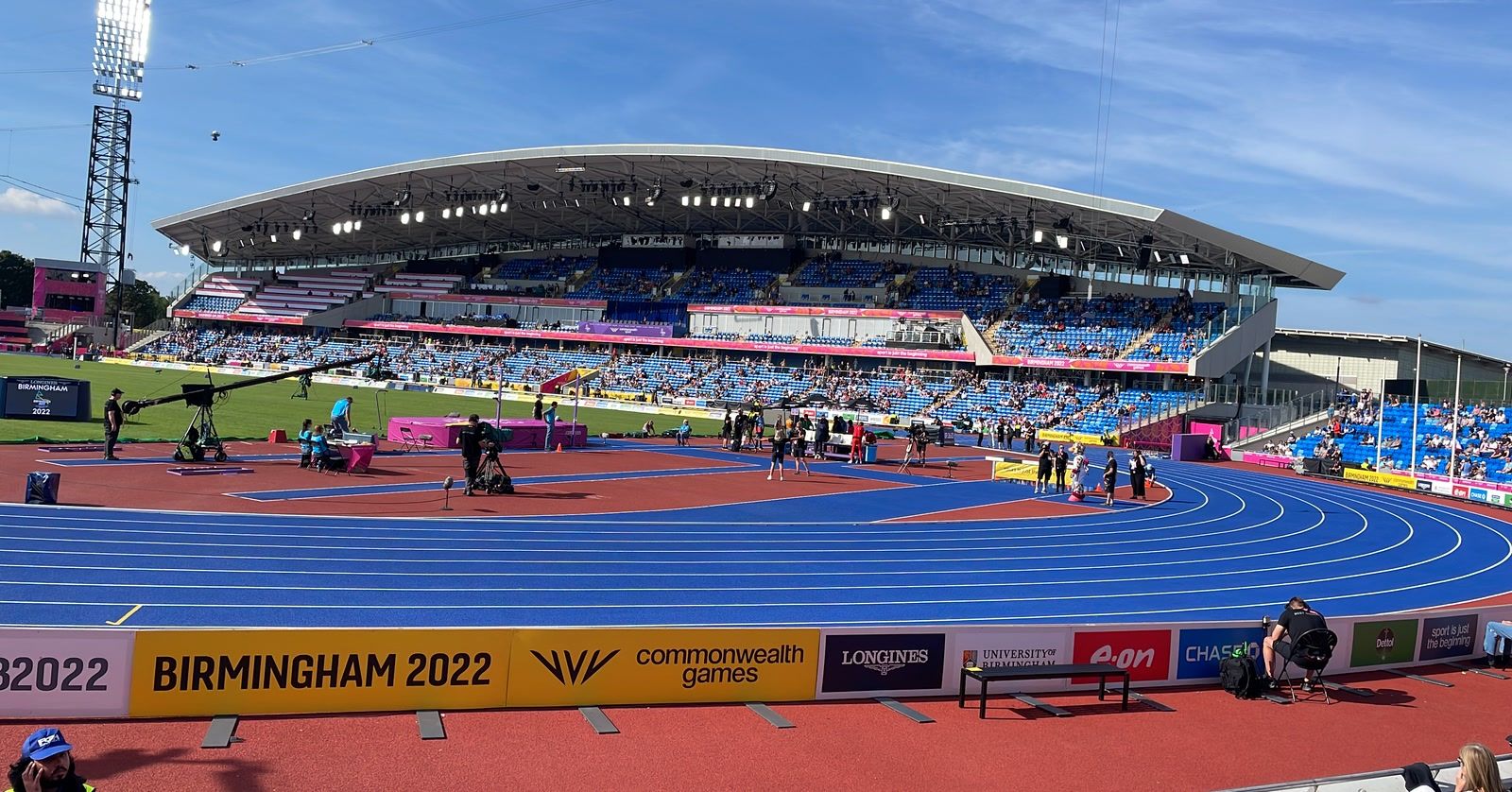
Photo: Broomcleaning2006, Alexander Stadium during the 2022 Commonwealth Games, CC BY-SA 4.0. Authentic historical photograph of the venue, not the 2026 host broadcast. Preserve attribution, source and share-alike terms; any adapted photo must be licensed compatibly and changes described.
Photo adaptation: center-cropped from the 3840 by 2160 original, removing about 74 pixels from the top and about 74 pixels from the bottom, then resized to 1600 by 838. This derivative remains licensed CC BY-SA 4.0.