


A search finds the bridge. The editor opens the clip and discovers it is last year's footage, with graphics burned in.
AI video search for broadcasters has to solve that last part. Finding a visually similar shot can help a producer discover material. Choosing the correct event, source version and usable range determines whether the result survives the edit.
For archive teams, engineers and technology buyers, the useful unit of success is an editor-accepted selection with traceable evidence. A fluent description or attractive thumbnail is only an intermediate result. The test should continue through source playback and the handoff into production.
With IBC2026 scheduled for September 11–14, this is a practical moment to prepare that test before a demonstration sets your buying criteria.

Original conceptual illustration. No real archive footage or product interface is shown.
What should AI video search for broadcasters return?
A production-ready search result should identify the source asset and version, locate the relevant passage, explain the match and let an authorized user verify it. Its usefulness depends on what happens after the search page appears.
Recent industry coverage makes that distinction timely. In an August 14 sponsored Streaming Media article, Telestream's Bruno Munger describes content analysis producing typed segments and in/out timecodes for downstream workflows. That is a vendor's proposed workflow, not an independent performance test. Streaming Media: contextual content analysis.
TV Tech's August 25 report on EditShare's IBC plans similarly brings discovery, storage and collaboration into the same conversation. It covers announced developments and previews; it does not establish retrieval accuracy on your library. TV Tech: EditShare's IBC2026 plans.
SVG's July 28 Cloud & Content Workflows Summit programme included sessions on AI-driven logging and search, and on monetizing library content. An agenda establishes the industry's questions, not the answers or measured returns. SVG: full programme.
Separate discovery from acceptance
Start your specification with the producer's actual request. “Find a bridge at dusk” is an exploratory visual query. “Find the clean opening shot from the approved version of yesterday's bridge package” adds editorial identity and version requirements. A search system should not silently drop those requirements to produce a more impressive list.
Media asset management, usually shortened to MAM, records can supply identifiers, relationships and workflow status. Speech recognition can locate dialogue. Visual analysis can suggest shots whose contents were never described in a log. These signals should complement each other, with their origins visible.
Define the expected handoff too. Does the producer need a playable reference, a marked source range, or media available in an editing system? For a master-control operator retrieving an approved replacement, version and approval status may matter more than semantic similarity. An archive researcher may need several plausible candidates to compare.
Those are different jobs. Score them separately.
How do you prove a match belongs to the source?
Prove a match by connecting its claims to the exact media version and a reviewable source passage. A generated summary is an assertion to check, even when it includes a link.
Gracenote's Tyler Bell makes a related grounding argument in an August 13 contributed Streaming Media article about entertainment discovery. His examples concern consumer titles and catalog facts. They are not a benchmark for broadcast clip retrieval, and the reported error rates should not be transferred to your archive. The relevant connection is narrower: identify which authoritative record supports an answer. Streaming Media: grounding entertainment discovery.
For a broadcast result, request these evidence fields:
- Source identity: the stable archive identifier, version and relationship between the preview and the production media.
- Located passage: source in/out points, the timing convention and enough surrounding material to review context.
- Match evidence: the transcript passage, visible frame or verified catalog field that supports the result.
- Annotation history: whether the description came from a person or a model, when it was made and whether someone corrected it.
- Availability and status: whether source media can be retrieved, what this user may access and which reuse decisions remain unresolved.
A result can show the correct bridge while the claimed date comes from an unrelated filename. Reviewing the pixels alone will not establish the date. A transcript can contain a person's name without proving that the person is on screen. Match each claim to evidence capable of supporting it.
Timecoded video search needs a reference frame
Ask whether a displayed time is relative to the preview file, the source media or an edited timeline. OpenTimelineIO's documentation explicitly distinguishes clip-relative ranges from ranges in a parent track. Its source range selects media within the clip's own time frame. That distinction matters when a search result moves into an edit. OpenTimelineIO 0.18.1: time ranges.
Consider a fictional, constant-rate 25 fps master starting at source timecode 01:00:00:00. A selection from 01:12:10:00 to 01:12:18:00, using an exclusive out point, lasts eight seconds: 8 × 25 = 200 frames. Its start is 730 seconds into that master. These values agree only because the timing assumptions are explicit.
Do not apply that simple offset blindly to a proxy with a different edit, a speed change or a removed slate. Ask the vendor to demonstrate the mapping against your actual source and proxy pair. Include frame rate, drop-frame convention where applicable, and whether the out point includes or excludes its displayed frame.
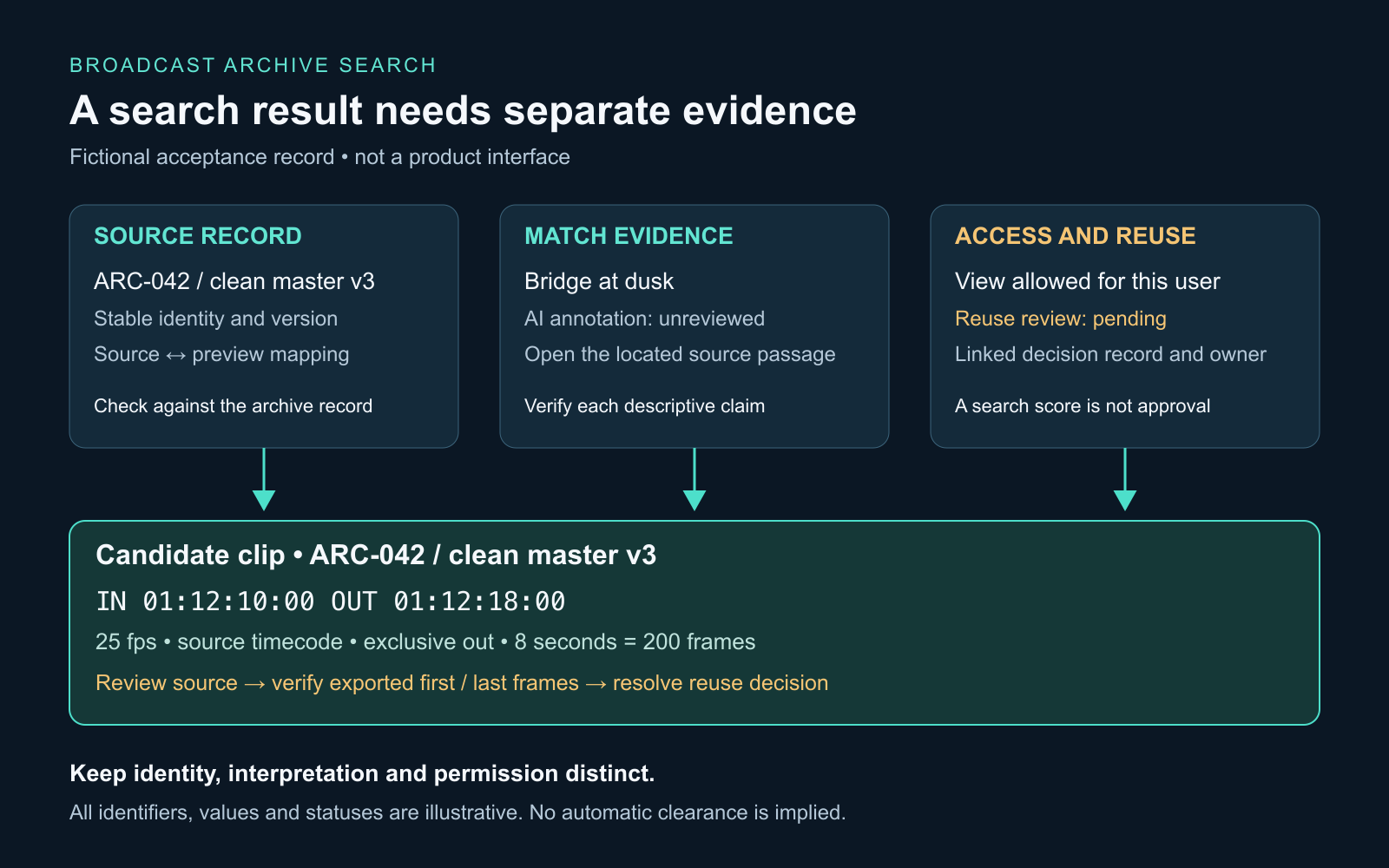
Illustrative acceptance record, not an Amira interface. Viewing permission and reuse approval remain separate. All identifiers and timing values are fictional.
Verify the exported selection
Open the selection in the intended downstream application and check its first and last frames. Confirm that audio tracks, version identity and any requested handles survive. A format name in a compatibility list is not a demonstrated round trip.
Keep the original machine annotation when recording a correction, with the reviewed replacement clearly distinguished. Our guide to small LLMs for newsroom metadata and summaries addresses the related editorial-control problem. Search should not promote an unreviewed description into a trusted catalog fact just because it was retrieved repeatedly.
Does permission to view a clip mean it is ready to reuse?
No. Treat permission to access material and approval for a proposed reuse as separate workflow decisions. A person may be allowed to research an asset while the proposed publication still needs review.
EBU TECH 3397 v2, published in April 2025, illustrates why the data model matters. EBUCorePlus distinguishes editorial objects from their physical media resources and includes a Rights class for grants and obligations. A descriptive annotation and a rights record serve different purposes. The ontology is a way to represent relationships; it does not grant permission or make a reuse decision for you. EBU: EBUCorePlus specification.
In the search result, preserve a link to the relevant rights or approval record and the owner of the next decision. If the record is missing or stale, show that state. Do not turn an empty restriction field into an approval badge.
For example, a producer looking for a social excerpt should be able to see that the asset needs a separate reuse check, even if internal playback is allowed. The applicable decision may depend on the intended outlet, territory, date or version. Your designated rights team defines those rules; a similarity score cannot infer them from the footage.
Test access changes, not just the initial login
Require access checks before protected material becomes available to the requesting user or enters an answer generated for that user. Include thumbnails, transcripts, filenames and cached responses in the test. Blocking the download is insufficient if the search page already reveals protected content.
Microsoft's current Azure AI Search documentation describes document-level filtering and warns that source permission changes become effective in search only after the relevant metadata is synchronized. Native permission integrations described there include preview features. This is a documented implementation example, not a claim about every search product. Microsoft: document-level access control, checked August 31, 2026.
Build a controlled test with an approved test asset. Query as an authorized account and a restricted account, then change the permission and repeat, including any cached answer. Measure when the change takes effect. Agree how the system should behave if it cannot establish authorization.
An operational error should not be disguised as “no matching footage.” Equally, an unauthorized user should not receive a message that exposes the existence of a protected asset. Define user-visible responses and administrator diagnostics separately. For the related question of where derived content may be processed, see broadcast AI data sovereignty.
How should you test search against your own archive?
Test real production requests against a fixed, representative collection and have people judge the returned media. Measure discovery quality and the work required to turn a result into an accepted selection.
NIST's TREC 2025 Ad-hoc Video Search overview, published in February 2026, provides useful evaluation context. Its V3C2 collection contained 9,760 videos and approximately 1,300 hours of material. Systems searched 1,425,454 candidate shots using 20 topics; assessors judged whether shots contained the described content. NIST: TREC 2025 AVS overview.
Those are research-task figures, not a commercial accuracy guarantee. The collection consists of Vimeo Creative Commons material, and shot retrieval is not the same as choosing a cleared, frame-accurate broadcast excerpt. Use the discipline of a defined collection and explicit judgments. Add the operational tests your facility needs.
Build difficult cases deliberately
The following is a proposed acceptance set, not an industry standard or a benchmark result.
Test family | Example request or condition | What the reviewer should check |
|---|---|---|
Spoken facts | Locate the passage where a speaker revises an earlier estimate | The actual revision, with sufficient context; not an earlier mention |
Visual event | Find a bridge opening to let a vessel pass | The requested action occurs; a static bridge is insufficient |
Similar material | Find yesterday's opening shot among repeated coverage | Correct event and date, supported by the source record |
Alternate edits | Request the clean master rather than the captioned social cut | Correct version, preview-to-source mapping and export |
Multilingual material | Ask in one language for a passage spoken in another | Source-language evidence and review by a competent speaker |
Missing or partial evidence | Ask for an event absent from a deliberately bounded test set | Appropriate uncertainty; no invented matching scene |
Restricted material | Repeat the request under different approved test accounts | No protected content disclosed to the restricted account |
Changed state | Correct metadata, replace a version or revoke access | Search and cached answers reflect the change within the agreed interval |
Include both familiar queries and held-out requests the supplier has not tuned against. Agree acceptable answers before the demonstration. Some queries have several valid clips; others require an exact version. Do not penalize a valid alternative because the test writer happened to remember only one shot.
Keep the measures interpretable
Record the query, returned identifiers and ranks, source ranges, relevant system settings and the reviewer's decision. Separate ordinary user query refinement from supplier intervention. Where reviewers disagree, resolve the judgment before using it to compare products.
Measure | How to record it | What it does not prove |
|---|---|---|
Useful results near the top | Count relevant results within a fixed review depth; define duplicate handling | That all relevant material was found |
Known-answer coverage | Count approved reference passages found within that depth | Complete archive recall unless the reference set is exhaustive |
Boundary correctness | Compare exported first/last frames and source identity with the accepted selection | That a relevant shot is editorially sufficient |
Time to accepted selection | Time from the first query through review, correction and successful handoff | That saved time will automatically become revenue |
No-match behavior | Judge absent-event cases separately from answerable requests | That the entire archive contains no such event |
Access and freshness failures | Log each unauthorized disclosure or stale-state failure separately | Acceptability merely because average relevance is high |
For a hypothetical trial, if three of the first five results are relevant, precision at five is 3 ÷ 5 = 60%. That says nothing about how many relevant clips remain elsewhere. If only one result is the requested version and exports correctly, record that additional outcome rather than calling all three production-ready. These are illustrative numbers, not Amira measurements.
Define hard requirements separately from convenience scores. An unauthorized disclosure cannot be offset by faster search. A result that points to the wrong master should fail an exact-version request even if its description is excellent.
Measure the work outside the search box
Compare the candidate system with the team's existing catalog and transcript tools on the same requests. Include initial indexing, newly ingested footage, permission synchronization and media restoration. Report interactive query delay separately from time spent waiting for source media to become available.
For the business case, use observed task time, request volume and operating costs. Deduct annotation review, failed searches, integration support and reindexing effort. A shorter demonstration does not establish a staffing reduction or licensing return. The credible question is whether the same team can complete more accepted work under its actual deadlines.
When is ordinary catalog or transcript search enough?
Ordinary search may be sufficient when users know the title, identifier or spoken phrase and the existing records reliably lead them to the required version. Establish that baseline before adding visual indexing or generated answers.
Visual and cross-modal search deserve testing when staff cannot name the asset but can describe what they need to see or hear. They may also help where useful moments are poorly logged. That potential still depends on the footage, languages, sampling, query design and review workload in your own environment.
Ask which parts of the media are actually analyzed. A visual request cannot be reliably checked against a transcript alone. An indexing method that examines selected frames needs a test containing brief events between those frames. Require the supplier to describe coverage and demonstrate the relevant failure case, without assuming that all systems sample identically.
Some problems need archive housekeeping first. Duplicate identifiers, missing source files and undocumented proxy edits cannot be resolved merely by making descriptions more fluent. A local proof of concept also cannot establish reliability across untested genres, languages or permission arrangements.
What should you ask at IBC?
Take these questions into an archive-search demonstration:
- Can we bring an unseen request and verify every claim against the exact source version?
- Can the returned in/out points survive a handoff into our editing environment, with timing conventions explained?
- What happens when a match is absent, ambiguous, inaccessible or not yet indexed?
- How do corrected metadata and revoked permissions propagate to results and cached answers?
- What did the trial improve over our current tools after review and integration work were included?
Before the meeting, choose a small set of recent research requests and save their accepted sources and ranges. Include a failure that cost the team time, an alternate edit and a controlled access-change test. Have a producer and an engineer agree what a successful handoff looks like. Then run the same requests through the existing tools and the proposed system. Buy against the work your team can verify and complete, with unresolved reuse decisions still visible to the people responsible for them.
Sources
- IBC: IBC2026 dates and programme, checked August 31, 2026.
- Streaming Media: contextual content analysis, Bruno Munger, August 14, 2026. Sponsored Telestream contribution.
- TV Tech: EditShare's IBC2026 plans, Tom Butts, August 25, 2026. Announcement coverage, not an independent test.
- SVG: Cloud & Content Workflows Summit programme, July 28, 2026. Agenda, not a session transcript.
- Streaming Media: grounding entertainment discovery, Tyler Bell, August 13, 2026. Gracenote contribution; consumer catalog context.
- OpenTimelineIO: time ranges, version 0.18.1 documentation, checked August 31, 2026.
- EBU TECH 3397 v2: EBUCorePlus, April 2025, especially sections 5.4.1 and 5.4.6.
- Microsoft: document-level access control in Azure AI Search, checked August 31, 2026. Feature maturity and synchronization qualifications apply.
- NIST: TREC 2025 Ad-hoc Video Search Track Overview, George Awad, published February 15, 2026; 2025 evaluation.