


An unaired interview does not stop being confidential when it becomes a transcript.
Imagine a producer sending interview audio to an AI service for transcription, then sending the transcript to another service for a summary. Both steps may be useful. They also create two separate decisions about who can receive the material, what they can do with it, and how long copies remain.
Broadcast AI data sovereignty starts with those decisions. A regional endpoint, an enterprise subscription, or a promise against model training answers only part of the question.
This guide separates the legal questions from the engineering controls, with a practical checklist for newsrooms, master control, production teams, and technology buyers. Sources and vendor policies were checked on August 30, 2026.

AI-generated editorial illustration. The people, footage, and facility are fictional.
Is sending broadcast content to a cloud AI API illegal?
It can be unlawful, or breach a contract, when the proposed processing lacks the necessary authority or safeguards. There is no useful blanket answer covering every broadcaster, asset, country, and AI service.
Start with four separate questions:
- Content rights: Does the relevant agreement permit this processing, disclosure, and use of subcontractors?
- Personal data: If the material identifies people, what rules and lawful basis apply to this use?
- International transfers: Does a recipient or subprocessor outside the relevant jurisdiction receive access, and what transfer mechanism covers it?
- Confidentiality and security: Are access, retention, deletion, and incident arrangements acceptable for this specific material?
Broadcast permission should never be treated as proof of permission for every external AI use. Ask the rights owner or your contracts team to check the actual agreement. Transcription for production, generating promotional material, and training a model are different activities; approval for one does not establish approval for the others.
Where the GDPR applies and a provider acts as your processor, Article 28 requires appropriate processor arrangements and controls over subprocessors. Journalism also needs a careful reading: Article 85 leaves relevant exemptions and derogations to national law. It is not a universal exemption for anything a newsroom uploads. GDPR, Articles 28 and 85
Our operational recommendation is simple: approve a defined workflow and content class. Avoid a company-wide statement that a vendor is approved for everything.
Has the EU–US Data Privacy Framework collapsed?
No. As of this research check, the European Commission still lists the EU–US Data Privacy Framework, or DPF, as a mechanism for transfers to participating US companies. That does not make every American AI service eligible, or authorize every use of the transferred material. Check the actual recipient and relevant certification coverage. European Commission: EU–US data transfers
The litigation needs precise wording. On September 3, 2025, the General Court dismissed the annulment action in T-553/23. An appeal was lodged on October 31, 2025; the Court's C-703/25 P docket lists that appeal as pending. A pending appeal is different from an invalidation. General Court case, appeal docket
For procurement, record the transfer mechanism actually relied on and assign someone to review changes. If standard contractual clauses are used, the Commission's guidance requires assessment of the particular transfer and potentially additional safeguards. Signing clauses alone does not finish that work. Commission SCC questions and answers
UK operations need their own analysis. The ICO updated its international-transfer guide on January 15, 2026, and explicitly explains that EU SCCs alone do not cover restricted transfers under the UK GDPR. An EU approval should therefore not silently become a global approval. ICO transfer guidance, UK IDTA and Addendum guidance
How is data residency different from data sovereignty?
Data residency describes where data is located. For a broadcast procurement review, data sovereignty is the broader question of applicable jurisdiction, control, and access. Ask separately where storage, inference, support, and backups occur.
The EDPB gives a relevant example: a processor in a third country remotely accessing personal data stored in the EU can constitute an international transfer. The storage location alone does not settle the question. Its guidance also distinguishes an employee of the same controller accessing data while traveling abroad; that is not automatically a Chapter V transfer, although security obligations remain. EDPB Guidelines 05/2021, examples 8 and 11
Government-access exposure is another question. Section 2713 of Title 18 of the US Code, added by the CLOUD Act, addresses relevant providers' preservation and disclosure obligations for information in their possession, custody, or control, including information outside the United States. This is not automatic government access to every US-owned service; jurisdiction, legal process, and the information under the provider's control matter. CLOUD Act text, Section 103
Translate those distinctions into evidence requests. Which legal entity supplies the service? Who can access readable content? Can support personnel retrieve it? Where are encryption keys controlled? What happens when a lawful disclosure request conflicts with your instructions?
An EU region label is useful evidence about one setting. It is not the complete answer to those questions.
Which broadcast assets need the strictest controls?
Unreleased, source-sensitive, and rights-restricted material should receive the most restrictive initial handling. The table below is an Amira Labs review framework, not a statement that these categories have identical legal treatment everywhere.
Material | What the review must protect | Recommended starting position |
|---|---|---|
Unaired interview with a confidential source | Identity, voice, location clues, unpublished allegations | Keep within the existing restricted workflow until editorial, privacy, and security owners approve any external processing. |
Pre-release drama, screeners, or production rushes | Embargoes, performer arrangements, distribution agreements | Check the specific contract and approved suppliers before uploading either footage or derived transcripts. |
Rights-restricted sports or entertainment pre-feed | Permitted recipients, purposes, territories, and subcontractors | Do not add an AI destination to the signal path without checking the rights and distribution conditions. |
Archive containing identifiable contributors | Personal data, reuse purpose, legacy permissions | Review the proposed use and minimize the material sent; age alone does not establish clearance. |
Publicly released promotional material | Remaining rights, personal data, account configuration | A candidate for an approved cloud workflow after the relevant checks; publication does not erase all restrictions. |
For producers, the practical issue is whether a new destination is authorized. For engineering, it is whether the system enforces that destination. For master control, it is what happens under failure.
A useful acceptance test is to simulate an outage of the approved service in a test environment using non-sensitive material. Does the workflow stop, queue safely, or switch to an approved alternative? It should not quietly forward restricted audio to an unreviewed fallback because a captioning or translation job is late.
Does a no-training promise mean no retention?
No. Model training, request retention, application storage, and human access are separate controls. Read the policy for the exact commercial service, endpoint, model, and configuration you intend to use.
The following snapshot illustrates why procurement cannot stop at a vendor name. It is not a ranking of providers.
Service or policy | What the current documentation says | Broadcast implication |
|---|---|---|
OpenAI API | API content is not used for training by default unless the customer opts in. Default abuse-monitoring logs can be retained for up to 30 days, with stated exceptions. Its endpoint table lists no abuse-monitoring or application-state retention for audio transcription and translation endpoints; other features have different storage rules. | Do not apply a blanket 30-day audio-retention claim to every endpoint. Verify the actual path through your application. |
Anthropic standard commercial API | Its July 1, 2026 retention article describes deletion of inputs and outputs within 30 days, subject to exceptions including user-controlled storage, different agreements, policy enforcement, and legal requirements. | Check your agreement and any file-storage features separately. |
Anthropic Covered Models policy | Effective June 9, 2026, the policy requires 30-day prompt and output retention for the specified Covered Models, including where a zero-data-retention arrangement otherwise exists. Flagged content and legal requirements can extend retention. | Changing the selected model can change the retention position without changing the vendor. |
Sources: OpenAI API data controls, Anthropic commercial retention, Anthropic Covered Models retention.
Treat model upgrades as change-control events. Recheck approval when a model, endpoint, region, storage feature, or intermediary changes. An exception negotiated for one configuration should not be assumed to follow a new one.
Also distinguish your vendor's policy from your own integration. A service might retain no transcription content while your application writes the full transcript into its troubleshooting logs. The overall workflow still has a retained copy.
Where else can an AI workflow leave copies?
Look beyond the uploaded media file. A useful review traces the input, each derived artifact, and the operational systems around the request.
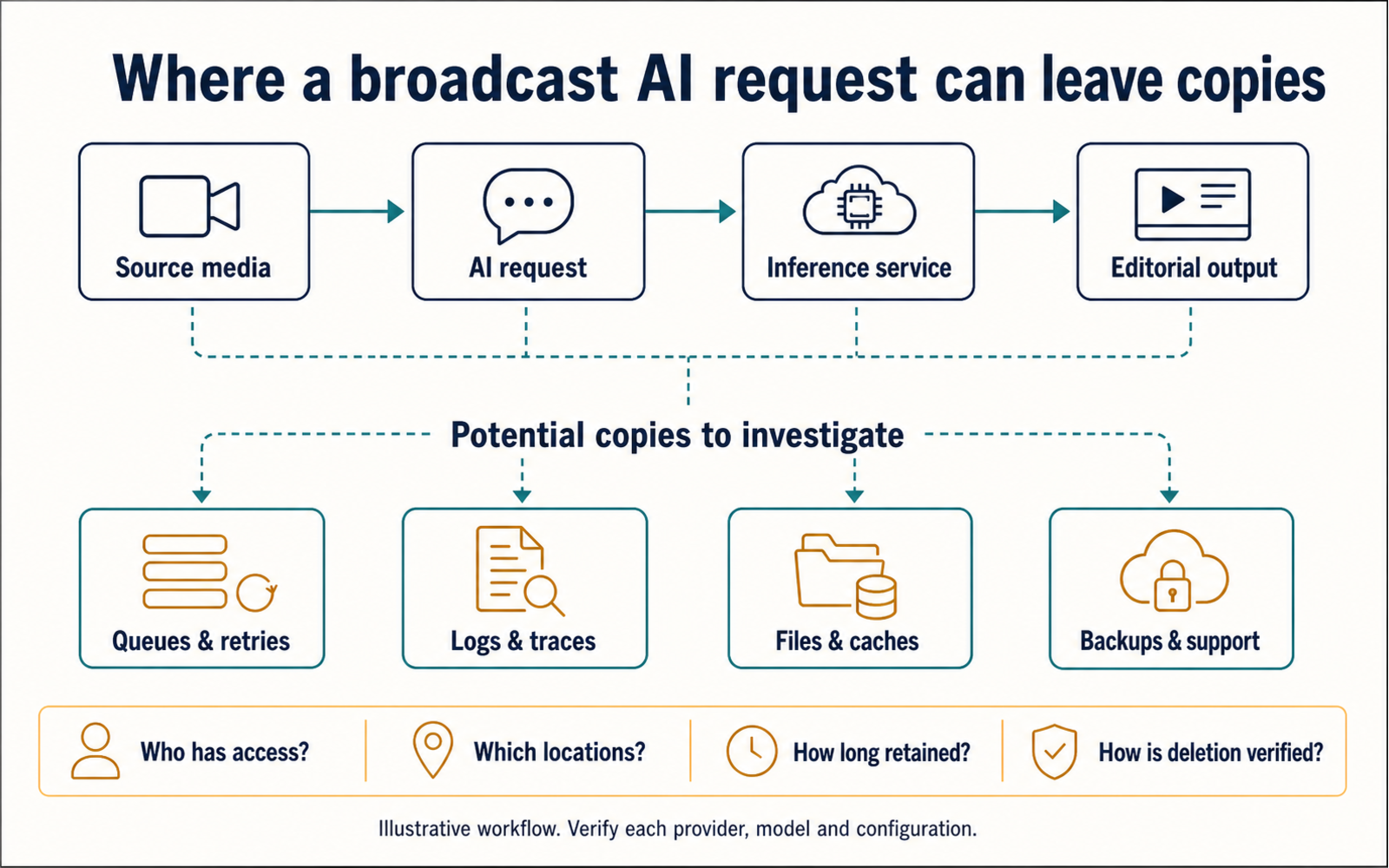
AI-generated explanatory diagram reviewed for this article. These are potential copy locations to investigate, not a claim that every service uses all of them.
Use these categories for an engineering walkthrough:
- Request handling: temporary uploads, queued jobs, retries, and failed requests.
- Derived content: transcripts, translations, summaries, searchable indexes, and exported captions.
- Operations: application logs, traces, exception reports, and support attachments.
- Persistence: saved files, caches, backups, and restoration procedures.
For each category, record the owner, location, authorized readers, retention period, and deletion process. Ask how a request to delete a media asset propagates to its derivatives. If backups expire on a separate schedule, record that schedule and how restoration avoids reintroducing deleted content.
Minimization can help. A timing check may need timestamps rather than a complete transcript. An audio task may not need video frames. A test of retry behavior can use synthetic material instead of an actual source interview.
Removing names is not enough to assume anonymity. The remaining voice, location, or context may still identify the contributor. Treat that as something to assess, not a checkbox that automatically clears the upload.
Does the EU AI Act require all inference to stay on premises?
The AI Act should not be treated as a general instruction to host every broadcast AI workload locally. Identify the provision and use case at issue before translating a legal obligation into an infrastructure requirement.
A current example is Article 50. The Commission's July 20, 2026 guidelines address transparency obligations for providers and deployers of certain AI systems, applying from August 2, 2026. Those are transparency requirements; they are not, by themselves, a hosting-location rule or permission to transfer footage. Commission Article 50 guidelines
For broadcast teams, keep the reviews separate: where processing is permitted, how content is protected, and what disclosure or labeling rules apply to the output. Our broadcast caption-compliance guide covers the adjacent accessibility and transparency questions.
When does local inference make sense, and what does it leave unsolved?
Local inference can be a good fit when contractual restrictions, source protection, or operational requirements make external processing unsuitable. It can also give engineering teams direct control over network access and the systems holding the content.
It does not automatically resolve rights, privacy, access control, or retention. A locally hosted model can sit inside an application that sends telemetry, creates cloud backups, or falls back to an external service. A private network connection to a cloud service likewise does not establish that every supporting operation stays inside your chosen region.
There are operational costs to owning the deployment: patching, capacity, redundancy, monitoring, and accountable support. Our broadcast AI GPU buyer's guide addresses the capacity side. Choose that architecture because it meets your requirements, with an operating plan to match.
Approved external services can be appropriate for suitable material. The Associated Press's July 23, 2026 newsroom standards update permits specified assistive uses, including transcription, translation, and summarization, while retaining human review and editorial accountability. That illustrates a task-specific approach to AI; it does not establish which hosting arrangement another newsroom should approve. AP newsroom standards update
The limits of this guide matter. It cannot determine your license terms, national journalism rules, or exposure across every distribution territory. Security controls can reduce exposure; they cannot create a missing right to process content. Involve qualified privacy and media counsel for the jurisdictions and agreements that actually apply.
What should a broadcast team do before its next AI upload?
Select one real workflow and make its approval inspectable. Live transcription, archive search, or pre-air translation is specific enough to start.
Record five answers:
- What may enter? Name the permitted content classes, purposes, and explicit exclusions. Include derived transcripts and summaries.
- Who may receive it? Identify the service, contracting entity, subprocessors, and support-access arrangements.
- Which configuration is approved? Record the endpoint, model, processing locations, retention settings, and applicable transfer arrangements.
- What happens under failure or change? Define approved fallbacks, change review, deletion handling, and who can suspend the route.
- Who owns the decision? Assign editorial or rights approval, privacy review, and an engineering owner who can demonstrate the controls.
Then test that record against the running system using non-sensitive material. Inspect the route, logs, stored artifacts, and failure behavior. Give operators a clear stop-and-escalate path when material falls outside the approval.
The useful procurement deliverable is an approved, testable path for a defined class of content. Start there before sending the next unaired interview.
Sources
Primary sources checked August 30, 2026. Vendor documentation can change; verify the exact service and contractual terms before deployment. This article provides general operational information, not legal advice.
- GDPR official text, particularly Articles 28 and 85.
- European Commission: EU–US data transfers.
- General Court T-553/23 and Court of Justice C-703/25 P.
- European Commission: standard contractual clauses FAQ.
- ICO: international-transfer guide and UK IDTA and Addendum.
- EDPB Guidelines 05/2021, version 2.0, adopted February 14, 2023.
- CLOUD Act text supplied by the US Department of Justice.
- OpenAI: API data controls.
- Anthropic: commercial data retention and Covered Models retention policy.
- European Commission: Article 50 transparency guidelines, published July 20, 2026.
- Associated Press: updated AI newsroom standards, July 23, 2026.