


A producer asks for a shorter headline. The model removes one word: “alleged.” The result fits the graphics template and changes the meaning of the story.
That is the evaluation problem for small LLMs for the newsroom. A large language model can produce fluent text quickly while creating more verification work than it saves. The useful test is whether it can complete a bounded editorial task, preserve its source evidence and leave a producer with less work before transmission.
Local models are credible candidates for metadata, internal summaries, headline variants and tagging. They should earn each job separately. This guide focuses on roughly 7–30-billion-parameter models, a practical evaluation range rather than an industry definition of “small,” and on assisted workflows rather than autonomous publishing.
Model cards, licences and newsroom guidance were checked on August 30, 2026. The comparisons below describe documented capabilities and proposed tests, not an Amira benchmark or a claim that any checkpoint is cleared for broadcast use.

AI-generated editorial illustration for Amira Labs. The scene is fictional and does not depict a product interface or a real newsroom.
Which newsroom jobs are good candidates for a small local LLM?
Start with transformations of material the newsroom already has permission to process. Give the model a defined input, a constrained output and a human owner.
There is current editorial precedent for this boundary. On July 23, 2026, the Associated Press updated its AI standards to allow specified assistance including document summaries, suggested headlines and shotlists. AP requires its journalists to review and edit generated output before publication, retaining responsibility for verification and editorial decisions. This is AP's policy, not a universal permission for other newsrooms. AP's updated newsroom standards
For broadcast operations, the first evaluation can be narrow:
Job | Useful candidate output | What the reviewer must check |
|---|---|---|
Metadata extraction | Names, organisations, locations and candidate subject codes, each tied to an input passage | Correct identity, spelling and source version; unknown fields stay unknown |
Internal summary | A short account of an approved script or transcript, with source references | Attribution, negation, chronology, numbers and material omissions |
Headline variants | Alternatives for a named destination and a specified length limit | Allegations, uncertainty, tense, tone and whether shortening changes meaning |
Archive tagging | Proposed terms from the organisation's controlled vocabulary | False matches, missed relevant subjects and whether tags describe this asset |
Metadata needs particular discipline. A person mentioned in a transcript is not necessarily visible in the clip. A location in a reporter's biography is not necessarily where the event occurred. A model should not turn either inference into an authoritative asset field.
Use the taxonomy the operation actually supports. IPTC's Media Topics is a maintained news-subject vocabulary; its current tree is dated July 9, 2026. Have the application check proposed identifiers against a pinned, approved vocabulary and permit an abstention when no suitable term exists. Free-form labels can remain suggestions without silently becoming new production categories. IPTC Media Topics, current NewsCodes tree
For master control and distribution teams, keep generated descriptions away from authoritative transmission fields. Rights windows, embargo releases, programme identifiers and routing destinations should come from approved records. A plausible description cannot establish permission to air an asset.
Which small LLMs should a newsroom evaluate in 2026?
Evaluate exact checkpoints against the same newsroom test set. The following four are current, downloadable candidates within the chosen size range, not a ranking or a complete market inventory.
All four linked repositories list Apache 2.0 as of the research date. Check the actual model files and licence notices you deploy; a similarly named fine-tune or conversion may introduce additional provenance questions.
Exact checkpoint | Published size and context | Why include it in a trial | Qualification that matters |
|---|---|---|---|
9B language model; 262,144 native context tokens | A smaller starting point for the same extraction and summarisation tests | Apache 2.0. Measure final-answer latency with the chosen thinking configuration | |
11.95B total parameters; 256K context | A dense, instruction-tuned alternative with text, image and audio input support | Apache 2.0. Multimodal support does not establish transcript accuracy on your feeds | |
13.5B language model plus 0.4B vision encoder; 256K context | An instruction-focused multilingual comparator | Apache 2.0. This repository is FP8; distinguish it from the separately named BF16 variant | |
27B language model; 262,144 native context tokens | A larger candidate to test when smaller models miss important distinctions | Apache 2.0. Its advertised coding advances are not evidence of newsroom accuracy |
The release dates matter. Google's release history lists Gemma 4 12B Unified on June 3, 2026. An evaluation built around an older generation should be identified as such, rather than presented as today's complete shortlist. Google's Gemma release history
Context is the amount of input and generated text a model can hold in one request, measured in tokens, which are pieces of text. An advertised context ceiling is neither a guarantee of reliable recall throughout a long document nor a promise that the maximum fits on your chosen GPU.
Likewise, parameter count describes learned weights, not editorial judgement. Qwen's current cards document thinking and direct-response configurations. Test the mode you intend to use; extra reasoning tokens belong in the latency and capacity measurements even when the editor sees only a short answer.
How much GPU memory is enough?
Begin with a weights-only calculation, then measure the complete configuration. For illustration, a nominal 12-billion-parameter model stored at 16 bits per parameter requires 24 GB for those weights alone:
12 billion × 16 bits ÷ 8 = 24 billion bytes.
At an idealised four bits per parameter, the same arithmetic gives 6 GB. These are decimal GB and theoretical storage figures, not measured model files or recommended GPU capacities. Quantization, which stores weights more compactly, adds format-specific metadata and may leave some tensors at higher precision.
Serving also needs working memory, cached request state and space for concurrent jobs. A model loading successfully proves only that it loaded. Mistral's card says its 14B FP8 model can fit within 24 GB of VRAM; that vendor statement does not specify your transcript lengths, concurrent producers or deadline performance.
Compare the exact quantized candidate with a higher-precision reference on names, numbers and attribution. Then test simultaneous requests and queue behaviour using the approach in our broadcast inference-stack guide.
How do you keep generated newsroom text tied to its source?
Make every candidate output traceable to an approved input version, and separate generating a suggestion from accepting it into production.
A practical pattern is to retrieve only the material the requesting user may access, attach stable document or asset identifiers, generate a draft, validate its structure and present it beside the evidence. This is a proposed workflow for evaluation, not a description of Amira product internals.
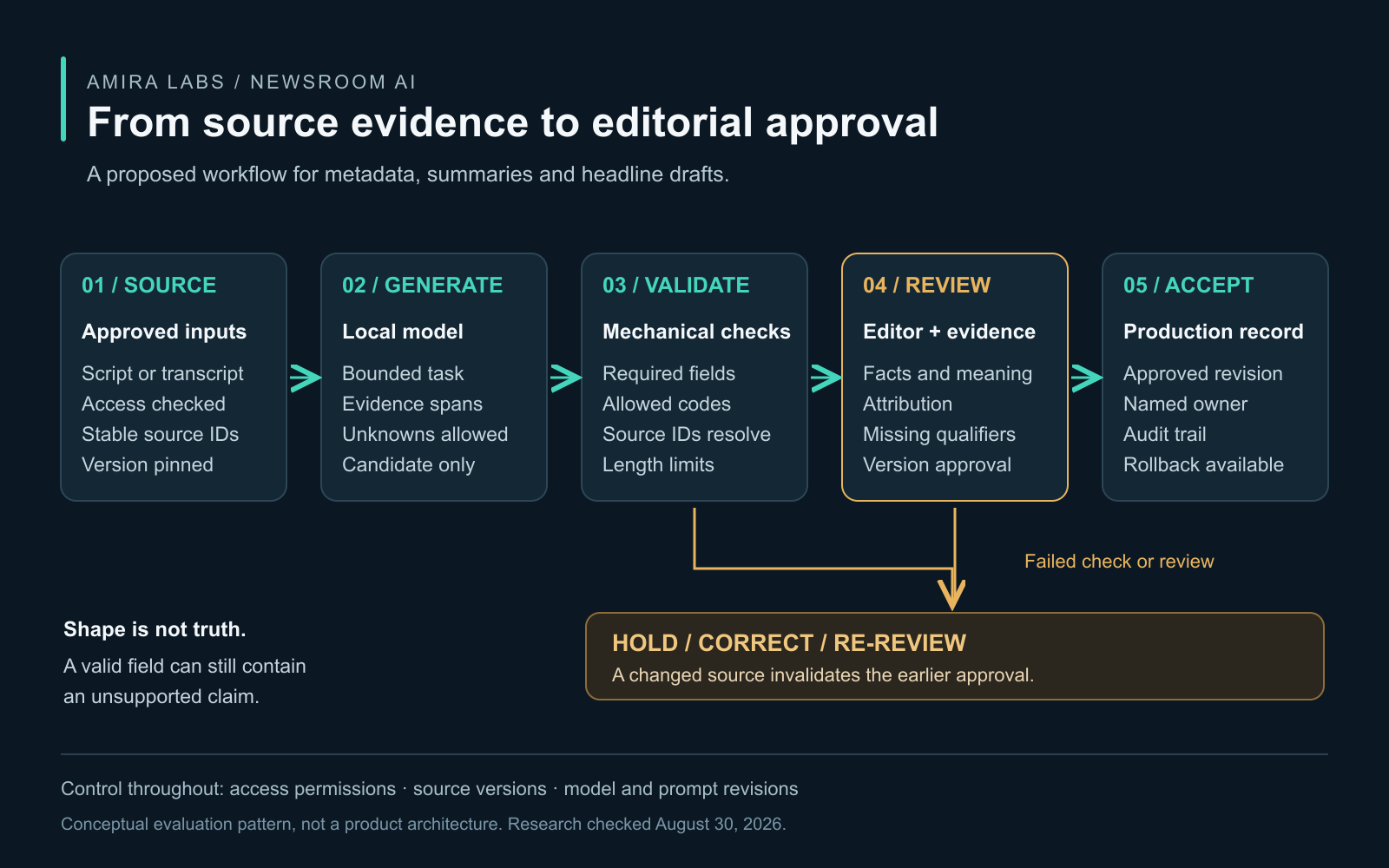
Proposed evaluation workflow. The model produces a candidate; an editor approves a specific version. Failed checks and source changes send it back for review.
Retrieval-augmented generation, often shortened to RAG, supplies relevant source material with the request. It does not make that material true or guarantee that the model uses it correctly. A citation can point to a real paragraph and still fail to support the sentence beside it.
Consider this fictional source excerpt: “The transport authority said the bridge may reopen on Friday, subject to inspection.” A candidate headline reading “Bridge reopens Friday” loses the attribution, condition and uncertainty. A safe evaluation records all three failures even if the wording is concise and the source link opens correctly.
For summaries, ask reviewers to inspect each factual statement against its supporting passage. For metadata, preserve the exact evidence span and distinguish a name in the source from a resolved identity in the asset system. Reuse authoritative identifiers only when the matching process has actually established the identity.
Structured output helps with the mechanical checks. A schema can require fields, restrict a subject code to allowed values and represent missing information explicitly. vLLM documents constrained structured generation, but a correctly shaped response still needs semantic verification. A valid date field can contain the wrong date. vLLM structured outputs
Keep the production destination read-only during the trial. The reviewer should see the source version, the proposed change and its destination. Record the model revision, quantization, prompt version and review decision. If the source script changes, invalidate the old approval rather than silently retaining a summary of the previous facts.
Does local deployment keep scripts private?
It can remove the need to send scripts to a hosted inference provider. That benefit depends on the surrounding system.
Check retrieval services, error reports, prompt logs, backups, support access and any fallback that sends difficult requests elsewhere. A locally running model with an external embedding service still has an external content path. Apply source permissions before retrieval; instructing the model to hide unauthorised documents is insufficient.
Even software setup deserves a check. Hugging Face documents separate controls for offline Hub access and telemetry. Those controls govern the relevant libraries, not every network connection made by an application. Provision the required files first, then verify the deployed service's outbound behaviour and failure handling. Hugging Face environment controls
Treat incoming scripts, agency copy and documents as untrusted content. An embedded instruction must not be allowed to change access permissions or approve publication. OWASP states that retrieval and fine-tuning do not fully eliminate prompt-injection risk, and recommends least privilege and human approval for high-risk actions. OWASP prompt-injection guidance
Local hosting also leaves content rights and retention obligations intact. The model's licence does not grant rights to agency copy or confidential source material. Review those separately, as discussed in our broadcast AI data-sovereignty guide.
Where do small newsroom models stop being useful?
They stop earning their place when the total review and correction burden exceeds the work they remove, or when the workflow cannot contain the consequences of an error.
Google's current model card explicitly warns about incorrect or outdated facts, language nuance and difficult open-ended tasks. Those limitations matter in a newsroom even when the source document is present. Gemma 4 capabilities and limitations
Be particularly cautious with:
- Developing stories. Conflicting wire versions and corrected transcripts require explicit chronology and supersession rules.
- Allegations and sensitive identities. A subtle attribution change can be more consequential than a visibly broken sentence.
- International output. Evaluate each target language, transliteration convention and mixed-language source set. A multilingual capability claim does not establish equal quality across languages.
- Weak source material. An automatic speech-recognition error can be polished into a confident summary. Keep the original audio accessible when the transcript is uncertain.
- Simple deterministic jobs. A rule, lookup or existing classifier may handle a fixed mapping more predictably than a generative model. Include that baseline.
A larger local model or an approved hosted service may be the better option when it passes the newsroom's tests and the smaller candidate does not. A hosted service can also reduce the operational burden for a team without capacity to maintain local inference. Neither choice removes editorial accountability or the need to approve data handling.
Reuters' current standards retain editorial accountability for AI-assisted output and restrict the use of non-approved external tools for covered content. Your operation needs its own clear policy and enforcement, not an assumption that local hardware settles the question. Reuters journalistic standards
How should a broadcast newsroom run a useful pilot?
Compare accepted editorial work with the existing workflow using a representative, held-out test set. Decide the gates before looking at a preferred model's results.
Build the test around failures an editor cares about
A suggested starting exercise is 200 cleared source items, explicitly a pilot design rather than a statistically sufficient certification sample. Include routine scripts, long interviews, corrections, unsupported questions and difficult language cases. Hold some items back from prompt tuning and keep related versions of the same story together when splitting the data.
Score tasks separately. For tagging, count false positives and missed relevant terms. For summaries and headlines, assess unsupported claims, attribution changes, missing qualifications and factual omissions. Reviewers should judge outputs without seeing which model produced them where practical. Escalate disagreements instead of treating the model's own confidence score as an acceptance gate.
Define critical errors in advance. For example, changing the named person in an allegation or inventing an election result should stop that candidate's release for the affected use case. Zero critical errors in a small trial is a necessary result under that policy, not proof that the production error rate is zero.
Measure the economics at the editor's desk
Track total handling time, including review, failed generations, rework and manual completion. An illustrative calculation shows why this matters:
- Existing handling time: 8 minutes per item.
- Assisted handling time: 5 minutes per item, including the work on rejected outputs.
- At 200 items, time released is 200 × (8 − 5) = 600 minutes, or 10 hours.
These are chosen assumptions, not measured savings. If the assisted workflow takes 9 minutes, it adds 200 minutes of work instead. GPU ownership cannot rescue that result by itself.
Treat released hours as capacity unless the business can identify a real budget reduction. Include engineering, integration, support and fallback work when assessing the business case. A faster first draft may still be valuable, but establish where the benefit lands.
Test the deadline and the recovery path
Measure completion time from the editor's request to a usable candidate, including retrieval and queueing. Report the slow tail as well as the median. Test the period when several producers need summaries at once, plus a server restart and an unavailable dependency. An internal archive task and a headline needed before a bulletin deserve different deadlines.
Before any wider deployment, agree on four operational answers:
- Who owns each supported task and its critical-error policy?
- Can a reviewer reach the exact source passage and version from every candidate?
- What happens when the model, retrieval service or approval step is unavailable?
- Can the team roll back the model and prompt together without losing the audit trail?
This week, choose one job, assemble the cleared examples and time the existing process. Run the smallest plausible candidate alongside it without writing into production. Expand only when editors can demonstrate less total work with the required factual checks intact.
Sources
Primary sources checked August 30, 2026. Publisher capability statements are not independent newsroom performance results.
- Associated Press: updated newsroom AI standards, July 23, 2026
- IPTC: Media Topics overview
- IPTC: Media Topic NewsCodes tree, dated July 9, 2026
- Qwen: Qwen3.5-9B model card and licence
- Google: Gemma 4 12B instruction-tuned model card and licence
- Mistral AI: Ministral 3 14B Instruct 2512 model card and licence
- Qwen: Qwen3.6-27B model card and licence
- Google: Gemma release history
- Google: Gemma 4 capabilities and limitations
- vLLM: structured-output documentation
- Hugging Face: Hub environment variables
- OWASP: LLM01:2025 prompt injection
- Reuters: journalistic standards