
Two redundant contribution feeds can fail together: six source-diversity tests
Dek: A backup feed protects a live broadcast only when its source, transport path and recovery behavior are independently tested.
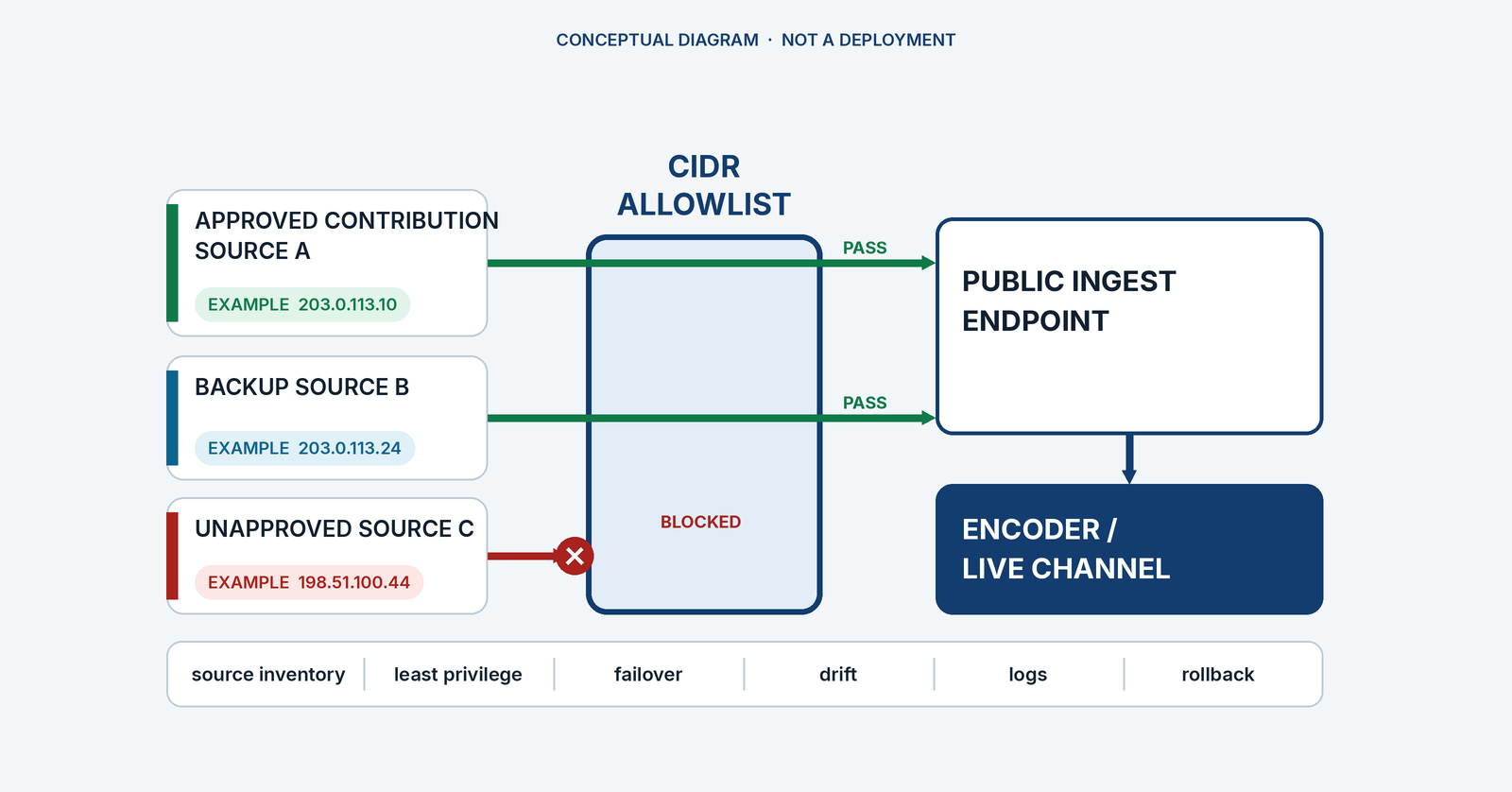
Two green contribution inputs do not prove a resilient broadcast. If both streams originate from the same encoder, traverse the same network bottleneck or carry the same upstream fault, redundancy may protect packet delivery without protecting the program.
Why it matters: Master control may see two connected sources while viewers experience the same frozen frame, missing audio or corrupted service on both. The engineering task is to distinguish transport-path redundancy from genuinely independent content generation.
Merge and failover solve different problems
AWS Elemental MediaConnect documents two modes for transport-stream source redundancy. Merge combines packets from two binary-identical streams to recover losses on either path. Failover selects one source and switches when that source stops delivering data. Its documentation specifies a 500-millisecond no-data switching condition in failover mode, not a guarantee of clean decoded output or a universal recovery time.
For RTP merge, aligned sequence numbers and SMPTE ST 2022-7 compliance are required. AWS lists merge support for RIST, RTP, RTP-FEC and certain Zixi inputs, while SRT source redundancy uses failover rather than merge. Protocol support is configuration-specific, not interchangeable.
Source: AWS MediaConnect source failover documentation, accessed November 15, 2026.
Six tests before declaring the backup ready
1. Draw the shared-failure map. Trace both routes from camera or playout through encoder, switch, firewall, ISP, cloud ingress and downstream decoder. Identify shared power, clock, DNS, credentials and routing dependencies. Two public IP addresses alone do not establish independence.
2. Lose one transport path. Disconnect path A without stopping the encoder. In merge mode, confirm that packets from path B repair the output. In failover mode, record the selected-source transition, output gap and decoded impact. Repeat with path B removed.
3. Inject mismatched content. Feed merge inputs from separate encoders or alter one stream deliberately in a controlled test. The expected outcome is a visible mismatch alarm, not an assumption that packet combining remains safe. AWS documents SourceMergeStatusWarnMismatch for precisely this risk.
4. Break the shared origin. Freeze or mute the upstream program before it branches to both paths. Verify that transport alarms do not falsely announce protection. If both copies contain the same defect, a downstream merge cannot restore missing content. This is an engineering inference from the requirement for identical merge sources, not a vendor claim about application-layer QC.
5. Measure buffer and recovery behavior. Increase path delay asymmetrically and introduce short bursts of loss. Compare SourceMergeLatency, SourceMissingPackets, SourceNotRecoveredPackets and decoded output. A longer merge recovery window can improve tolerance to late packets but adds delay. Record the maximum acceptable contribution latency before testing.
6. Test failback and alert ownership. Restore the preferred input and observe whether the receiver switches back, flaps between sources or introduces a visible discontinuity. Assign one incident owner for the originating fault and retain per-path evidence. A clean aggregate output should not hide the loss of redundancy.
AWS lists SourceSelected for failover mode, SourceMergeActive for merge mode, and separate missing-packet and mismatch metrics. Its flow-health metrics also expose FailoverSwitches and MergeActive. These are useful operational signals, but they are not substitutes for checking decoded video, audio and captions.
Sources: AWS source-health metrics and flow-health metrics, accessed November 15, 2026.
What should the NOC alarm on?
Separate three conditions: loss of one path while output remains healthy, degradation of the combined output, and a common-mode program fault. They warrant different severities and response teams.
MediaConnect's flow-health event documentation describes source-state changes, failover switches, zero bitrate and transport-stream integrity indicators. Use those events as evidence, then correlate with program-level checks rather than treating every transport event as an on-air failure.
Before signing off, ask: Which components are truly independent? What fault can damage both feeds simultaneously? How long can the receiver wait for late packets? Who notices that one path is lost before the second fails? And what does the viewer actually see during switch and recovery?
The acceptance criterion should be specific: a defined fault produces a predictable alarm, a bounded interruption and an unambiguous recovery record. Redundancy is a tested behavior, not a count of cables.
Image: Jan Tik, [Satellite dish (Television)](https://commons.wikimedia.org/wiki/File:Satellite_dish_(Television).jpg), 2005, CC BY 2.0. Archival illustrative photograph; crop and JPEG recompression planned. It does not depict a documented incident.