

Dek: A transport stream may stay locked while packet loss damages individual services, so operators need PID-level evidence and a decoded-output check before clearing an alarm.
An MPEG transport stream can retain its overall bitrate, valid synchronization and apparently normal service information while a handful of missing packets damage video, audio or subtitles. The practical question for master control is not simply whether the transport is present. It is which service was affected, whether the loss reached viewers and whether recovery actually worked.
Why a green transport indicator is not enough
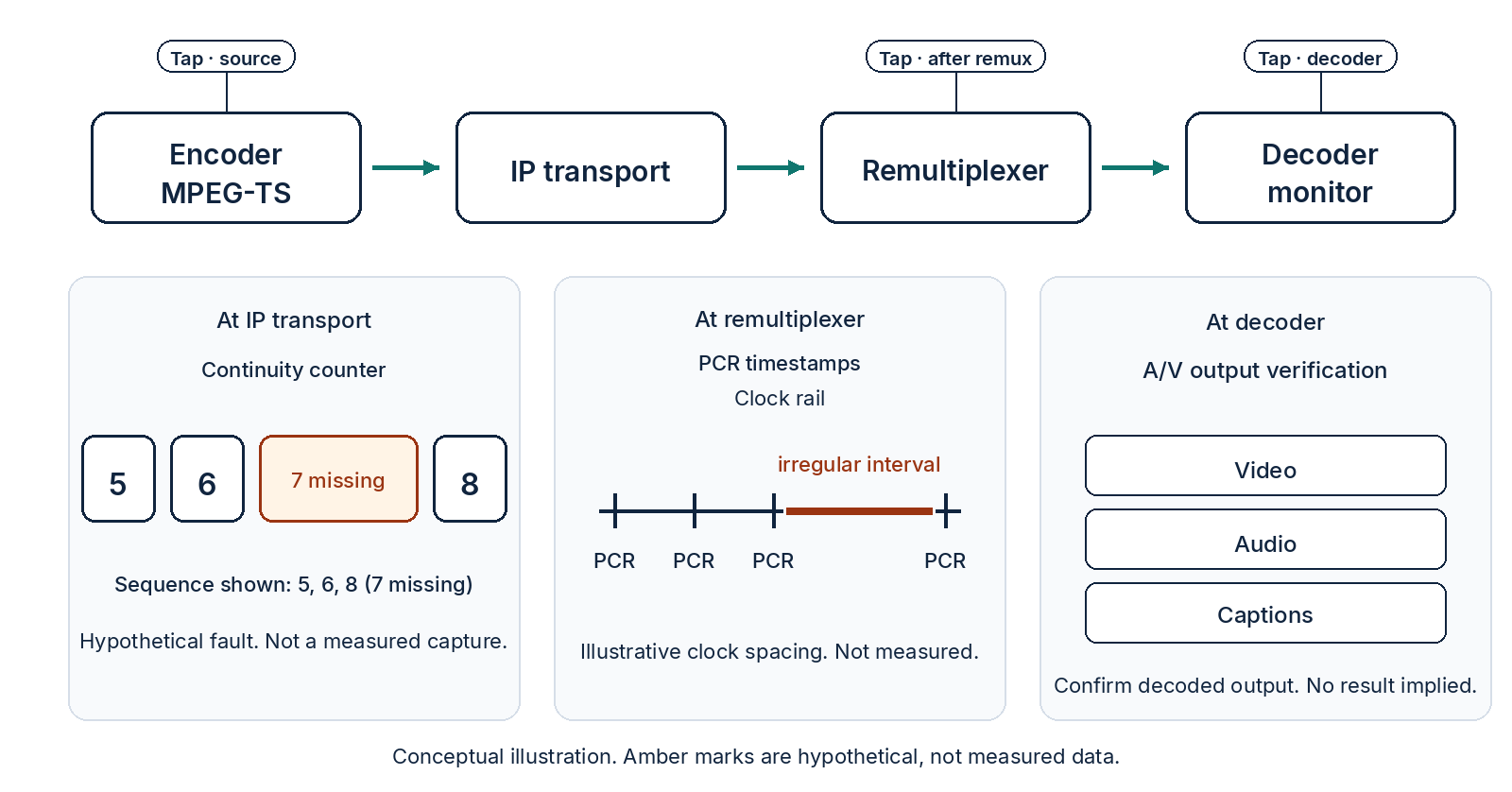
The ETSI TR 101 290 measurement guidelines, version 1.4.1 (June 2020) define a layered approach to DVB transport checks, including continuity-count errors. Those measurements help identify packet-level faults, but they are not a substitute for watching the decoded service.
Each MPEG-TS packet carries a PID identifying its elementary stream or signaling purpose. A four-bit continuity counter provides a way to detect unexpected gaps or repetitions on a particular PID. It wraps from 15 to zero. Importantly, the counter does not advance for adaptation-only packets, and permitted duplicate packets have special handling. Treating every repeated number as packet loss will generate false alarms. The underlying behavior is discussed in the TSDuck project's specification analysis.
Why it matters: A single multiplex can carry several services. An error on one video PID should not automatically condemn every channel in the transport. Conversely, a transport-wide green light should not override evidence of corruption on a critical program.
Six checks to make a continuity alarm useful
1. Establish a known-good PID map. Record the service ID, PMT, video, audio, subtitle and PCR-bearing PIDs for each monitored program. Revalidate the map after a legitimate service change. Without this baseline, an operator may investigate the wrong elementary stream.
2. Test a controlled packet drop. In an isolated test feed, remove one payload-bearing packet from a selected PID and record the expected continuity alarm. Repeat separately for video and audio. Do not deliberately damage production traffic. Check whether the monitoring system identifies the affected service rather than reporting only a generic transport failure.
3. Distinguish loss from legal counter behavior. Test adaptation-only packets, wraparound from 15 to zero and valid duplicates. A naïve increment-by-one rule can overstate faults. TSDuck's user guide documents continuity checking and the limits of rewriting counters.
4. Compare upstream and downstream taps. Observe the same program before and after the relevant network or processing boundary, using time-aligned evidence. If the upstream counter sequence is intact but downstream packets are missing, investigate the intervening path. If both points show the same gap, move the investigation upstream. Avoid declaring the network at fault from one probe alone.
5. Correlate with actual decoded impact. Preserve a short sample around the alarm and inspect the decoded video, audio and subtitles. A missing packet might produce a visible block, a brief mute or no obvious impairment because of concealment. Severity should reflect both the transport evidence and viewer-facing effect, not a universal one-packet threshold.
6. Verify recovery without hiding the original loss. After switching paths or restoring a source, confirm counters stabilize and the decoder resumes correctly. The TSDuck TR 101 290 analyzer reference explains that some input plugins resynchronize before packets reach the analyzer. Record where observation occurs. Never treat a counter-repair operation as restoration of missing media: changing packet headers cannot recreate lost payload bytes.
The operating decision
The useful alarm record is compact: service and PID, first and last affected timestamps, count of unexpected discontinuities, observation point, concurrent network evidence, decoded impact and recovery status. Those fields let an operator decide whether to escalate to contribution, distribution, encoding or playout.
A sensible acceptance test uses at least one clean baseline, one deliberately impaired copy and one recovery case. The goal is not to eliminate every counter warning. It is to distinguish actionable damage from expected transport behavior and avoid clearing an incident while the viewer-facing output remains impaired.
For the next maintenance window, select one representative service and run these six checks end to end. A repeatable test record is more useful than another dashboard that simply says the transport is online.
Image: Television news production control room, Asterzenback, September 12, 2019, Wikimedia Commons, CC0 1.0. Archival illustrative photograph, not a depiction of a fault. Proposed crop and JPEG re-encode; not yet performed.