
Dek: Vizrt's Story Object Model demonstration points toward graphics that follow a story's editorial state, but safe on-air automation still needs ownership, versioning and explicit approval gates.
On November 9, 2026, Vizrt described a proof-of-concept integration with the Story Object Model (SOM), built through IBC's Smart Stories Accelerator. Its demonstration used Viz Arc, with related graphics designed in Viz Artist and shown in Viz Engine. This is a demonstrated integration, not evidence that every newsroom, MAM and graphics system now interoperates in production.
The difference matters during a developing story. A name can be corrected, a figure can be withheld or a claim can be cleared after a producer has already built a lower third. A rundown may know which item is next; a graphics operator still needs to know which facts are approved for that output at that moment.
Why shared context changes the workflow
The open SOM 1.0 specification describes JSON message families that let systems exchange a story's context, events, links, available media and audit information. The schema is open, but a common schema alone does not decide who is authorized to approve a fact or how a downstream system should respond to late or conflicting updates.
The model is deliberately about coordination, not media delivery. A story-context message should not be mistaken for a playable video object, a validated lower-third template or permission to put text on air. SOM's published schemas provide a useful starting point for conformance testing; facility-specific policy remains necessary.
Six acceptance tests before connecting graphics to agents
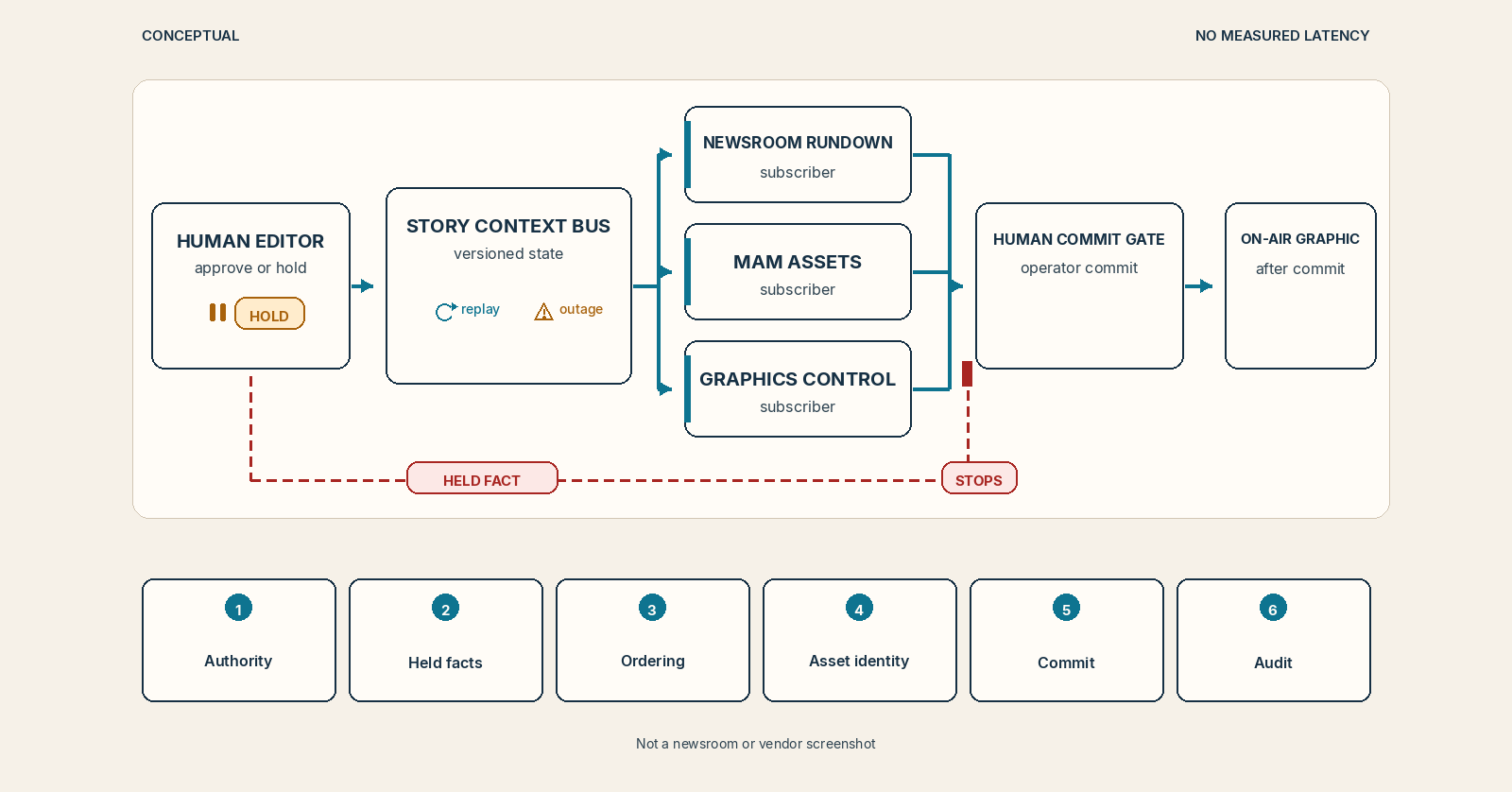
1. Define the authority for every change. Identify which editorial system owns the story, which people can approve a correction and which processes may only suggest one. An AI-generated fact proposal must not inherit the permissions of a producer who merely reads it.
2. Prove held facts stay held. Create a test story with one confirmed fact and one withheld fact. Change its status upstream and verify that every connected graphics surface handles the new state as the newsroom intends. A visually plausible graphic is a failure if it contains a fact no one has cleared.
3. Exercise late, repeated and out-of-order events. Re-send a prior update after a correction. Disconnect and reconnect one subscriber. Confirm that the graphic reflects the current approved state rather than whichever message arrived last. Retain the message IDs and timing evidence.
4. Check story and asset identity separately. A correct story identifier does not prove that the attached headshot, still or footage has the correct person, version, rights or duration. Rebind an asset in a rehearsal and verify that the automation does not silently keep the superseded media.
5. Make the on-air boundary explicit. Let an agent prepare a graphics update, then require an operator-controlled commit for an output that has editorial or legal risk. Test both approval and rejection. An emergency correction should have a known manual path even if the agent or context bus is unavailable.
6. Audit and recover. Record the originating change, its approver, version, consuming system and actual on-air result. Simulate a bus outage and a malformed message. The desired behavior may be to hold the last approved graphic, suppress it or alert an operator, depending on editorial policy. That behavior must be chosen and rehearsed.
What the proof of concept does not prove
In its November 10 coverage of the integration, TVBEurope describes the aim of shared editorial context across systems. Neither that report nor the announcement establishes measured end-to-end propagation latency, security certification, interoperability across unrelated deployed vendors or automatic compliance with a broadcaster's rules.
Those are commissioning questions, not reasons to dismiss the standard. A useful pilot would connect a newsroom source of truth to a test graphics output, then run a controlled set of corrections, revocations and outages. Capture both the message trace and the rendered output. Passing schema validation is only the beginning; the success criterion is that the right information appears, at the right time, after the right human decision.
Image credit: Original Amira Labs editorial engineering diagram, November 11, 2026, to be rendered from the attached specification. Conceptual workflow, not a Vizrt product screenshot or actual newsroom deployment.