
A television ad appears on the home screen. The viewer installs the app and starts a stream on the same device. Roku can connect those events. The streaming team still has to answer the budget question: would that viewer have opened the app anyway?
Roku Outcomes, announced by Roku Advertising on November 4, 2026, makes that question practical for connected-TV (CTV) buyers. Its Actions product can optimize delivery around selected in-platform events. A buyer can use those events to steer the campaign, then use a separate experiment to decide whether to buy another flight. The two decisions require different evidence.
What does Roku Outcomes optimize at launch?
Roku describes two parts of the suite. Amplify is for enterprise advertisers seeking unique or incremental household reach and frequency control. Roku says it can run across native placements and in-stream video. Actions optimizes for conversions. Its initial rollout targets media and entertainment advertisers on Home Screen Marquee placements, with app installs, first views, and account signups among the initial use cases. The announcement discusses subscriptions and trials as outcomes, and lists purchases, site visits, and cart activity as future support. Confirm exactly which event your account and placement can optimize before building the media plan.
Buying question | Signal to evaluate | Main caveat |
|---|---|---|
Can I reach more households beyond an existing plan? | Deduplicated household reach, overlap, and frequency | Estimated reach beyond a prior plan answers a reach question. Incremental viewing is a separate outcome. |
Can delivery find more people likely to take the selected action? | Attributed actions and cost per action for the eligible placement | Observed actions can include people who would have acted without the campaign. |
Did the ad bring viewers or subscribers we would otherwise have missed? | Difference in qualified outcomes between eligible groups | The experiment needs enough eligible units, comparable groups, and a known exposure policy. |
The event on the television is attractive because the ad, install, and first stream can happen on the same device. Roku says those signals feed models that adjust bids and delivery during the flight. Events that occur elsewhere, such as renewal billed through another channel, need a separately validated reporting path. Roku’s broader Ads Manager event documentation describes tracking capabilities. Verify that the signal is actually available for this campaign and objective.
What does Roku’s nine-flight result tell a buyer?
Roku reported that all nine paid external Actions beta flights that began in September came in at or below their own targets. The median cost per action (CPA) was 38% below target. Roku’s October 30 snapshot included seven completed flights and two that were still running. The comparison was flight-to-date against each flight’s target, using conversions within 14 days of exposure. Roku excluded its own marketing flights.
The result answers a real operating question. Those campaigns met the CPA targets used for the comparison as of the snapshot. A target can come from a budget, a prior campaign, or a negotiation. It cannot stand in for a group that received no campaign. Roku’s announcement gives no randomized lift estimate for those flights. A median also gives each flight the same standing in the ranking, regardless of how much money it spent or how many actions it recorded.
Use the beta to decide what a pilot should measure. Ask what counted as an eligible exposure, whether two events from the same household can count twice, and how changes to campaign settings affect the reporting window. Request both the distribution of attributed results and a way to measure lift. A buyer that only receives the CPA target comparison can use it to monitor pacing and delivery against that target. A decision about extra spend needs a stronger basis.
Which event is worth optimizing?
Choose the earliest event with enough volume to steer delivery and a demonstrated relationship to business value. An install is usually easier to record than a paid renewal. For a streaming service, a first qualifying playback may separate someone who opened the app from someone who found a show worth watching. A buyer can define a qualified event for the experiment even when a different event is the only one available for optimization.
Start with a cohort analysis. For a recent set of installs, count people who opened the app, started eligible content, came back the following week, and became paying customers where relevant. Break out preexisting subscribers. If a large share of installs comes from people restoring access to an app they already use, cost per install is a weak proxy for acquisition. A distributor may still value reactivation, in which case it should be named and priced as its own objective.
Agree with finance on the source of truth for subscriptions. Decide whether trial starts, paid starts, and reversals count, and when the records settle. Document device, household, and account deduplication separately. Keep those differences visible when you reconcile buyer and publisher reports. A single television can represent several profiles. A single account can appear on several devices. Pick a reporting unit that matches both the experiment design and the commercial decision.
Viewer behavior can also expose a playback or entitlement problem. An install cohort that fails to produce streams may have encountered a sign-in loop, an out-of-market rights restriction, or a deep link that opened the wrong page. Before changing targeting, reproduce that route on an actual television. The Amira Labs guide to connected-TV live delivery checks covers authentication, playback, and fallback scenarios that can explain a drop after acquisition.
How should a streaming team measure incrementality?
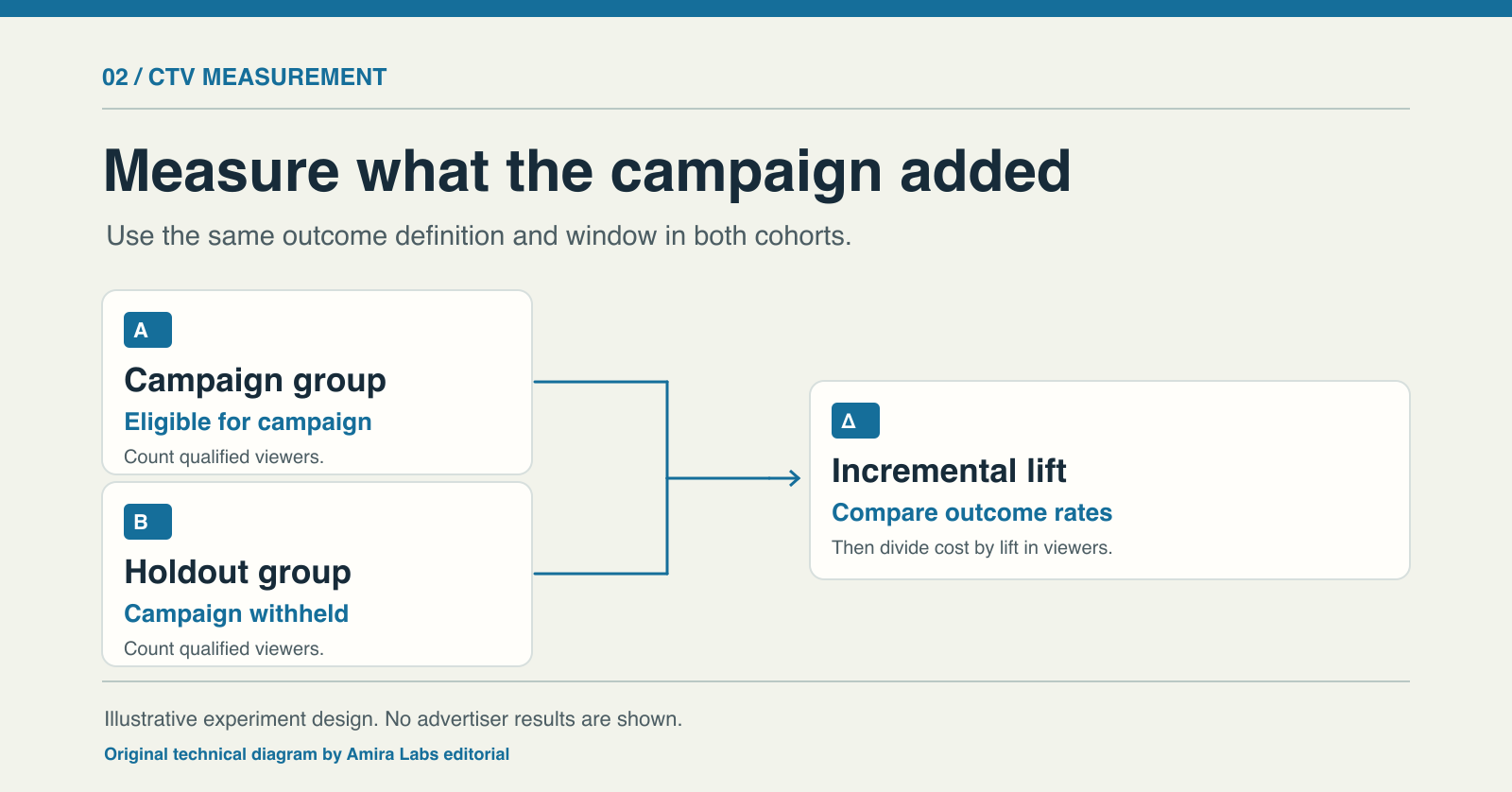
Keep an eligible comparison group out of the campaign and measure the same business outcome in both groups. Ideally, allocate households at random before delivery begins. The exposed population can differ from the wider eligible group because delivery is optimized and ad opportunities vary. Compare everyone assigned to each arm using the original allocation. This preserves the comparison even when some households assigned to treatment receive no impression.
Agree on the primary outcome and its observation window before looking at results. A first stream within a defined time can settle sooner than a paid subscription or a retention measure. Where a user has to wait until a trial ends, give both arms equal follow-up. Record other media activity and major content launches. If you run a geographic experiment instead of household randomization, document cross-market spillover and how you selected comparable markets.
A simple example shows why the two CPAs can diverge. Assume a $48,000 campaign assigns 100,000 eligible households to each arm. A qualifying viewer appears in 2,400 treatment households and 2,000 holdout households. The rates are 2.4% and 2.0%. The difference is 0.4 percentage points, equivalent to 400 incremental households in the treatment arm. The modeled cost is $120 per incremental household. If delivery reporting attributed 1,600 actions to the campaign, its attributed CPA would be $30. Both divisions are correct for the inputs. Only one uses the difference between randomized groups.
Preserve the reason each household was eligible at assignment. If a mid-flight suppression rule removes recent installers only from treatment reporting, the two denominators no longer describe the same population. Run a count check before the first spend posts. Ask the analyst to produce an assignment balance table and identify every population filter applied after allocation. Separately, record which conversions are missing because an account could not be joined. If missingness differs materially between the arms, treat that as a measurement problem to investigate before converting the observed difference into a budget forecast.
Calculate uncertainty around the rate difference. Check whether randomization happened at the household, device, or market level and use analysis that matches it. Ask whether the study can detect a lift small enough to matter financially. If it cannot, report the range of plausible outcomes before committing more spend. A campaign can hit its target while the experiment remains too small to settle the question.
When is the closed loop too narrow?
Closed-loop reporting is strongest when the outcome you care about happens within the environment you can observe. A Roku install may lead to viewing on Roku and a later purchase on a website. If the reporting link ends at the device, the buyer may see the install and miss the purchase. An instrumented purchase event can help, provided the partner can establish permission, coverage, match quality, and a deduplication policy. Do that work before treating missing events as people who did nothing.
Other launch conditions can make a result hard to generalize. A marquee placement seen while someone is choosing what to watch differs from a video impression in the middle of a program. A campaign that starts during a tentpole premiere may perform differently in a quiet week. Keep the placement, creative, app version, and programming calendar with the experiment record. Treat expansion to other formats as a new test when those conditions change.
A holdout also has a cost. Some eligible households will never see the campaign during the test. A tiny audience may need a larger budget or more time to generate a useful estimate, and a platform may offer fewer choices for how to allocate groups. If the available design is too weak, use the campaign to learn about event capture and economics within the measured placement. Set a separate decision threshold for claims about incremental demand.
What should a buyer put in the pilot brief?
Write down the eligible placement and optimization event in one sentence. Then name the independent decision metric, such as cost per new household reaching a first qualified stream. Set the commercial ceiling with finance. For a subscription business, use contribution after costs and a stated retention assumption rather than assigning the full subscription price to every signup.
Ask for one test export with eligibility, assignment, aggregated outcomes, window, and exclusions. Check how consent and suppression rules affect both arms. Walk one known household through the test flow and confirm that the platform and your own records use the agreed event definitions. Then freeze the measurement plan before live traffic enters the campaign.
Set a date for reading results after both groups have matured. Bring the platform’s delivery report, the experiment estimate with its uncertainty, and the first-party reconciliation. If attributed CPA looks attractive and the lift estimate still spans an uneconomic result, choose in advance whether to extend the trial or stop. That decision rule will be more valuable on the next flight than a slide showing how far under target the first one came in.