
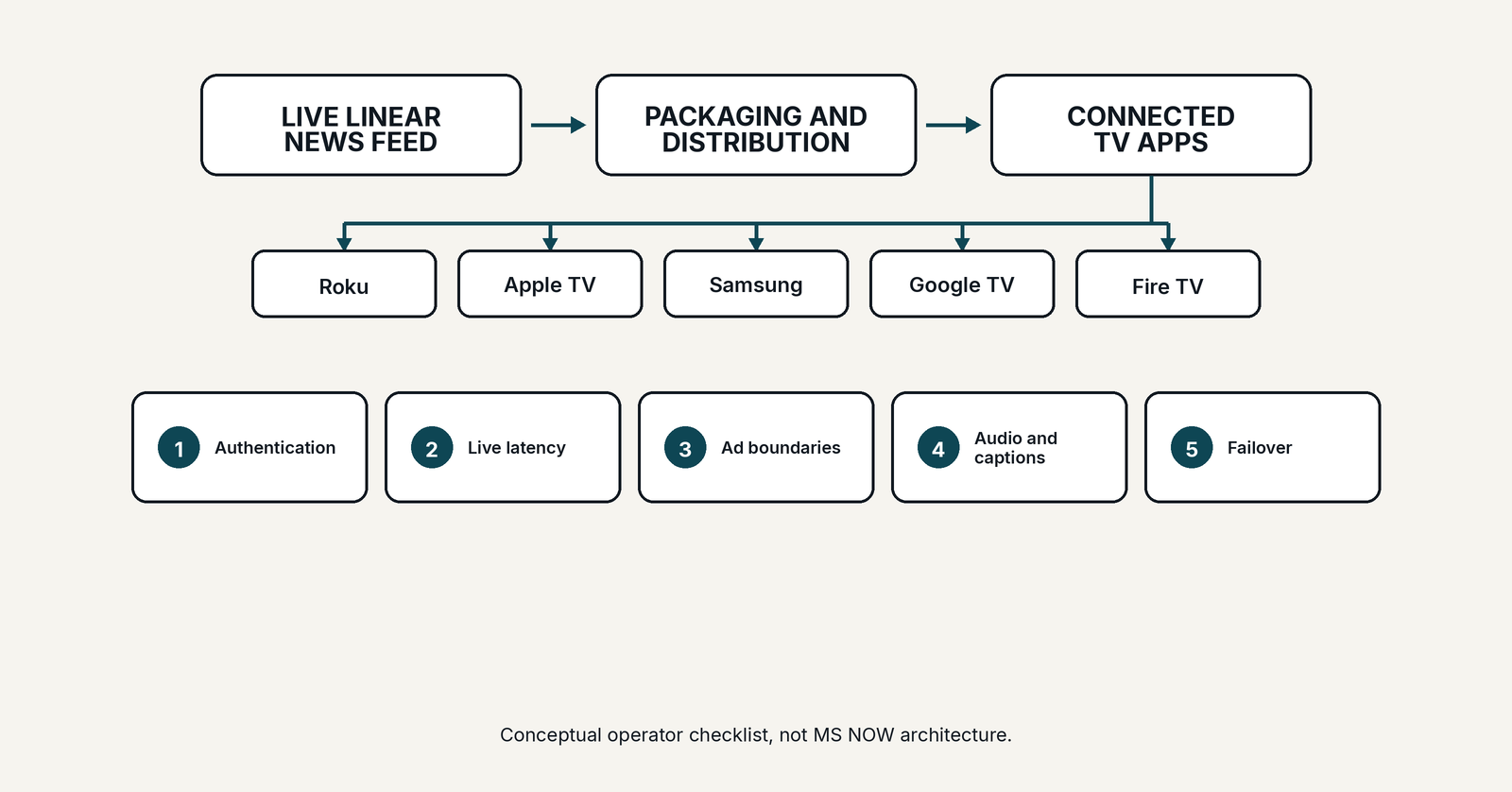
MS NOW's November 2 connected-TV expansion puts a 24-hour linear news feed directly into television apps just before Election Day, making entitlement, playback and failover tests especially relevant.
The launch
On November 2, 2026, Versant announced that MS NOW's paid membership would carry its 24/7 live linear feed to Roku, Apple TV, Samsung, Google TV and Amazon Fire TV. Members can watch the channel on a television without a cable subscription, while users can also sign in with participating television providers through the MS NOW app. The announcement describes access to full episodes on demand as well.
The service costs $7.99 monthly or $79.99 annually, according to Versant's November 2 announcement. Reuters also reported the expansion on November 2.
The timing matters. The rollout arrives one day before the November 3 US midterm elections, when viewers may open live news streams simultaneously, switch devices and expect uninterrupted coverage. Versant did not publish platform-specific concurrency targets, latency figures or outage budgets in its announcement. Those figures should not be inferred.
Why it matters
For a linear network, connected-TV distribution is not simply another screen. It introduces app-specific authentication, adaptive-bitrate playback, device software differences and potentially distinct advertising and measurement paths. A functioning source feed is necessary, but not sufficient, evidence that a household can actually watch it.
There is a wider election-night distribution lesson. NewsNation's November 2 production briefing describes a separate approach to synchronizing election data across broadcast and digital experiences. It is not evidence about MS NOW's architecture. Together, the announcements show how live-news operators increasingly need to verify the audience experience beyond the traditional transmission chain.
Five checks before a high-demand live event
1. Test both sign-in routes. A membership account and a participating pay-TV-provider login can have different token lifetimes and entitlement behavior. Confirm fresh sign-in, expired sessions, subscription changes and device reauthorization. Verify that a successful login actually opens the live channel, not merely the app homepage.
2. Measure live playback at the screen. Monitor startup time, rebuffering, audio-video sync and distance from the live edge across supported device families. A healthy origin or CDN response does not prove that a particular television firmware version can decode and sustain the stream.
3. Inspect ad transitions, not just program video. Where ad insertion applies, test entry and exit boundaries, slate behavior, unexpected black frames, loudness discontinuities and whether captions return correctly after breaks. Do not assume every app uses the same advertising workflow.
4. Check audio and accessibility end to end. Confirm expected audio tracks, caption availability, caption timing and recovery after a rendition switch. Validate the displayed result on real devices. Manifest metadata alone cannot establish that captions are legible and synchronized.
5. Rehearse failure and recovery. Simulate a source interruption, packaging failure or delivery-path problem in a controlled test. Record how long it takes to detect, route around and recover. Confirm the app resumes playback without requiring viewers to sign out or restart.
These are recommended acceptance tests, not claims that MS NOW has failed them or disclosed its internal systems.
The operating decision
Election-night readiness should be expressed as a device-by-device matrix: supported model and software version, sign-in method, live-start result, observed latency, caption status, ad-transition behavior and recovery time. Assign an owner for each failed test and establish an escalation path that connects app support, distribution engineering and master control.
The practical takeaway is that live-news reliability now extends to the final app session. An operator can have a clean linear feed and still lose the viewer at entitlement, playback or device recovery. The useful question for the next launch is not just whether the channel is on air, but whether each supported television can stay on air with it.
Image credit: Original Amira Labs editorial diagram. Conceptual checklist only; not a representation of MS NOW's actual distribution architecture.
Sources: Versant, November 2, 2026; Reuters, November 2, 2026; NewscastStudio, November 2, 2026.