
A router can report a successful switch while the audience hears the old commentary or sees the wrong regional feed. Test the seconds around the take.
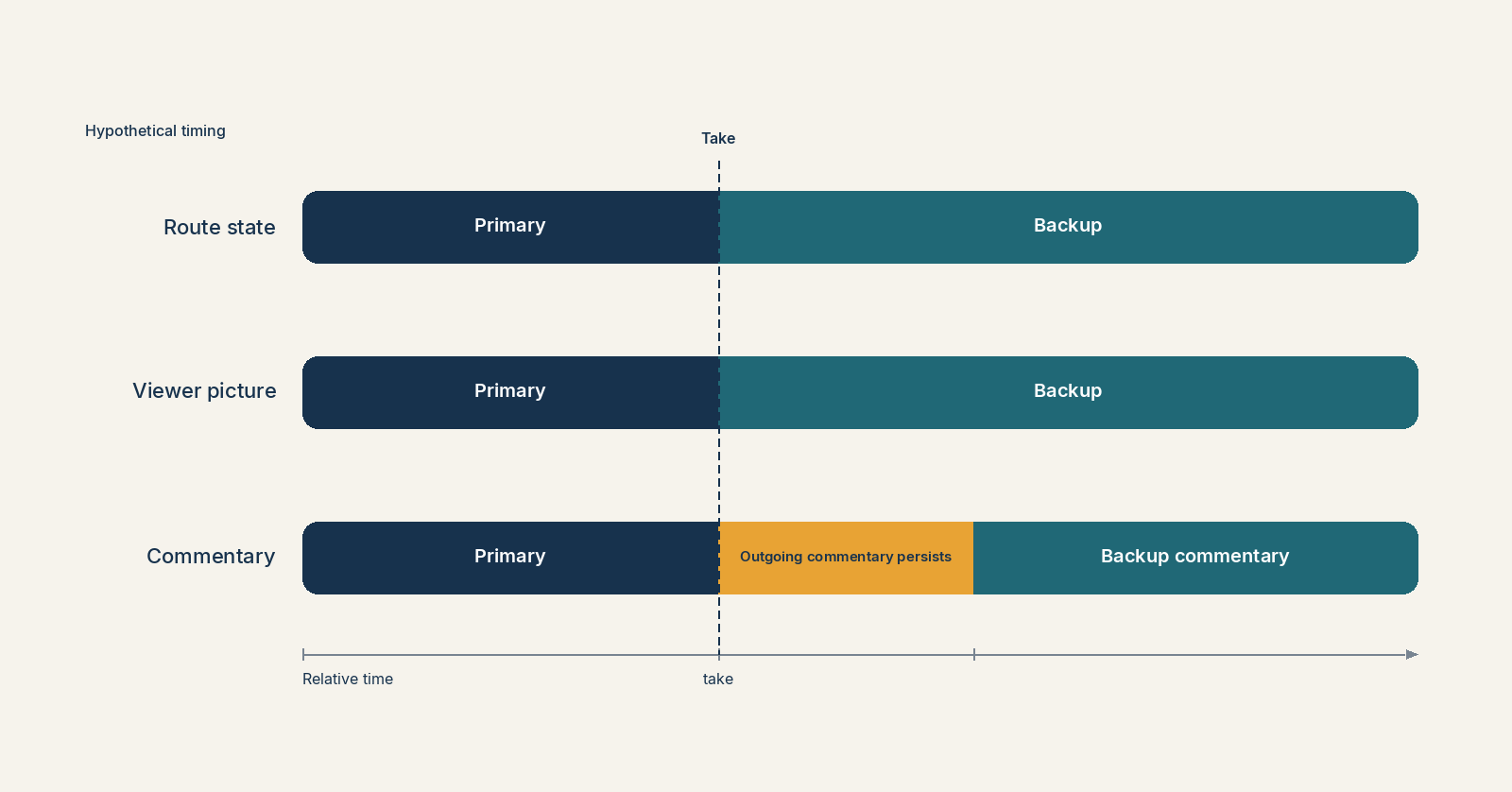
In a rehearsal, master control takes a backup world feed. The picture changes cleanly. The English commentary stays on the outgoing source and the score graphic jumps backwards. An input monitor shows both feeds healthy. To find the fault, engineering needs the intended transition, the router’s actual state and an independent recording of what went to air.
Why it matters. Most preflight tests inspect feeds in steady state. A live switch changes which sources, audio channels, captions and graphics must agree at the same moment. Build acceptance tests around the transition itself, then repeat them at the program output and at an outlet that can alter the viewer experience.
What should a switch record prove?
Capture the command and the output on a shared time reference. Keep a short recording from before the take through stabilization. Log the intended source and audio map, the command time, the observed route activation and the first correct output frame. Include the first intelligible commentary after the take and the timestamp of the first caption cue corresponding to the new source, when applicable. A record with both control and media evidence can distinguish late activation from a correctly timed switch to the wrong bundle.
For synchronous baseband video, SMPTE RP 168 defines the vertical-interval switching point and area. In an NMOS plant using IS-05, the specification distinguishes staged connection settings from active settings and describes scheduled activation. Use the applicable mechanism to prove the routing state, then inspect the output for evidence of actual media recovery. SMPTE RP 168-2009 · AMWA IS-05 v1.1.2 behavior specification.
Which transitions deserve their own acceptance tests?
Rehearse changes that alter what the audience is supposed to see or hear.
- Live to replay and back. Verify the replay identification, intended replay audio and return to the current action. Hold a clip long enough to expose stale graphics, then confirm the live score and clock recover together. Keep a reference recording with the expected transition marked.
- Commentary or regional handoff. Listen to the selected program pair and inspect the associated captions. On a rights-restricted outlet, run the approved substitute before, during and after the boundary. Verify an unrestricted outlet in parallel so the restriction does not spread to the wrong audience.
- Backup take and return. Make the primary fail in rehearsal while the backup is already verified. Compare the outgoing and incoming audio for a mute, pop, level jump or wrong channel mapping. Repeat when the primary returns. A good backup take and a bad return are separate results. For facilities following R 128, use their applicable audio delivery profile and the EBU’s production guidance when setting levels and measurement practice. EBU Tech 3343, November 2023.
How should the crew score the rehearsal?
Grade each outlet against its own planned change. Log switch-to-correct-picture time, switch-to-correct-audio time, wrong-source duration and any caption or graphics carryover. Where deployed, AMWA’s NMOS monitoring practices provide receiver-side status and stream validation that can help localize a fault. Use independently decoded output to verify the audience experience. AMWA, device monitoring and BCP-008, June 2025.
Set tolerances by transition and outlet. An intended dissolve, a blackout substitution and a hard emergency cut have different expected pictures. Carry player buffering in the outlet’s time budget and keep it separate from the switcher’s own activation timing. Use the multiview sports sync guide if the audience can choose among concurrent angles. At the next rehearsal, deliberately swap one commentary pair and require the crew to identify the first incorrect observation before clearing the event.