
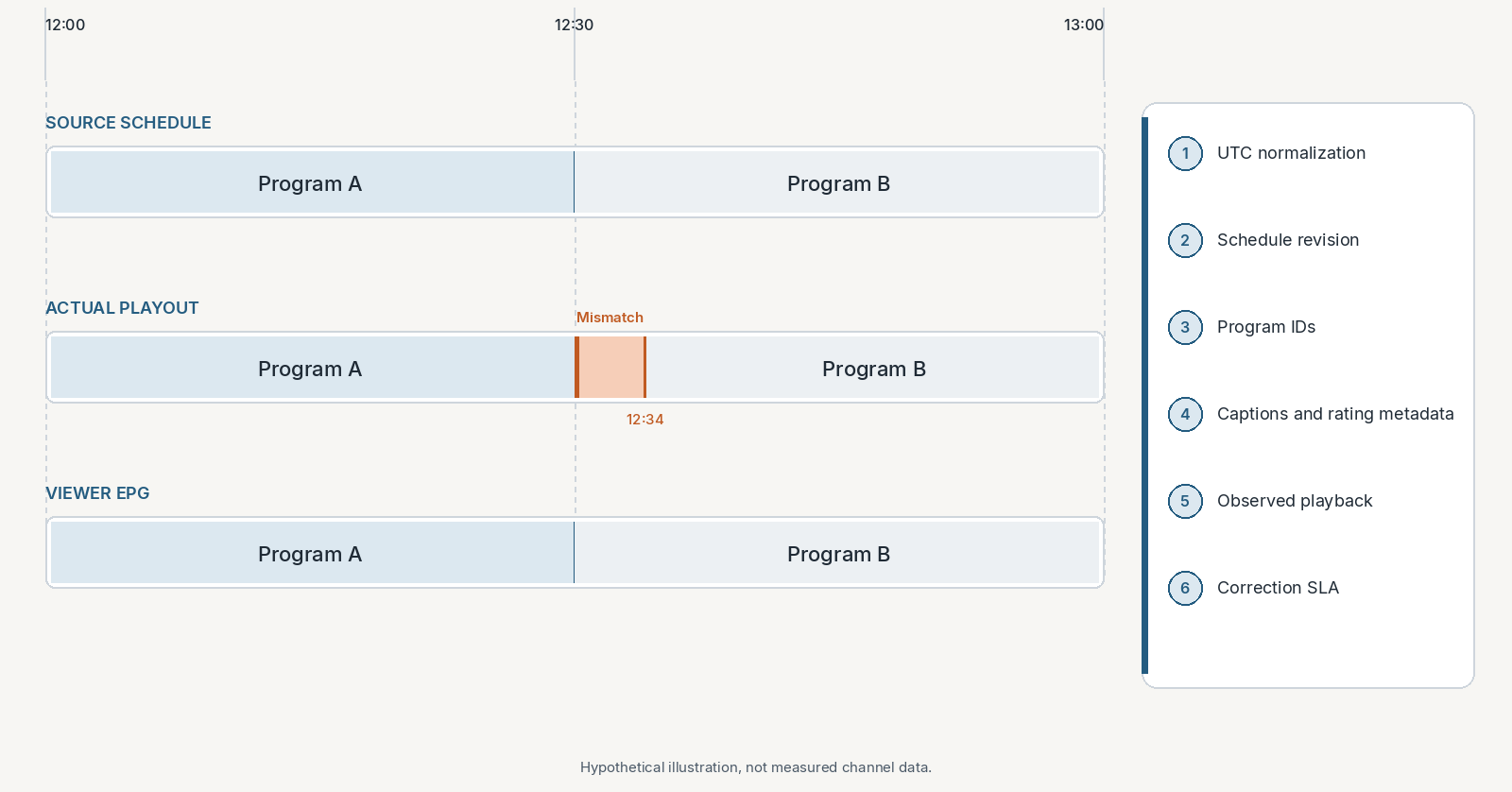
A FAST channel can deliver flawless video while its electronic program guide names the wrong show. The fix is to reconcile the schedule, the platform feed and what actually played, not just monitor stream uptime.
The invisible distribution fault
A viewer opens a FAST guide, selects a film and gets the last four minutes of the previous program. The stream is healthy. The program guide is not. This hypothetical failure illustrates a real operational class: the electronic program guide (EPG) and playout timeline can diverge without triggering conventional video or transport alarms. Roku's EPG requirements show why guide data is an operational deliverable, not a cosmetic overlay. For eligible channels on The Roku Channel, Roku specifies at least seven days of future schedules and one day of history, with program durations from 15 minutes to four hours. It also asks partners to avoid changes within 48 hours of airtime. Those are platform-specific rules, not universal FAST standards. The Roku linear ingest specification likewise calls for eight days of data, covering a week forward and 24 hours back. An ingest feed can pass schema validation yet still disagree with the current playout sequence.
Why it matters
A mislabeled guide can undermine discovery and the promise made at click time. It can also put the wrong content rating, episode identity or closed-caption indicator beside a program. These are operational risks, not evidence of any particular platform's failure. The scheduling engine and guide publisher may have different clocks, caches, revision cycles and ownership. AWS's MediaTailor program transition API illustrates a subtle source of divergence: absolute start times can truncate a preceding program at a common segment boundary, while gaps can play configured filler slate. A guide generated from an earlier schedule version would not necessarily reflect those actual transitions. A channel therefore needs a third record besides planned schedule and submitted EPG: the observed program at the viewer-facing output.
Six acceptance checks for FAST operators
1. Normalize the clock. Convert all guide and playout times to UTC before comparison. Test midnight boundaries, daylight-saving transitions and territory-specific schedules. Preserve original time-zone information for diagnosis. 2. Reconcile program IDs, not only titles. Compare canonical asset, episode and station identifiers across traffic, playout and distributor feeds. Two episodes of the same series may share a display title while carrying different ratings or rights. 3. Compare planned, delivered and observed timelines. Capture the schedule revision sent to the platform, its acknowledgement where available, and actual program transitions at output. Record start and end deviations, including filler, overruns and early cutovers. The tolerance should be explicitly agreed with each distributor rather than invented as an industry-wide threshold. 4. Test last-minute changes. Rehearse a breaking-news insertion, a live sports overrun and a canceled program. Confirm which systems regenerate the guide, how quickly the distributor ingests revisions and what viewers see during propagation. A 48-hour change recommendation may be incompatible with genuine live programming, so escalation paths matter. 5. Validate descriptive metadata. Check ratings, caption flags, episode numbers, artwork, language and territories against the actual asset. Roku's Live Search guidance also makes clear that channel discoverability can depend on external station identifiers such as Gracenote IDs. EPG completeness and search eligibility are related but distinct integration tasks. 6. Monitor the viewer's guide. Test the actual connected-TV interface on supported devices and regions, not just a feed URL. Look for stale caches, wrong current-program labels, mismatched thumbnails and guide selections that start the wrong content. Document how an operator can request correction and verify it has propagated.
A practical ownership model
Assign one authoritative schedule owner, one feed-publishing owner and one person responsible for observed-output reconciliation. Every discrepancy should include channel, territory, platform, program ID, UTC timestamp, expected and observed title, feed revision and a screenshot or playback evidence where permitted. Do not let a healthy HLS manifest close an EPG incident. Playback availability, metadata correctness and program identity are separate service dimensions. An effective FAST acceptance report shows all three and records who can correct each one. For further context on end-user validation beyond source health, see Amira Labs' published SRT/RIST contribution-feed acceptance guide. The transport problem differs, but the evidence principle is the same: inspect the delivered outcome. Hero credit: Original Amira Labs editorial diagram. Hypothetical schedule mismatch, not actual platform or customer data. *Primary references: Roku EPG guidance; Roku linear ingest specification; AWS MediaTailor transitions; Roku Live Search feed. Documentation checked November 5, 2026.*