
An HDR feed can remain technically healthy while its SDR conversion washes out highlights or crushes shadows; engineers need to test the actual pixels, metadata and downstream displays.
Live HDR production often needs to serve SDR outlets at the same time. That conversion is not merely a label change. An apparently healthy encoder, clean transport stream and valid manifest can still deliver faces that look flat, stadium lights that clip, or graphics that lose contrast.
Why it matters: The audience judges the decoded picture, not whether the stream passed packet checks. An HDR-to-SDR fault can be introduced by source identification, conversion settings, a lookup table, output signaling or playback interpretation. Treating all of these as an encoder problem wastes time and risks a bad on-air fix.
What the standards and implementations actually say
The ITU's Report BT.2446 (2019) describes tone mapping as the process of fitting a higher dynamic range into a lower one. Different mapping methods can produce different visual results. This is a picture-quality decision, not just a container-format decision.
AWS MediaLive's color-space documentation makes an important distinction: converting the actual pixels and changing the metadata are related but separate operations. MediaLive uses source metadata to determine conversions; it does not independently inspect the image to establish that its declared color space is truthful.
The implementation has codec-specific behavior, too. AWS documents that HDR10/HLG-to-SDR conversion with H.264 depends on enhanced video-quality settings, while H.265 follows a different path. An operator should not assume the same channel configuration behaves identically across every output.
Six acceptance checks before trusting the SDR feed
1. Establish the actual source format. Record whether the contribution feed is HLG, HDR10 or Rec. 709, including the transfer characteristics and mastering metadata where applicable. Compare declared values against the source handoff specification. A mislabeled source can drive a mathematically valid but visually wrong conversion.
2. Test the conversion, not just the output label. Verify that pixel values have actually been transformed for SDR. A Rec. 709 tag on unconverted HDR pictures does not create a correct SDR image. Capture decoded output and compare it with an approved SDR reference on a calibrated monitor.
3. Exercise difficult scenes. Include floodlights, bright jerseys, saturated graphics, dark crowd shots, skin tones and transitions. A test pattern alone cannot show whether the chosen tone mapping preserves useful creative detail during real programming.
4. Check metadata at every handoff. Compare source identification, encoder output signaling and the decoded destination. AWS describes input override and fallback settings, but forcing metadata is safe only when the operator knows the source format. Do not use a forced Rec. 709 label to conceal uncertainty about the pixels.
5. Validate LUT selection and changes. Where a 3D lookup table is used, confirm that it matches the exact source-to-output conversion and intended luminance range. AWS notes that its conversion configuration can select a LUT for a matching combination and otherwise use standard conversion. Record the active LUT version so a rollback is possible.
6. Inspect real SDR endpoints. Test the production monitor, a representative broadcast decoder and at least one consumer playback path. Look for clipped highlights, raised blacks, unnatural skin tones and unreadable graphics. Compare a live cut, a replay and a source switch, not only a steady studio shot.
The operational lesson
The strongest monitoring design separates three questions: Did the source identify itself correctly? Did the processing chain perform the intended transform? Did the viewer receive an acceptable SDR image? These are distinct fault domains, and each needs its own evidence.
For master control, a useful incident record contains source format, output format, conversion configuration, a timestamped decoded frame, the affected distribution path and the last known good configuration. For engineering, a controlled HDR/SDR test clip should become part of change acceptance whenever encoders, LUTs or packagers are updated.
A practical next step is to build one repeatable HDR-to-SDR acceptance sequence using the six checks above and require it before the next live-event profile change. That is more defensible than relying on a green stream-status indicator.
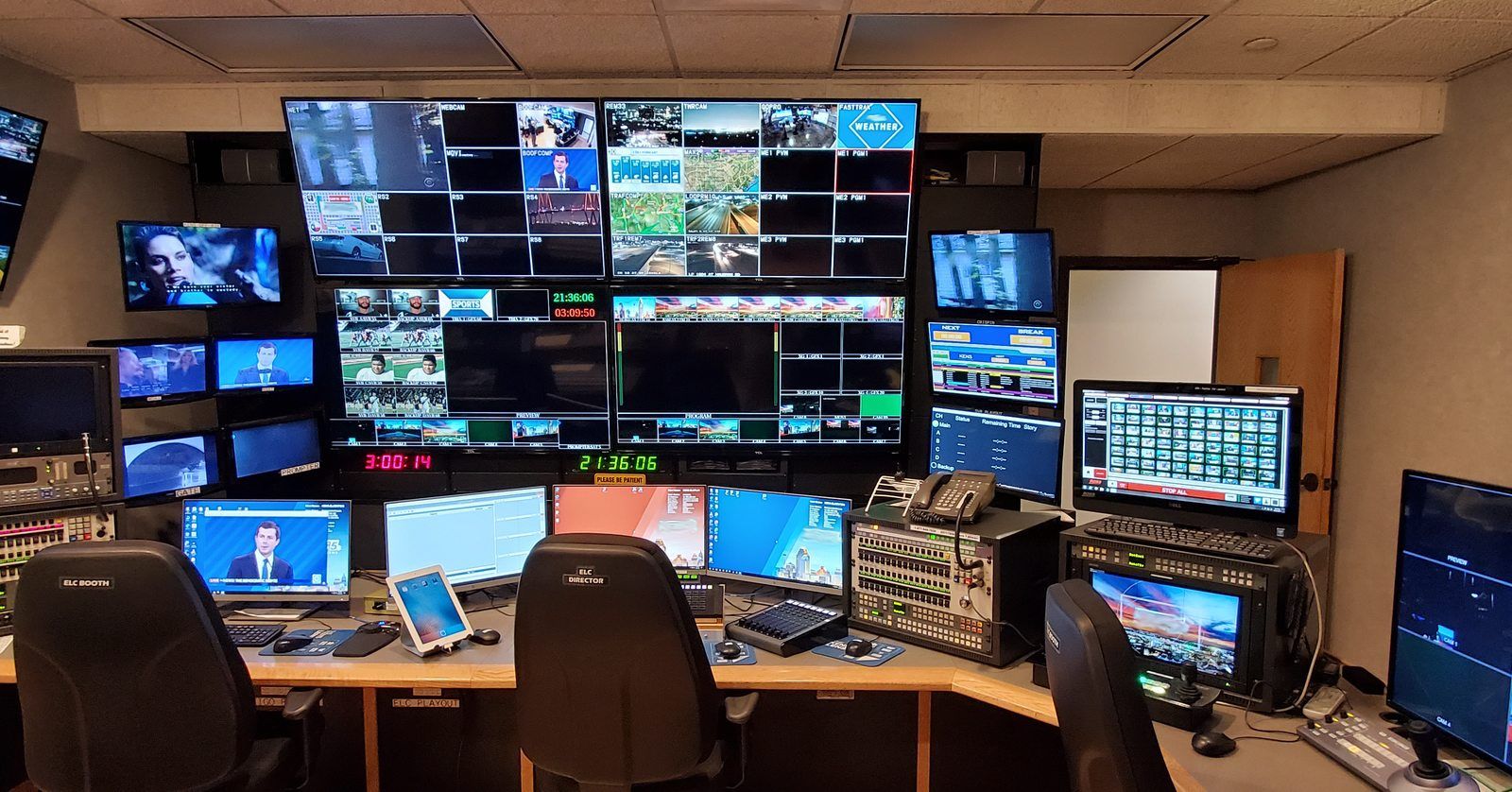
Photo: TV Station Control Room by Bluedisk. Archival illustration. Cropped and JPEG-encoded. CC BY-SA 3.0 applies to this derivative.