
Dek: A live 5.1 feed can pass transport and loudness checks yet lose its dialogue when channel order or downmix settings produce the wrong stereo output.
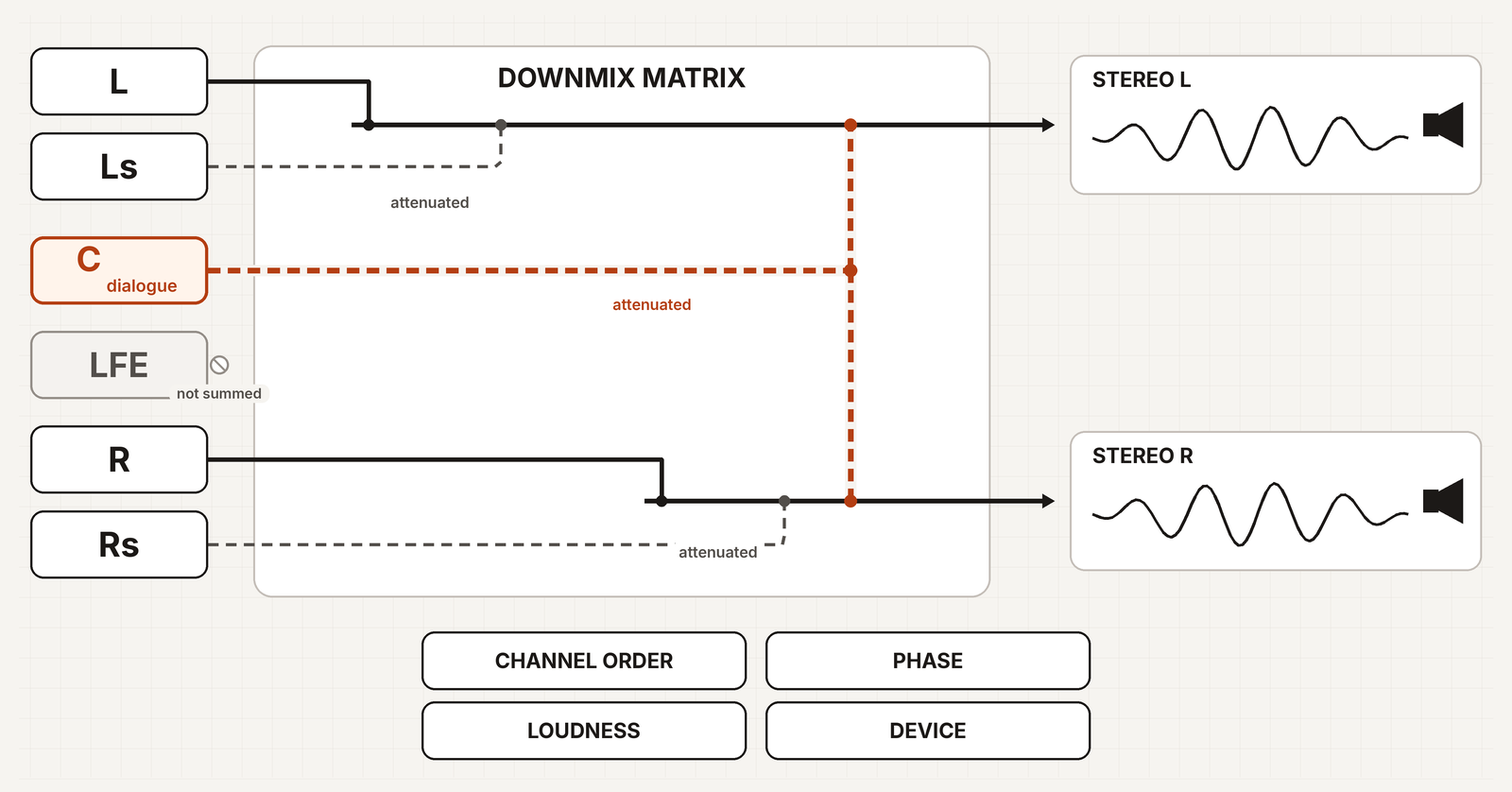
A broadcast operator hears effects and music on the stereo confidence monitor, but the presenter sounds distant or disappears. The incoming surround service is still on air. Its audio PID exists, the encoder reports healthy, and a loudness meter continues to move. The fault may be a channel-order mismatch or an incorrect downmix rather than missing audio.
Why it matters
Stereo remains an important playback path even when production delivers 5.1. A broadcaster may distribute a multichannel source to television, mobile, web and third-party outlets that each choose or create a stereo rendition. A clean 5.1 contribution feed therefore does not prove a usable stereo experience.
In an AWS engineering walkthrough published in 2024, the example problem is a swapped center and LFE channel. The article demonstrates a channel-remapping correction and gain adjustment. It is an illustrative configuration example, not evidence of an industry-wide incident.
AWS's MediaLive audio mixing documentation describes pre-mixing selected tracks or PIDs and separately remixing the output layout. Those are two distinct points at which an operator can change what each output channel contains.
Six acceptance tests
1. Identify the physical channel order. Use a known, licensed channel-identification test sequence and verify each speaker position independently at the source, encoder input and decoded output. Do not assume that six channels automatically mean the same L, R, C, LFE, Ls, Rs ordering at every handoff.
2. Isolate the center channel. Feed dialogue or a center-only test signal and confirm it contributes to both stereo outputs at the expected relative level. Then test the LFE separately to expose an accidental center/LFE swap. Keep test signals off the live service unless the operation explicitly authorizes a controlled test.
3. Inspect the matrix, not just the channel count. Compare the configured source indices and gains against the approved downmix policy. MediaLive's API reference documents per-output-channel input levels and remix settings. A six-to-two conversion can be technically valid while producing the wrong mix.
4. Check phase and mono compatibility. Use a correlated stereo test and listen to a mono fold-down. An out-of-phase contribution can cancel when summed even when separate left and right meters look healthy. Record the test source and the decoder used so a later engineer can reproduce the result.
5. Measure loudness after conversion. Measure integrated loudness, true peak and dialogue intelligibility on the actual stereo rendition, not only on the surround source. A downmix changes channel contributions, so the downstream result needs its own acceptance measurement. Do not treat one loudness reading as proof that dialogue is present.
6. Validate the advertised audio rendition on devices. The HLS specification, RFC 8216 (August 2017), defines audio rendition signaling and the CHANNELS attribute. Confirm the declared layout agrees with the delivered media, then listen on representative televisions, headphones and mobile devices. Repeat after switching language, audio format or bitrate where those choices are supported.
What the incident record should capture
Store the incoming PID or track identity, declared language and layout, actual channel-order test result, downmix matrix revision, output codec, device tested and the first timestamp of audible failure. Capture both pre- and post-remix audio samples where rights and retention rules allow. The evidence should tell the next shift whether the source was wrong, the remix was wrong or the player selected an unexpected rendition.
This is an engineering acceptance procedure, not a claim that any named broadcaster or encoder has failed. Thresholds and downmix coefficients must come from the service's approved audio specification, not a universal example copied into production.
Bottom line: A green audio PID and a moving meter are availability indicators. They cannot certify that viewers can understand the dialogue. Test the channel identity and decoded stereo output together.
Image credit: Original Amira Labs editorial engineering diagram, November 9, 2026. Conceptual six-to-two downmix, not a depiction of a real broadcast facility. Rendered from original editorial specification.