
A live contribution connection can remain established while recovered packets arrive too late to save the picture. These six tests help broadcasters distinguish transport health from usable output.
Why the green connection light is insufficient
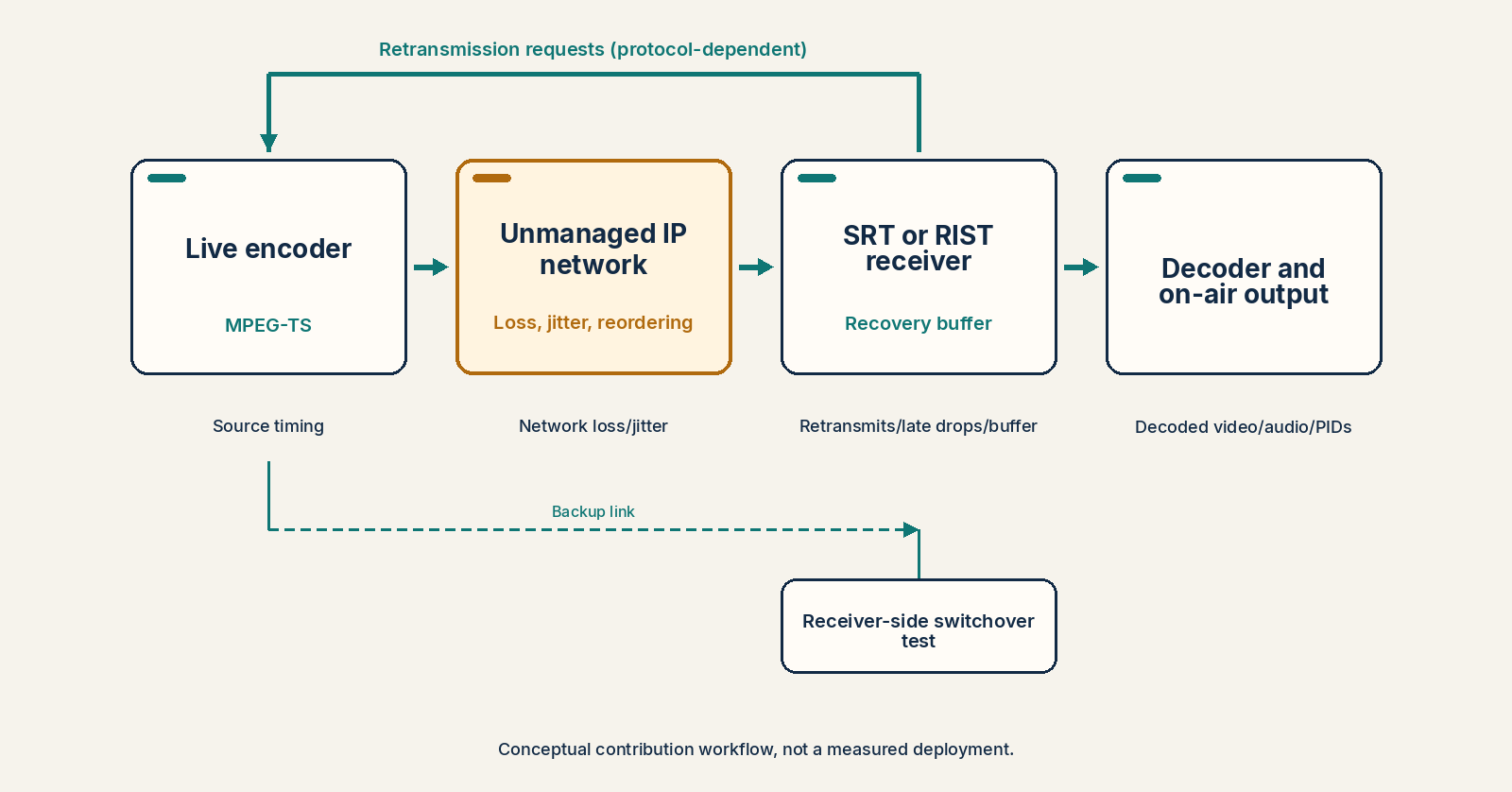
SRT and RIST make IP contribution more resilient to packet loss, but neither protocol turns an unpredictable network into a guaranteed broadcast service. A receiver may remain connected while its recovery window is overwhelmed, or while a decoder sees damaged video, missing audio or stale timing.
This is an evergreen engineering field note, not a report of a newly discovered outage. The question for master control and sports operations is straightforward: did the intended program reach the output, intact and on time?
SRT's maintainer documentation on socket statistics distinguishes packet loss, retransmissions, receive statistics and instantaneous network measurements. Those measurements are useful but not equivalent to verifying decoded media.
The SRT Cookbook's latency-negotiation guidance explains that configured peer and receiver latencies interact, with the negotiated value determined by both endpoints. An operator should inspect the negotiated result, not assume the setting entered on one encoder is what the receiving service uses.
For RIST, the RIST Forum's profile description identifies ARQ loss recovery, jitter handling and link aggregation in its Simple Profile. Capabilities still need to be checked against the exact vendor implementation and profile in use.
Six acceptance tests that expose hidden faults
1. Establish a clean baseline. With an authorized reference feed, record source bitrate, codec, audio and subtitle PIDs, clock behavior, end-to-end delay and output decode errors. Preserve receiver statistics over defined intervals, not only lifetime counters.
2. Introduce bounded packet loss. In a lab or staging path, inject controlled random and burst loss. Compare lost, retransmitted, recovered and too-late packets with actual output defects. Repeat at representative peak bitrate. The goal is to find the operating boundary, not a flattering average.
3. Exercise jitter and reordering. Vary delay and reorder packets without necessarily dropping them. Confirm the recovery buffer tolerates the agreed network envelope. Record the first point where audio or picture continuity degrades.
4. Verify the real latency budget. Compare configured and negotiated SRT latency where applicable, then measure glass-to-glass or encoder-to-decoder delay. A larger buffer may improve recovery but can make a live interview or sports return path operationally unusable.
5. Break the active path. Disconnect the primary WAN link or terminate the contribution session in staging. Observe failover detection, backup activation, return-to-primary behavior and any repeated frames or silence. RIST link bonding and SRT deployment-level redundancy are not interchangeable features; verify the actual configured design.
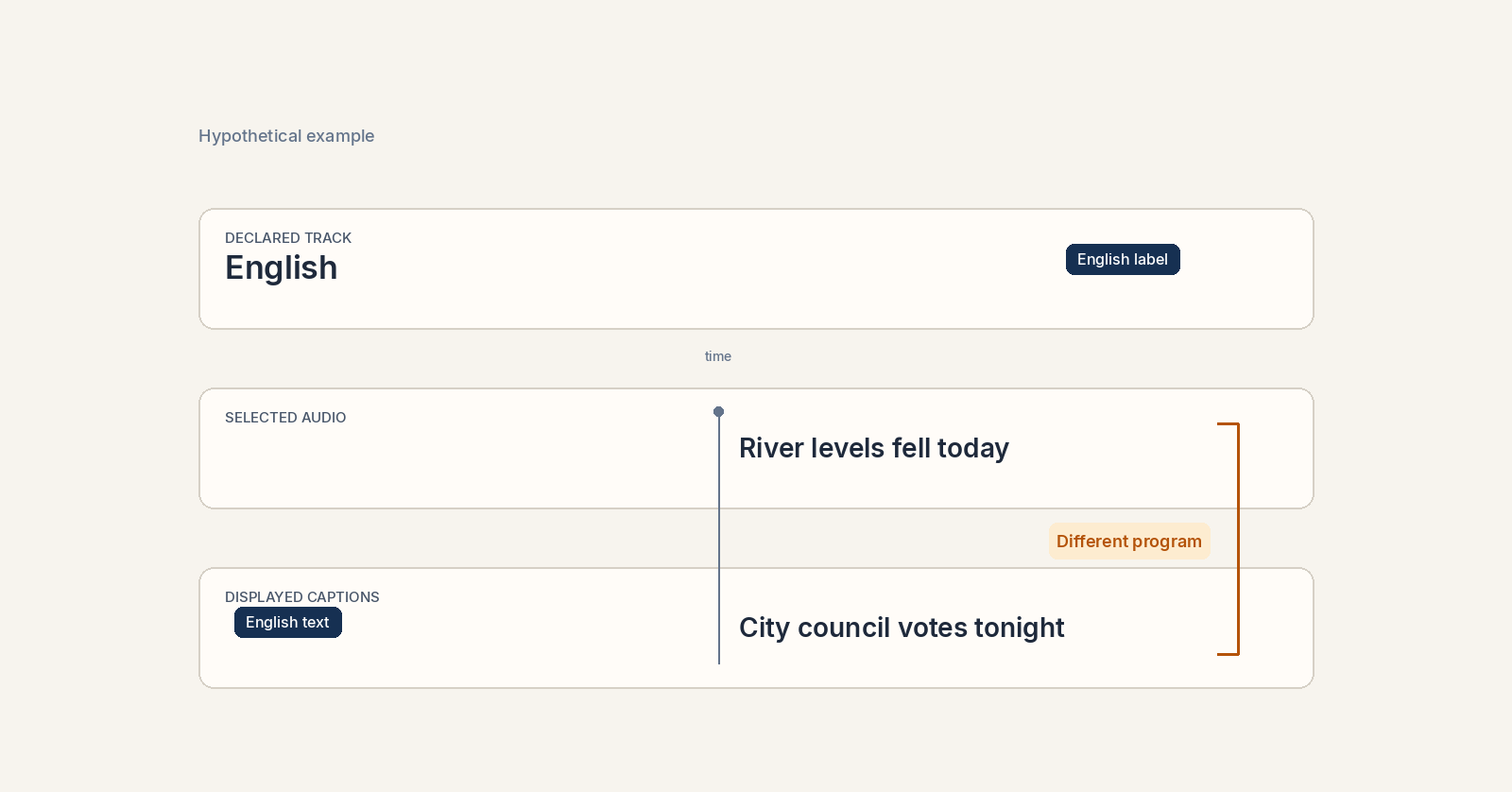
6. Check media after recovery. Inspect decoded video, audio channel mapping, language PIDs, captions where present and timestamp continuity after each impairment. A recovered packet counter does not prove the correct program or audio language is on air.
What to retain when a feed fails
Capture sender and receiver versions, protocol/profile, negotiated latency where available, bandwidth limits, packet-loss and retransmission counters, clock synchronization, a time-aligned impairment log and a recording of the decoded output. Note which observations are endpoint metrics and which are independent media checks.
The 2021 SRT protocol Internet-Draft describes retransmission and latency mechanisms, but it is an expired draft, not an approved IETF standard. Use the deployed implementation's current documentation as the operational authority.
For procurement, ask the vendor to demonstrate a live recovery test at your target bitrate and delay, then show what alarms an operator receives when recovery no longer protects the output. Require a failure recording, not only a dashboard screenshot.
The acceptance decision
A transport passes commissioning when it carries the intended program through the agreed impairment and failover envelope, with documented delay and recoverable fault evidence. A connected socket is only the first checkpoint.
Image credit: Original Amira Labs technical diagram, November 4, 2026. Conceptual illustration, not a depiction of a real deployment. No third-party image assets.
Sources: SRT statistics; SRT latency negotiation; RIST profiles; SRT Internet-Draft, 2021, expired.