
Give each test break a known outcome so FAST teams can separate cue loss, decision failure and a broken splice before they count a missed opportunity.
On a free ad-supported streaming TV channel, a player reaches a scheduled break and shows thirty seconds of slate. Playback looks continuous. The same result could come from a normal no-fill, a late ad decision or a valid ad whose media was never ready to play. Test one failure at a time and capture the first artifact that differs from a clean run.
Why it matters. A slate count describes what a viewer saw. It cannot tell ad operations where to fix the loss or how many billable impressions were missed. A controlled break test can identify where a cue or decision stopped producing the expected result without sending test traffic to a live campaign.
What does a clean test break establish?
Create a predictable break in a nonproduction feed and use a controlled ad response. Pick one output and a fixed-duration house creative with a visible marker. Record the expected start and return, the origin playlist at the break, the decision request and response, the personalized playlist and a player capture. Join the artifacts using outlet, break time, cue identifier where available, and session or request ID. Keep both the source media time and the capture clock so a timestamp mismatch is diagnosable.
RFC 8216 describes how SCTE-35 splice information can be mapped into HLS date ranges. AWS MediaTailor also documents several supported HLS marker forms. Verify the form accepted by the specific server-side ad insertion (SSAI) stitcher at its actual origin input. The presence of an upstream SCTE-35 cue only proves it reached that probe. RFC 8216, August 2017 · AWS MediaTailor HLS ad markers, checked November 5, 2026.
Which fault should you inject first?
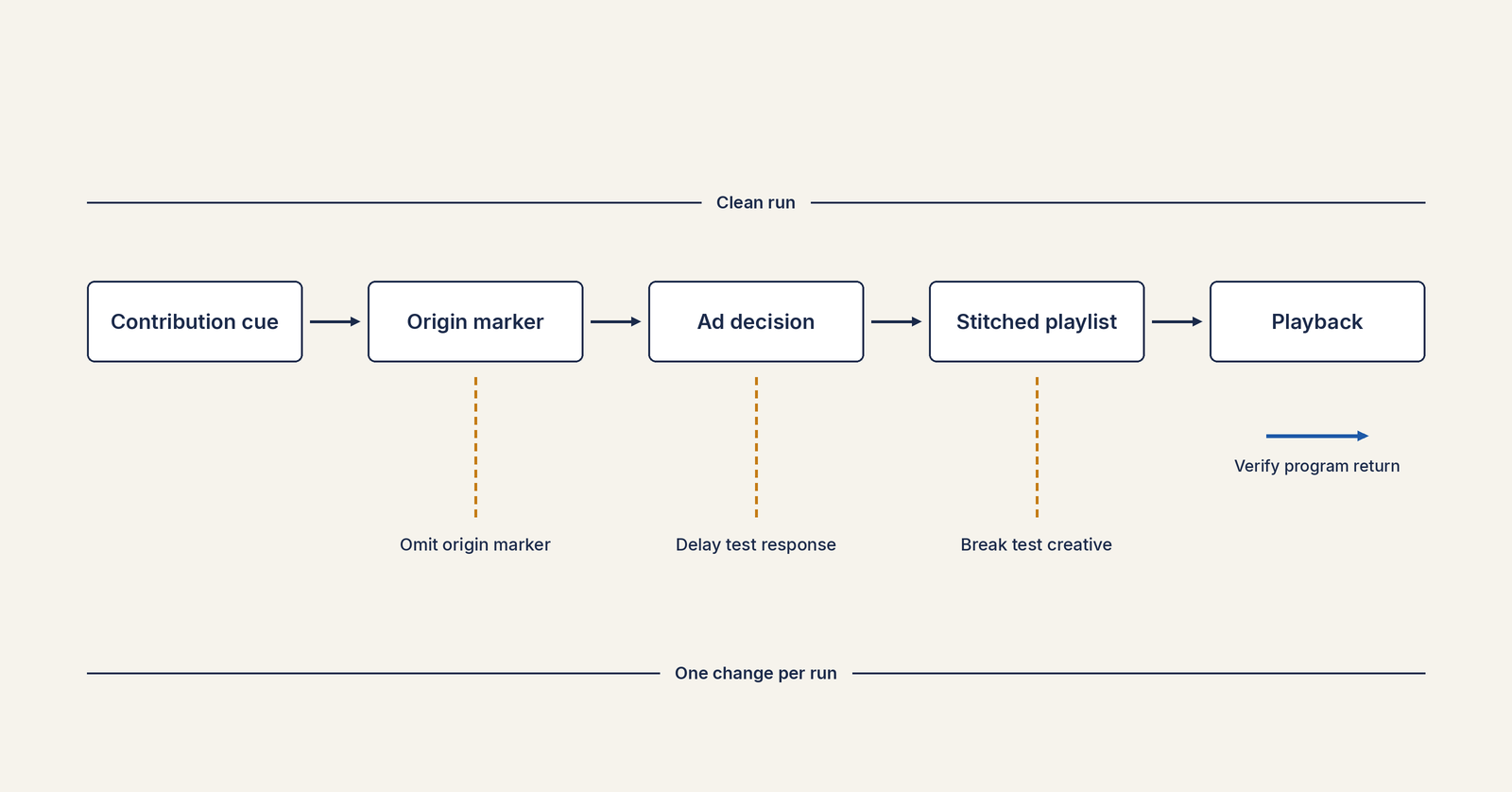
Change one stage per run and keep the rest of the fixture fixed.
- Cue disappears in packaging. Keep the splice signal at contribution and omit its corresponding marker from the origin playlist in the test. Compare the contribution capture with the playlist and confirm whether the expected decision request was absent. This isolates cue translation from demand.
- Decision returns empty or too late. Leave the marker intact. Run an intentional no-fill response and a delayed response as separate cases. Compare the logs, decision latency and player outcome. Confirm which fallback each case actually takes. MediaTailor documents different insertion behaviors depending on the configuration, including how available ad time is filled. AWS MediaTailor ad insertion behavior, checked November 5, 2026.
- A chosen ad fails downstream. Return a controlled creative and introduce a missing media asset or a deliberately incompatible test encode. Determine whether the failure first appears during creative preparation, playlist assembly or device playback. Check the first program segment after the break for a gap, repeat or delayed return.
What should count as proof?
Require evidence from the playback session and the measurement path. Compare observed start and return against the fixture, then compare the tracking events expected for that configuration. IAB Tech Lab’s VAST 4.3 specifies separate impression and tracking elements and discusses tracking in server-side insertion. Verify which component sent the event and what triggered it before treating the request as playback evidence. IAB Tech Lab, VAST 4.3, December 2022.
A controlled fixture isolates faults for its particular stitcher, playlist variant and device. Expand to other combinations after the baseline is reproducible. Use the live ad-break verification guide for wider outlet coverage. This week, give engineering and ad operations the same replay bundle and ask each to locate the first divergent artifact. If they pick different stages, tighten the capture before widening the test.