
Dek: SCTE 35-2 adds event-based signaling to a familiar live ad-break workflow, but operators must verify what survives packaging and what viewers actually receive.
A new cueing format does not automatically make a live ad break more reliable. SCTE 35-2 introduces an event-based signaling model, but every distribution chain still has to carry, interpret and act on the intended break.
The SCTE standards catalog lists SCTE 35-2 as a 2026 standard. The SCTE 35-1 catalog description explains that the legacy standard was renamed Part 1 and that Part 2 adds an EventDescriptor to TimeSignal. That is a standards development, not proof that any named broadcaster or ad platform has deployed it.
Why it matters
A live ad opportunity crosses more systems than the cue injector: encoder, MPEG transport, packager, origin, ad decisioning, manifest personalization, CDN and player. A cue that exists at the encoder can disappear or be interpreted differently downstream.
AWS MediaPackage documentation describes how qualifying SCTE-35 input messages can become HLS CUE-OUT, CUE-IN and continuation tags. Those tags are a packaging choice, not an end-to-end confirmation that a commercial played.
The transition question for operators is therefore narrower than “Does our equipment support SCTE 35-2?” It is “Can every handoff preserve the same intended event and produce the correct viewer-facing result?”
Six tests for a controlled rollout
1. Inventory the cue contract. Record whether each upstream and downstream component expects legacy splice/time signaling, the new event descriptor, or translated HLS/DASH markers. Pin the precise supported standard editions and vendor software versions. Do not assume backward compatibility from a product's generic “SCTE-35 supported” label.
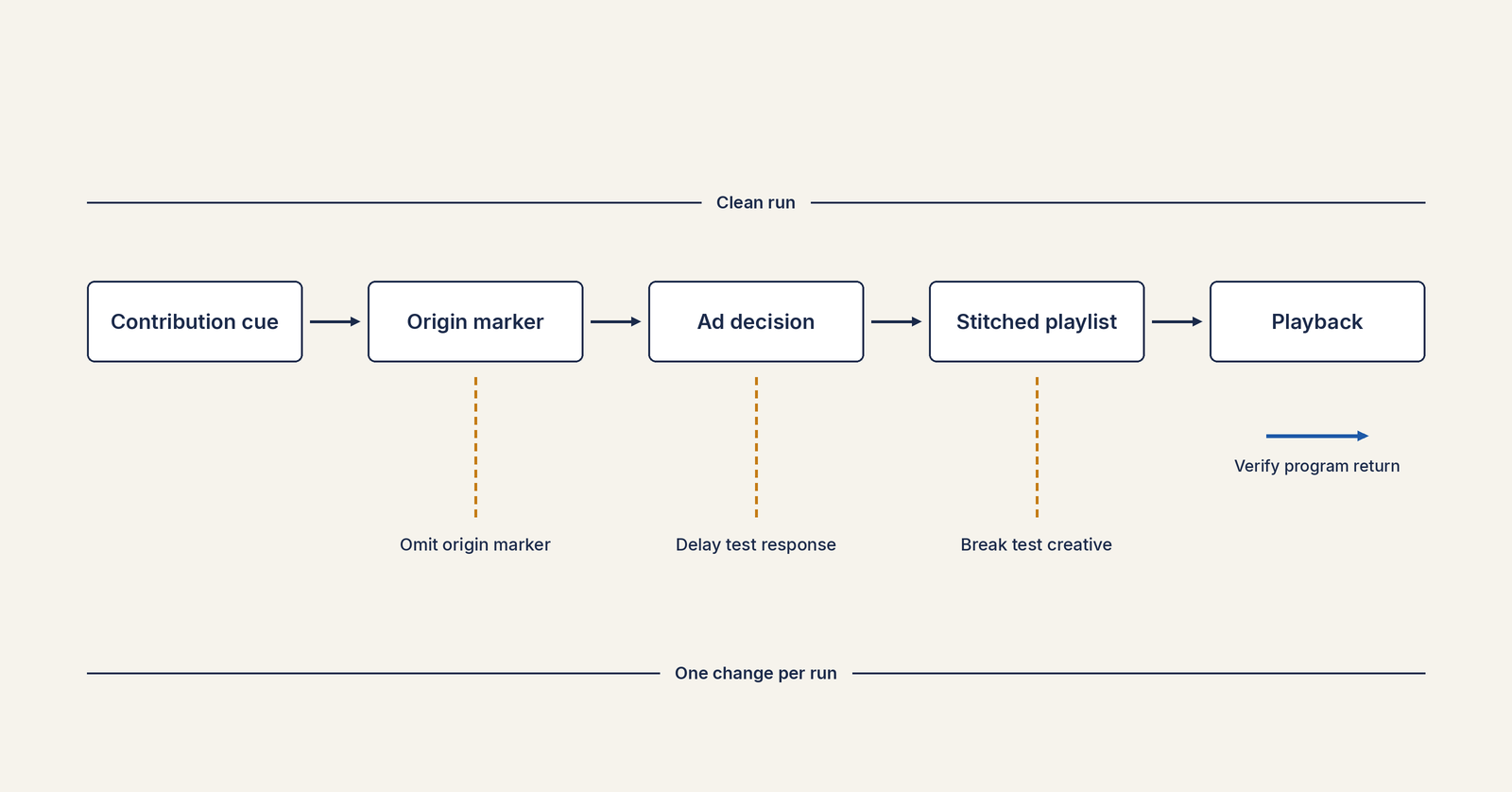
2. Preserve event identity. Inject known test events with distinct IDs, scheduled times and durations. Compare the original message with downstream signaling after remultiplexing, packaging and personalization. Log any transformation rather than treating differing representations as inherently erroneous.
3. Test trigger filtering. Confirm which segmentation or splice messages each packager recognizes. MediaPackage offers settings controlling marker type and event filtering. A valid cue can still be omitted from a particular output because of endpoint configuration.
4. Inspect personalized manifests. Fetch both origin and session-specific playlists. AWS MediaTailor's marker-passthrough guidance says personalized HLS manifests omit SCTE-35 markers by default unless passthrough is enabled. It also notes that a CUE-OUT duration can remain unchanged even if no ad is placed. A visible marker alone therefore cannot establish a successful ad impression.
5. Validate the break boundary. Force early, late, canceled and back-to-back events on a test service. Check segment boundaries, actual content replacement, audio continuity and return to program. The MediaTailor integration guide documents requirements for recognized ad markers and compatible stream representations. Treat those as platform-specific behavior, not universal SCTE mandates.
6. Observe the player, not just the playlist. Run representative device and bitrate combinations. Compare expected break start and end against decoded picture, audio and actual playback. Preserve a time-aligned capture of the origin cue, manifest response, ad decision and viewer output. If an ad fails, identify whether the cue, decision, stitching or playback failed first.
What should the acceptance report contain?
For each test, keep the source cue payload, program identifier, event ID, time base, expected duration, endpoint configuration, resulting manifest tags, ad response, decoded playback evidence and the responsible system at the first failed handoff.
A single green SCTE-35 indicator is insufficient. A stronger pass condition is that the intended break was signaled, understood, filled or deliberately left unfilled according to policy, and returned cleanly to program on supported endpoints.
The operational decision
Do not make SCTE 35-2 a fleet-wide switch based on one successful laboratory decode. Start with a representative channel, one packager configuration and one SSAI path. Publish the differences between source signaling and delivered playback before expanding the rollout.
The engineering takeaway: Cue interoperability is a chain of observable contracts. Treat each conversion as a testable boundary and each viewer session as the final evidence.
Image credit: Tony Webster, [WKBT-TV News 8 Satellite Dishes](https://commons.wikimedia.org/wiki/File:WKBT-TV_News_8_Satellite_Dishes_-_La_Crosse,_Wisconsin_(24363495350).jpg), January 27, 2016, CC BY-SA 2.0. Archival broadcast-infrastructure photo, not a depiction of SCTE 35-2 equipment or adoption. Proposed crop/resizing is an adaptation subject to share-alike and change-notice requirements; image not yet attached.