

Dek: A live HLS session can start normally and fail minutes later when authorization expires; six tests separate token policy failures from delivery faults.
A green encoder and a healthy CDN do not guarantee that a paying viewer can finish a live event. A signed URL or cookie may authorize the opening playlist, then expire before the next media request. The player can show a spinner while every upstream video metric remains normal.
Why it matters
Streaming operations often divide responsibility among identity, application, CDN and video teams. Authorization is an additional dependency that should appear in the incident runbook. The operational question is not merely whether a subscriber can press Play. It is whether the session can survive the full program, an interruption and an entitlement refresh.
AWS's CloudFront private-content guidance documents time-limited policies for protected objects. Its signed URL versus signed cookie comparison recommends cookies when access spans multiple files, including HLS media. These are documented platform behaviors, not evidence of a specific broadcaster outage.
Six acceptance tests
1. Cross the expiry boundary deliberately. Start a controlled session shortly before its authorized end time. Request a fresh playlist and segment on both sides of that boundary. Record HTTP status, request path, credential expiration, player behavior and whether the application refreshes authorization. Do not rely on a previously buffered segment as proof of continued access.
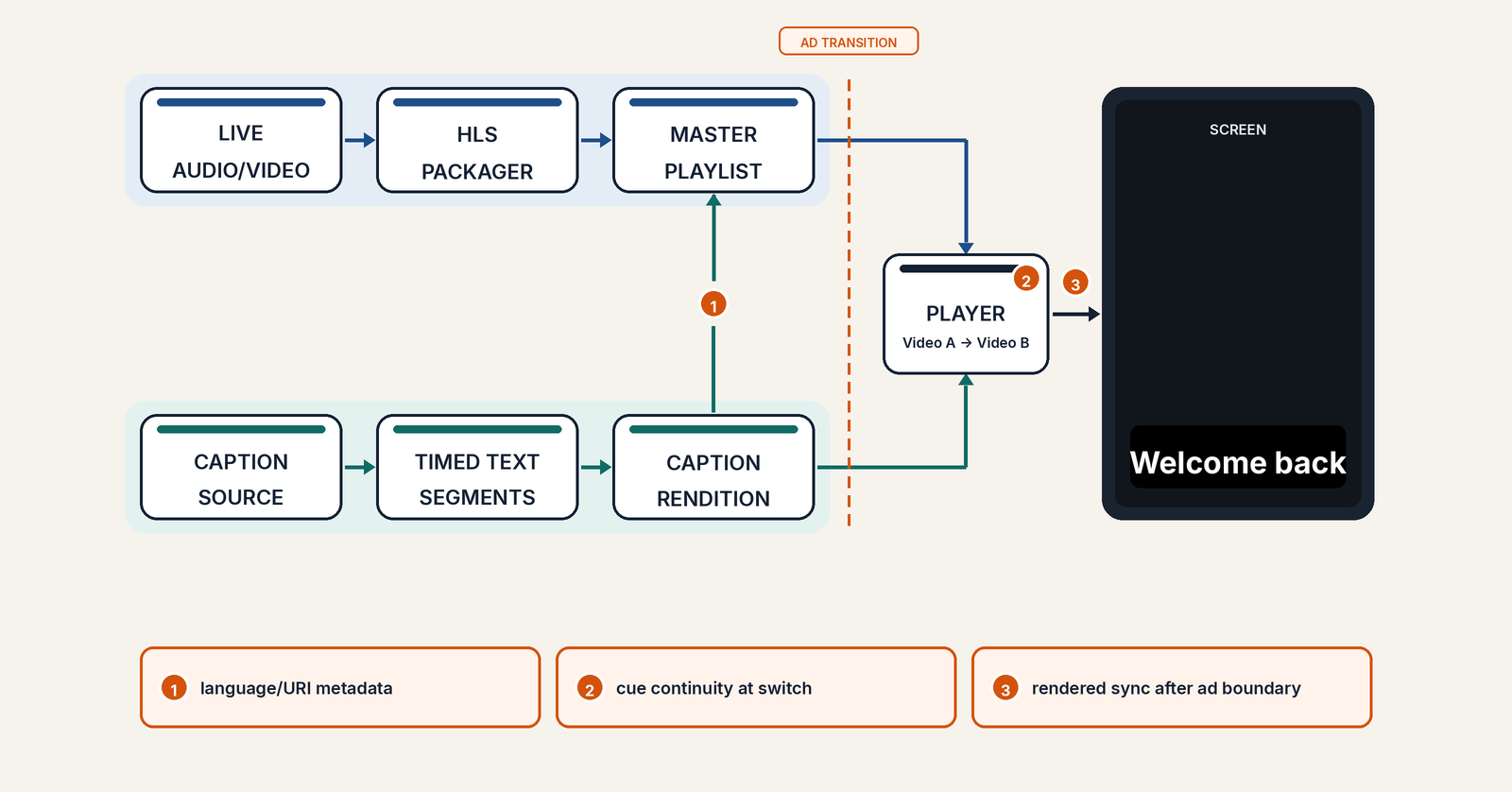
2. Verify every resource class. Test master playlists, media playlists, segments, encryption-key endpoints and subtitle playlists separately. Some deployments protect different paths with different policies. An authorized master playlist does not establish that all downstream requests are permitted.
3. Test signed URL and cookie precedence. CloudFront explicitly states that a signed URL takes precedence over signed cookies when both are present. A stale signature in a segment URL can therefore defeat an otherwise valid cookie. Inspect the actual URLs generated by packaging and personalization, not only the app's login response.
4. Rehearse refresh without restarting playback. Force a token renewal during live viewing. Test foreground playback, background/resume, device sleep and network reconnection. Measure time to first successful post-refresh segment and whether the player preserves its live position. The renewal mechanism is application-specific, so define a passing threshold before testing.
5. Separate authorization from origin failure. Compare CDN 403 responses, origin 4xx/5xx responses, connection errors and manifest parsing failures in the same incident timeline. The CloudFront signed-cookie documentation describes cookie scope and policy behavior; a denied viewer request is not automatically an encoder fault.
6. Validate revocation and security boundaries. An expired entitlement should fail predictably without exposing protected media through an alternate path. Verify signer rotation, CDN behavior selection and origin access controls. AWS's trusted key-group guidance recommends key groups for managing signing keys and explains how adding a signer changes access requirements.
What operators should collect
Build a test matrix with device, OS, application version, account state, resource path, policy expiry, refresh event, HTTP result, last decoded frame and recovery time. Correlate the player session with CDN logs while redacting tokens, signed URLs and cookies from shared tickets.
The engineering conclusion is straightforward: authorization is part of live-service availability. A complete incident record should distinguish valid content that was denied from content that was never delivered. Run the expiry-boundary test before the next high-value event, not during it.
Photo: Server racks at NOIRLab headquarters, Tucson, photographed in 2022. Credit: NOIRLab/NSF/AURA/T. Slovinský. [Source](https://commons.wikimedia.org/wiki/File:NOIRLab_HQ_Server_Racks_(6V6A0402-CC).jpg); CC BY 4.0. Archival illustrative image, not a streaming facility or outage. Proposed adaptation: center crop, resize to 1600x838, JPEG recompression and metadata stripping; attribution retained.