
Dek: ATSC's revised A/85 brings streaming delivery into its loudness guidance, making audio handoffs and metadata behavior important acceptance tests for hybrid broadcasters.
A broadcast channel can meet its audio loudness target at playout and still sound noticeably different in a streaming app. A transcoder can change channel layout, a downstream process can alter dynamic range, and a device may interpret codec metadata differently. Checking only the source loudness meter will not reveal every downstream result.
Why it matters: Broadcasters increasingly distribute the same programme through terrestrial television, OTT, FAST and connected-TV apps. A shared source does not guarantee a shared listening experience.
What changed in the guidance?
ATSC approved A/85:2026-07 on July 8, 2026. Its current recommended-practices index identifies the new edition, while ATSC's July 15 announcement says the revision expands its scope to streaming workflows, including metadata-based and non-metadata-based audio codecs. It also adds a loudness and true-peak quick reference.
This is a revision to engineering guidance, not proof that every downstream streaming platform has implemented it. Nor does publication automatically make every recommendation a legal obligation in every jurisdiction. Applicable FCC rules, distribution contracts and local requirements still need separate review.
The technical foundation remains measurement of perceived programme loudness and true-peak levels. ITU-R BS.1770-5, approved November 22, 2023, specifies the measurement algorithms. A measurement result becomes meaningful only when the team also identifies the content interval, channel configuration, processing stage and applicable target.
Where can a good source become a bad output?
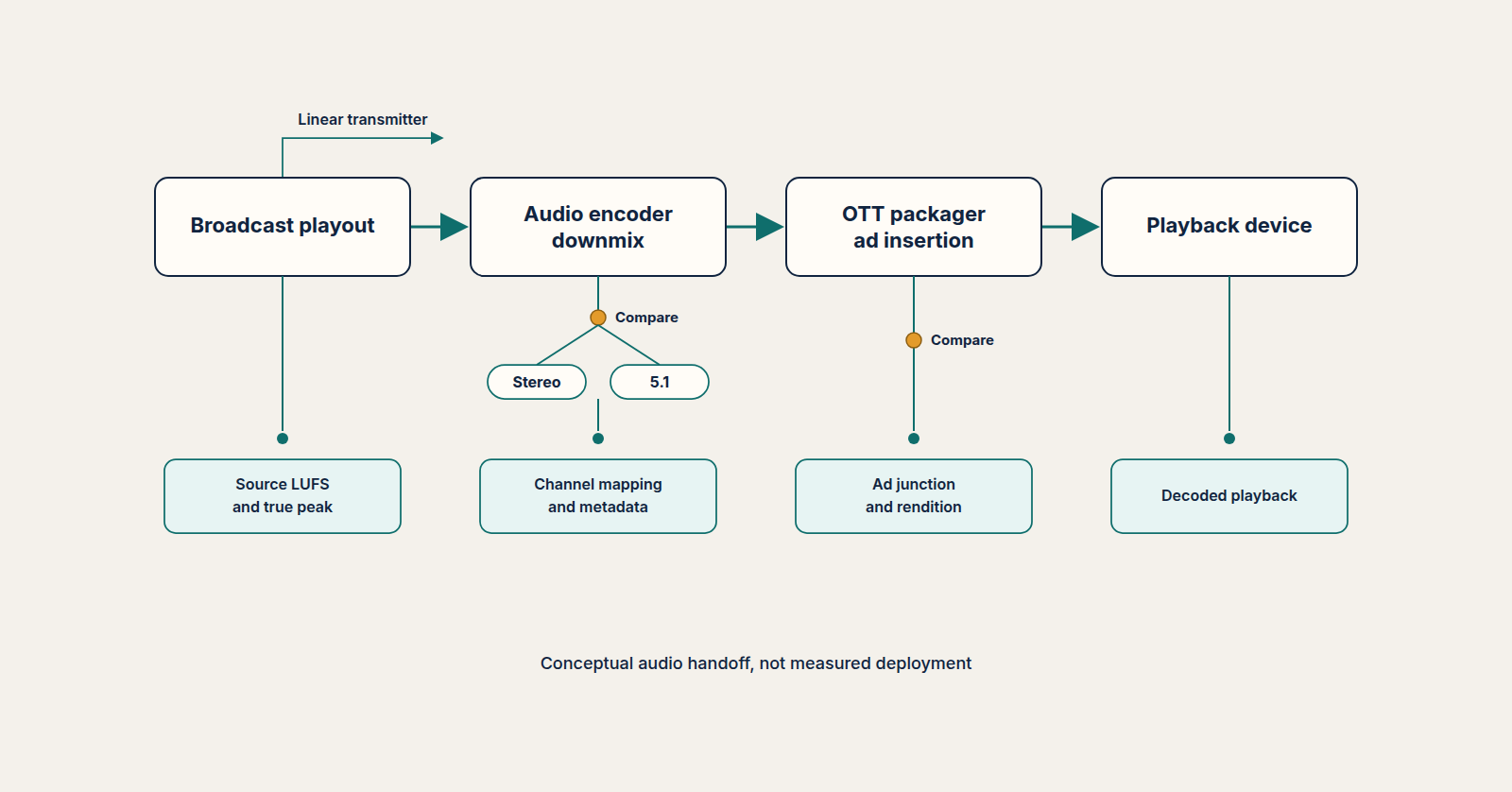
Four handoffs deserve separate checks.
1. Programme to interstitial. Measure programme, promotion and commercial material separately, then listen through the junction. A compliant long-form average does not explain every short transition. Record the source asset, junction time and downstream observation.
2. Multichannel to stereo. Verify the actual downmix after encoding and packaging. Centre-channel dialogue, surround energy and metadata-dependent gain can change the listener's experience. Do not assume that a 5.1 measurement represents the stereo rendition.
3. Linear output to streaming encode. Compare the decoded audio before and after transcoding. Capture integrated loudness, true peak, channel mapping, codec and processing settings. Distinguish a genuine audio-level change from a meter configuration difference.
4. Stream to player. Test representative devices with normal playback settings. Check volume continuity across ad insertion, content changes and audio-track selection. A server-side pass does not establish what a particular device rendered.
These are recommended acceptance tests, not findings from a measured Amira Labs deployment.
How should operators build the test?
Create a small, reproducible reference set: quiet dialogue, sports commentary, a loud promotion, a stereo programme, a multichannel programme and a transition containing an inserted ad. Record the intended delivery profile for each output.
For every item, retain the source and received audio, meter algorithm/version, measurement window, loudness, true peak, channel layout and relevant codec metadata. Use time-aligned comparisons so a failure can be assigned to a specific boundary. Keep an operator listening review alongside automated measurement.
For European services, EBU R 128, version 5.0 dated November 2023, recommends an average programme loudness of -23 LUFS. That is not a universal target for all US or streaming outputs. Document the applicable profile before defining a pass/fail threshold.
Questions for the next distribution review
Ask whether the monitoring point is before or after the last gain-changing process; whether stereo and multichannel variants are measured independently; whether the ad-insertion output is included; and whether device playback is sampled at all.
The operational takeaway is not to add another loudness meter indiscriminately. It is to place measurements at the handoffs where the audio can change, preserve enough evidence to compare them, and assign ownership for correcting the fault.
Related standard: Read the current ATSC A/85 listing before updating an acceptance checklist.
Image credit: Original Amira Labs editorial diagram specification, November 6, 2026. Conceptual architecture, not a real installation. PNG pending rendering.