
Dek: Apple's new sign-language viewing option makes accessibility a playback-quality issue as well as a content-delivery issue, with seven checks for OTT teams before viewers encounter a failure.
Apple announced on November 10, 2026 that supported titles in its TV app will offer selectable sign-language interpretation beginning Friday, November 13, alongside the premiere of Being Heumann. American Sign Language (ASL) and British Sign Language (BSL) options are also planned for F1, with Way of the Warrior Kid and Greyhound to follow later in 2026.
This is a limited-title rollout, not a new requirement that every streaming platform already meets. Apple says viewers will enable the setting, find eligible titles through an icon or search and select the interpretation during playback. Its announcement says the experience was designed and tested with Deaf and native signers. Those are specific product claims, not independently measured quality results.
Why captions are not the same product
A caption renderer is built around text cues. Sign-language interpretation communicates through movement, facial expression and body position, all of which have to remain visible at the right time. The W3C's media accessibility guidance explains why some viewers use signing, captions or both. Its WCAG 2.2 explanation of prerecorded sign language classifies that criterion at Level AAA; it does not mean every OTT service is automatically subject to a new universal mandate.
For operators, a healthy video stream and an intact caption file cannot prove that a selectable signer remains visible and in sync. The critical evidence must come from what the viewer actually sees.
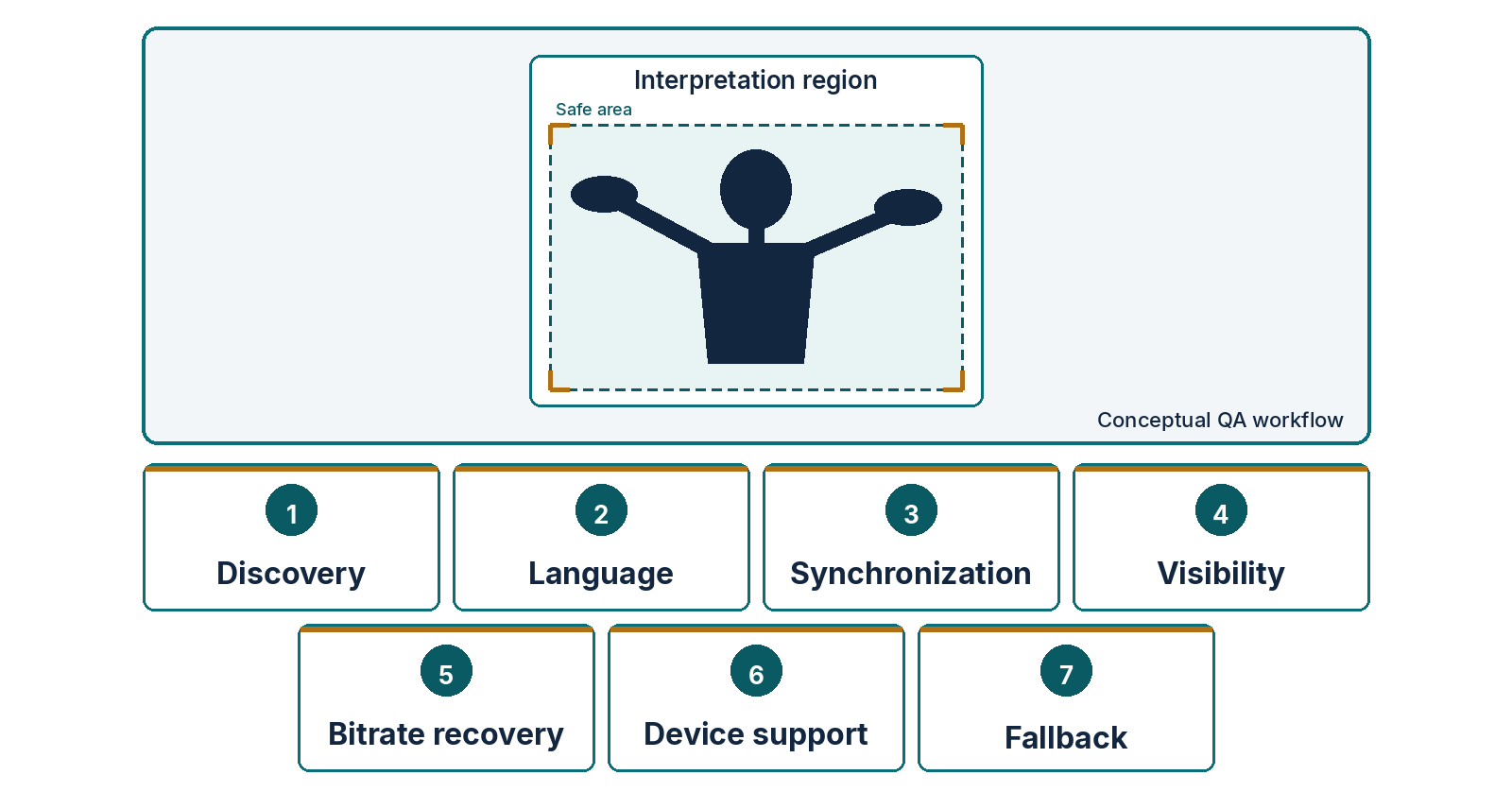
Seven tests for the launch checklist
1. Verify discovery and entitlement. On each supported device type, confirm that the title shows the appropriate sign-language indicator and is discoverable by the advertised search terms. Do not promise an option for a title or region where it is not supported.
2. Test language selection. Select ASL and BSL separately where both are offered. Restart playback and return to the title. Verify the intended language persists or resets exactly as the product specifies, without silently switching to a different interpretation.
3. Measure synchronization across seeks. Compare recognizable dialogue or narrative events against the corresponding signed performance at the beginning, after a long seek, after a pause and following playback recovery. Define an acceptance tolerance with accessibility specialists instead of inventing one from a generic video KPI.
4. Inspect visibility on real screens. Check that the interpreter's hands, face and upper body are not cropped by a picture mode, overscan, aspect-ratio change or player control overlay. Consider whether captions and signing can coexist without obscuring each other.
5. Exercise adaptive streaming and interruptions. Force bitrate changes, brief rebuffering and a network reconnection in a test environment. Verify that the interpreted presentation stays aligned with the main story after recovery and does not disappear while conventional video continues.
6. Build a device-and-app matrix. Apple's announcement specifies iOS, iPadOS, macOS, tvOS and visionOS 27.2 or later, and supported third-party devices with updated app software. Do not infer support on every smart TV or app version merely because the Apple TV app can play the title.
7. Test the fallback honestly. On an unsupported device, an unsupported title or a temporary failure, confirm the UI does not show a misleading sign-language affordance. Verify that captions and other existing accessibility options remain operable. Log the exact title, version, device, app build and playback position for diagnosis.
What operations should measure
For a release test, capture three kinds of evidence: discovery and configuration state; time-aligned playback recordings on representative endpoints; and a human accessibility review by qualified signers. A video analyzer can check continuity, but it cannot certify the semantic quality of an interpretation by counting frames or comparing caption timestamps.
TV Tech's November 10 report confirms the initial limited-title rollout. It does not establish implementation details such as whether every device renders the interpretation from a separate stream, track or precomposed asset. A broadcaster or streaming vendor should verify its own delivery architecture instead of assuming Apple's approach is a transferable specification.
The useful commissioning question is not simply whether the signing option exists. It is whether a viewer can find it, choose the right language, see every meaningful gesture and keep it through a normal session that includes seeks, network changes and device-specific playback behavior.
Image credit: Original Amira Labs editorial QA diagram, November 11, 2026, to be rendered from the specification. Conceptual layout only; not an Apple TV screenshot, footage from Being Heumann or a depiction of a real interpreter.