
The €142 million transfer of Viaplay's Dutch operations is complete, but customers are not being moved to a new app today. For streaming operators, the important work is defining what must be proven before any future service integration.
The deal closed. The services have not merged.
On October 30, 2026, Viaplay Group confirmed that it completed the sale of its Dutch streaming and broadcasting operations to DPG Media-owned Videoland for €142 million, on a cash- and debt-free basis. Viaplay reported €149 million in Dutch net sales for 2025 and expects approximately €100 million in cash proceeds after transaction, restructuring and certain legacy-contract costs.
Those figures describe the corporate transaction, not the cost of integrating platforms or a forecast of streaming profitability.
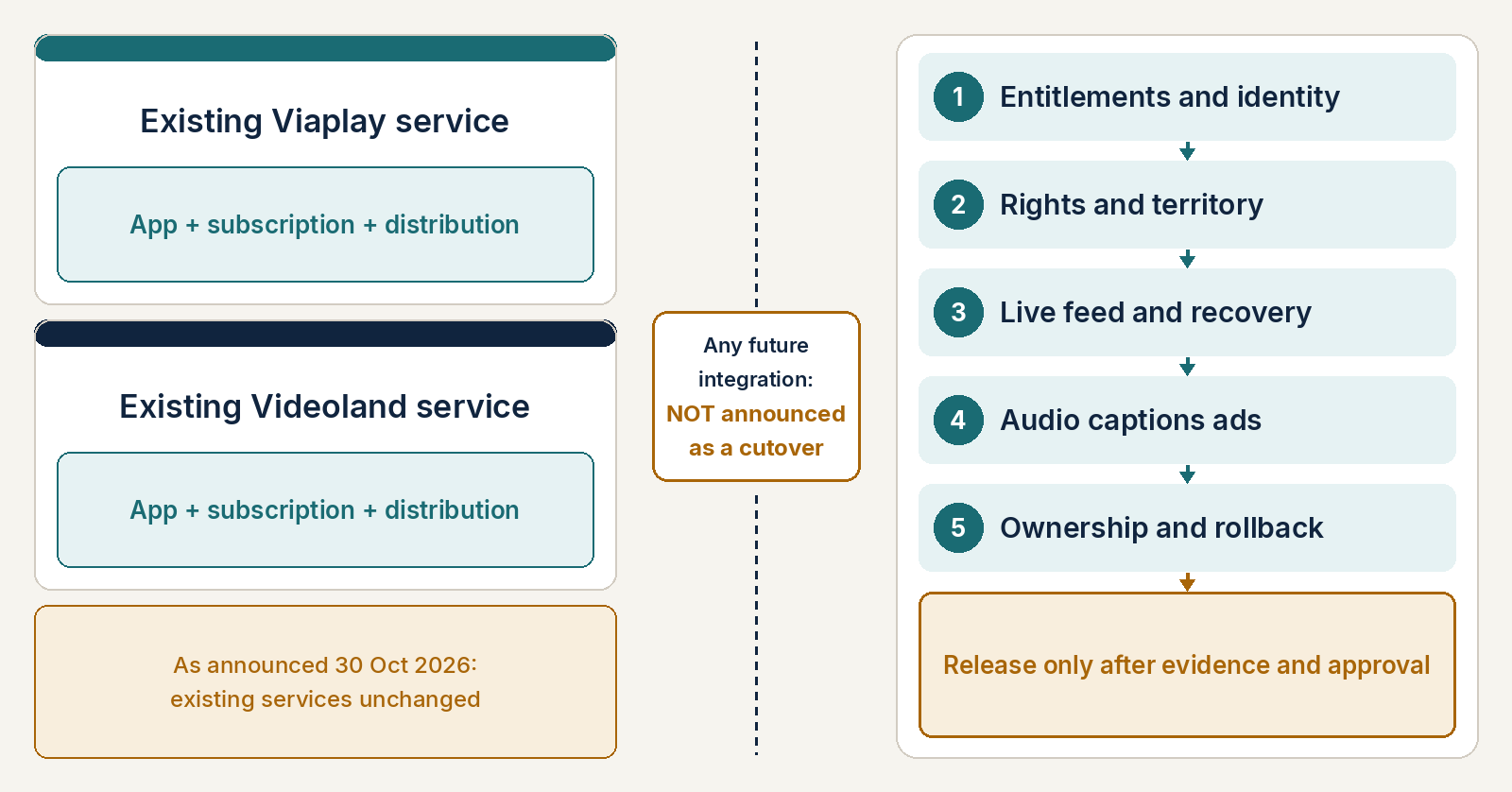
The distinction for viewers is explicit. In its October 30 announcement, DPG Media said that current subscriptions, prices and apps remain unchanged. Viaplay subscribers retain their existing app, TV channels and sports access, including through existing distribution partners. DPG expects to explain more about Videoland's future sports offer during 2027, with sport remaining an optional separate offering.
The Dutch competition authority, ACM, approved the takeover on October 20. Regulatory clearance is not evidence that an app migration, billing conversion or channel cutover has occurred.
Why the operating boundary matters
An acquisition can transfer ownership immediately while leaving playback infrastructure, subscribers and distribution agreements on their existing paths. That is not inherently inefficient. It can avoid forcing a high-risk technical migration into a legal closing date.
The engineering risk begins when teams treat commercial ownership as proof that entitlements, rights, channels, monitoring and customer support have become one system. The two companies have not published a detailed cutover architecture, so the following is an editorial acceptance framework, not a description of their private plans.
Five tests before changing a live service
1. Entitlements and account identity. Reconcile which customers can watch which packages across direct billing, app-store subscriptions and distribution partners. Test purchase, renewal, cancellation, device activation and denied access. Avoid assuming a transferred customer record automatically creates a valid playback entitlement.
2. Rights, territory and blackout rules. Build a rights matrix by event, country, device, platform and permitted replay window. Test representative authorized and unauthorized requests. A sports-rights acquisition does not remove existing contractual restrictions or guarantee identical rights on every endpoint.
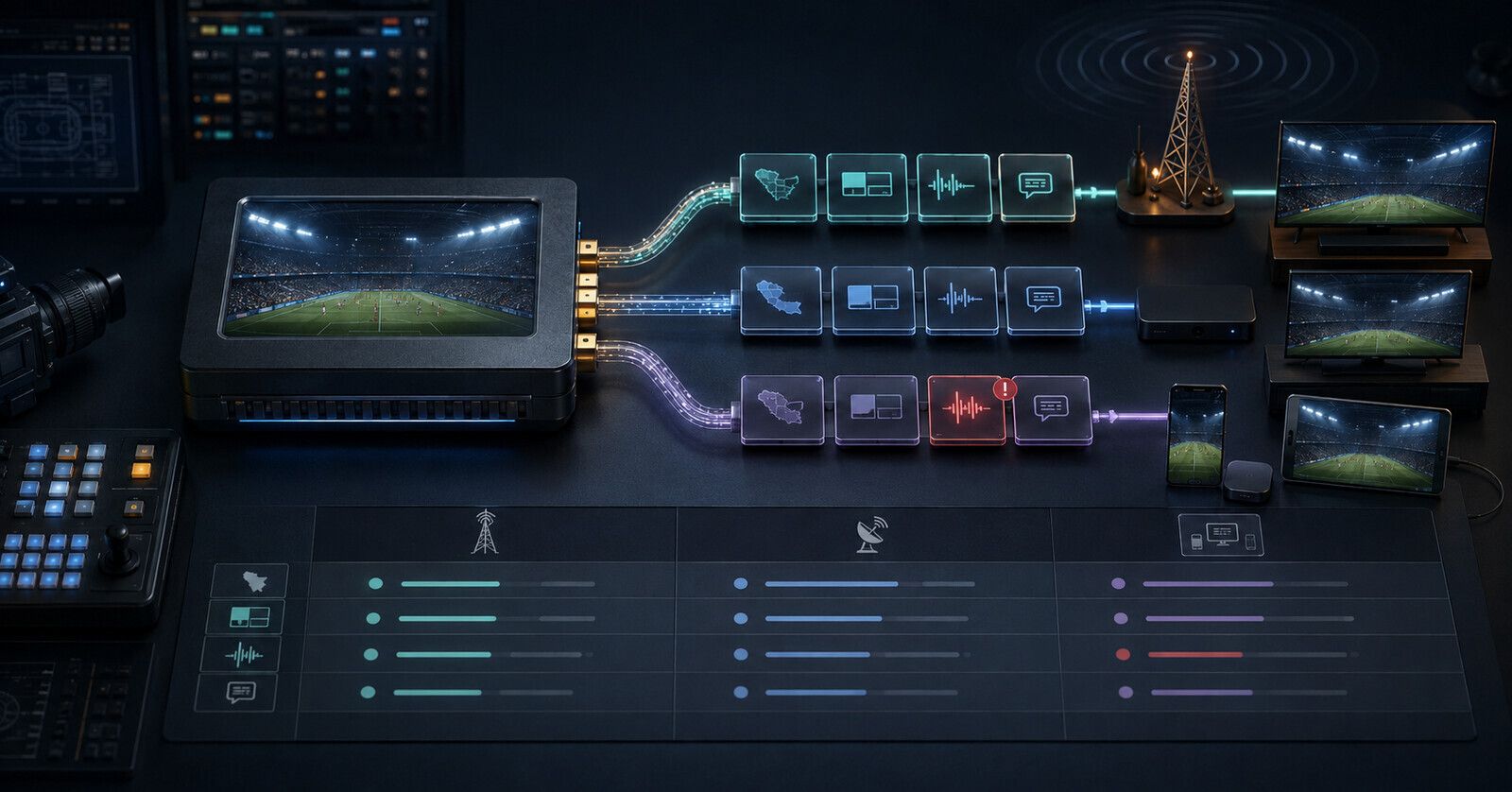
3. Live-feed continuity. For each service and event, record origin, backup path, manifest behavior, stream start and recovery. Run a controlled interruption on a test path and compare source, CDN and representative player observations. A healthy ingest alarm cannot prove that an end user can play the event.
4. Audio, captions and advertising. Verify language tracks, captions or subtitles, accessible playback, ad markers and regional variants on both existing and proposed destinations. Treat correct video with wrong audio or missing accessibility services as a failed handover, not a partial success.
5. Incident ownership and rollback. Assign who can change packaging, entitlements, metadata and distribution configuration; who answers a viewer complaint; and who can restore the prior service. Define evidence, response deadlines and a rollback decision before a live event.
For each test, capture the intended state, observed result, timestamp, device or partner, and named owner. The goal is an auditable release decision, not a dashboard that merely reports all components online.
What executives should ask
The commercial and technical workstreams should share one change register. Ask: Which customer-facing changes are actually authorized? Which sports rights require separate offers? What is the first migration dependency that cannot be rolled back? Who owns subscriber support across legacy and future products?
TVBEurope's October 30 coverage frames the sale as part of Viaplay's financial restructuring. That is the seller's business context. For the buyer's operations team, success will ultimately be measured by uninterrupted authorized access, not the transaction headline.
Bottom line: Keep the present service promises intact until a future migration has explicit scope, measurable acceptance tests and a reversible release plan.
Diagram credit: Original Amira Labs editorial technical diagram, November 1, 2026. Conceptual framework only; no depiction of Viaplay or Videoland infrastructure.
Related reading: Managed playout monitoring: what broadcasters still need to verify.