
Dek: A healthy LL-HLS encoder does not guarantee low-latency playback if a CDN mishandles blocking playlist requests, partial segments or cache keys.
A live stream can deliver valid HLS media segments while viewers drift behind the live edge or repeatedly buffer. When low-latency HLS (LL-HLS) fails, the encoder is only one suspect. The packager, CDN, cache policy and player have to agree on what the next piece of media is and when it becomes available.
Why it matters
Traditional HLS tolerates more delay between segment publication and playback. LL-HLS reduces that margin by exposing partial segments and allowing a player to request playlist updates before the next part exists. A CDN that serves an old playlist, drops request parameters or caches the wrong response can defeat the low-latency design without causing a total channel outage.
Apple's LL-HLS implementation guide describes partial segments, blocking playlist reload, preload hints and rendition reports. These are interoperating mechanisms, not independent performance guarantees. The guide is technical documentation, not evidence of a particular broadcaster's failure.
Five checks before accepting the delivery path
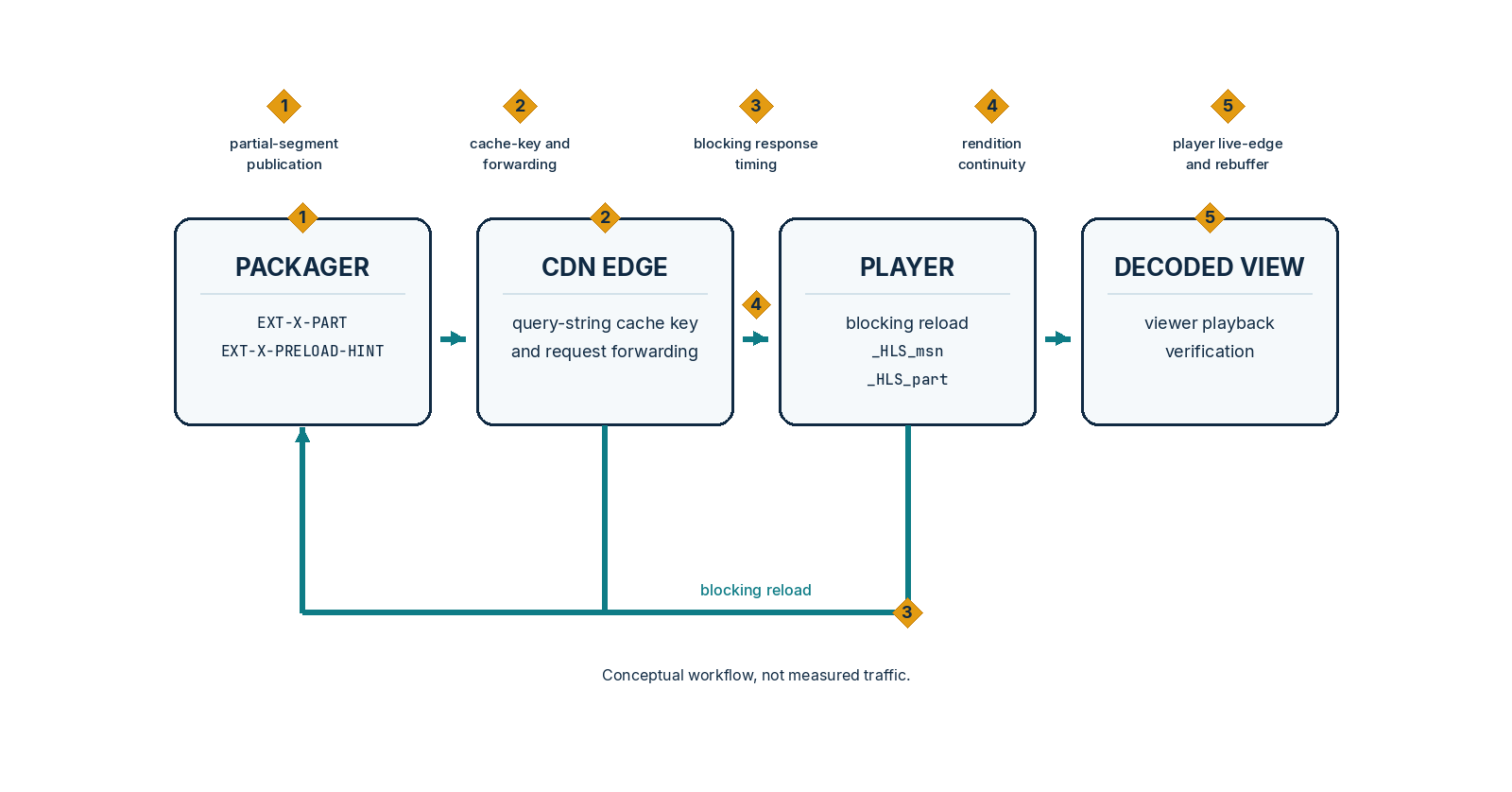
1. Confirm the packager publishes parts on time. Inspect the media playlist for EXT-X-PART-INF, EXT-X-PART, EXT-X-SERVER-CONTROL and, where used, EXT-X-PRELOAD-HINT. Compare advertised part availability with successful HTTP retrieval. A valid-looking playlist is insufficient if a hinted resource repeatedly arrives too late.
2. Verify the CDN forwards delivery directives. LL-HLS clients use _HLS_msn and _HLS_part to request a future playlist state. Capture the exact player request at the edge and the corresponding origin request. AWS's CloudFront live-streaming guidance specifically calls for forwarding these parameters for blocking reloads with MediaPackage. Treat that as a configuration requirement for that documented architecture, not a universal setting for every CDN.
3. Measure blocking reload behavior. A future-part request may remain open until the requested part becomes available. Record request start, response completion, HTTP status and returned media-sequence/part numbers at origin and edge. A fast response is not necessarily a correct one if it contains a stale playlist.
4. Check cache identity and rendition continuity. Compare playlist versions from different CDN points of presence and across bitrate renditions. Verify that the cache key distinguishes requests that legitimately require different responses. AWS's CloudFront media best-practices whitepaper addresses LL-HLS delta-manifest handling, including _HLS_skip. A cache hit ratio is useful for capacity planning, but it cannot by itself prove that the correct live playlist reached the player.
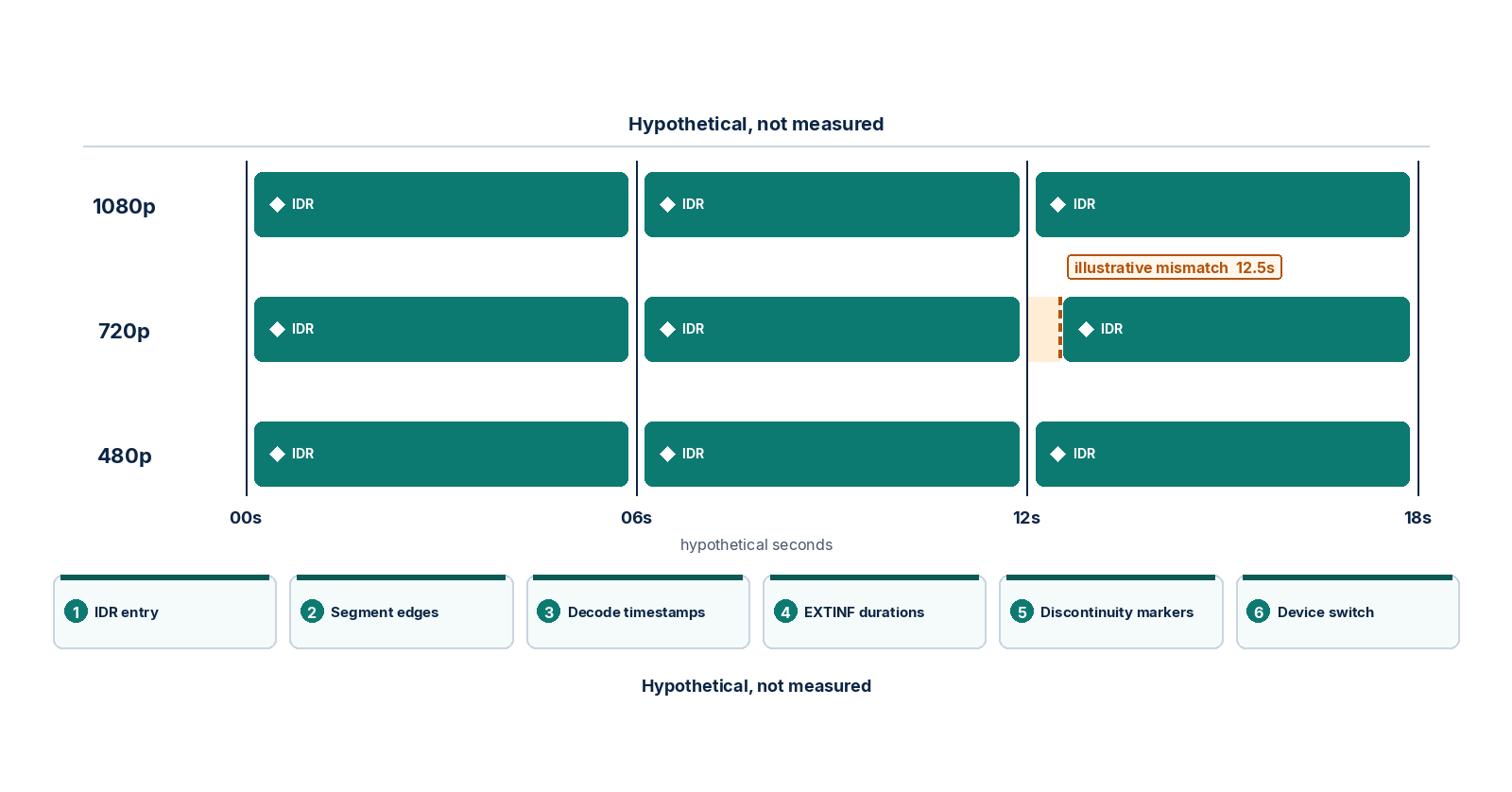
5. Test actual playback at the edge. Record live-edge distance, stalls, part-download failures and bitrate switches on real target devices. Include a controlled network impairment and a switch between renditions. RFC 8216, published August 2017, establishes foundational HLS live-playlist and media-sequence behavior; Apple's later LL-HLS guidance adds the low-latency mechanics. Do not assume that passing the older HLS checks proves LL-HLS delivery.
What operations should correlate
Build one incident timeline with the encoder output timestamp, packager part publication, CDN request and response, and player presentation time. Separate a slow origin from a stale edge response and a player that intentionally increases its buffer after network trouble. Without those distinctions, an alarm for rising end-to-end latency tells the NOC what viewers experience but not where to intervene.
For a commissioning run, ask: Do blocking requests reach origin unchanged? Can a player fetch the hinted part when it is published? Do renditions agree at discontinuities? Does a second CDN location behave the same way? How quickly does playback recover after a temporary edge failure?
These are proposed acceptance tests, not measured failure rates or claims about any CDN vendor. The practical conclusion is that low latency is an end-to-end operating property. Its evidence should span the packager, CDN and decoded viewer experience.
Related reading: How to find where a FAST ad break failed covers another boundary where a healthy stream can conceal a broken viewer outcome.
Image credit: Original Amira Labs editorial engineering diagram specification, November 9, 2026. Conceptual illustration; PNG pending rendering. No third-party imagery.
Source notes: Apple LL-HLS implementation guide (technical documentation, accessed November 9, 2026); AWS CloudFront live-streaming developer guide and CloudFront media whitepaper (accessed November 9, 2026); RFC 8216 (August 2017).