

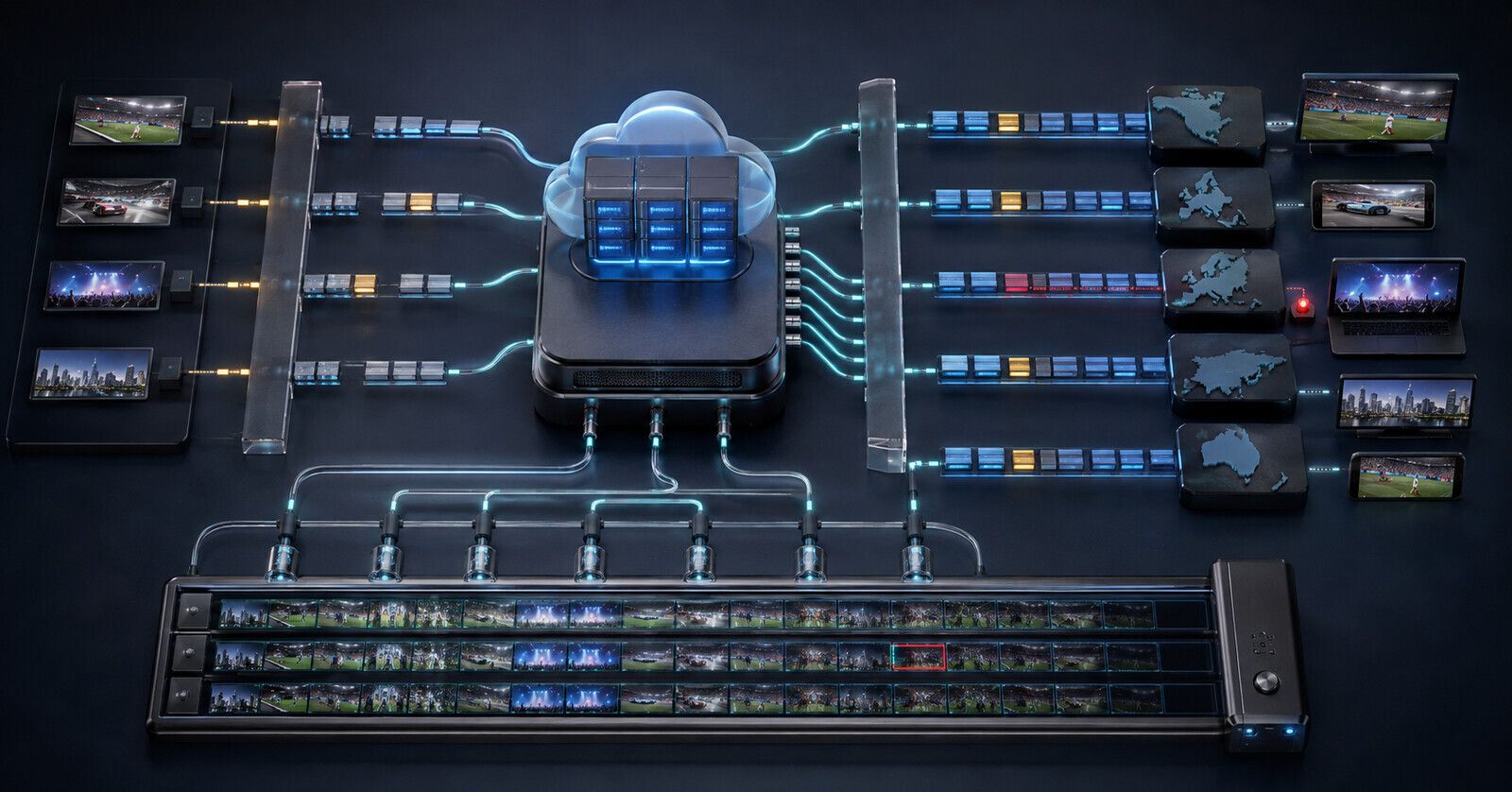
At 19:59:55, a managed playout dashboard is green. Five seconds later, the national service starts the right programme, one regional output carries yesterday's promo and an app receives the correct video with the wrong audio layout.
That is a hypothetical incident, but the accountability problem is real. A provider can operate channel origination, content supply, disaster recovery and distribution handoffs. The broadcaster still needs evidence that each promised service reached each agreed boundary correctly.
Outsourcing playout changes who operates the machinery. It does not remove the broadcaster's need to understand what went to air, which versions were affected, how quickly the fault was found and whether recovery produced the expected output.

Why is managed playout a timely IBC question?
Managed playout is timely because software-defined production, cloud operations and multi-platform delivery are converging around the same operational problem: more outputs, more late changes and more organizations sharing responsibility.
On August 28, 2026, Encompass Digital Media and Grass Valley announced Altitude Playout Plus, a managed channel-origination service designed for live, late-changing and complex programming. The companies say it combines Encompass managed services and media-supply-chain tools with Grass Valley AMPP and Playout X. Channel 4 selected the service under a multi-year agreement, with launch scheduled for 2027. That date matters. This is an announced transition, not evidence from a completed Channel 4 deployment.
The announcement reflects a broader operational direction. The IBC Master Control Cloud accelerator brought BBC, RTÉ, BT Media & Broadcast, ITV, SVT and other participants into a multi-vendor cloud proof of concept. Its published findings call out new latency, synchronization and component-failure modes, along with a continuing need for clear responsibility and unified operational control. IBC's 2026 programme also includes an Amagi and Zixi session promising end-point observability in a managed satellite-to-IP workflow.
Those are useful signals for buyers. They are not acceptance evidence for your channels. A procurement team still has to turn service claims into observable tests.
What responsibility actually moves to the provider?
The provider takes responsibility for the functions and outcomes written into the service agreement. Everything else must be assigned explicitly.
The phrase “managed playout” is not a complete operating model. One service may include ingest, validation, scheduling, master control, graphics, captions, live-event switching, distribution handoff and disaster recovery. Another may stop at an encoded contribution feed. The same term can therefore hide very different boundaries.
Build a responsibility register before debating service levels:
Operational question | Broadcaster decision that usually remains | Provider responsibility to define | Evidence to retain |
|---|---|---|---|
What should air? | Editorial schedule, rights, approved assets and regional rules | Ingest and execute the accepted schedule | Versioned schedule, asset IDs and change acknowledgement |
Which output is correct? | Service definition for every channel and platform | Originate each contracted output | Reference points, thumbnails, audio and ancillary-service checks |
Who can make a late change? | Authorization policy and escalation path | Execute approved change within agreed conditions | Request, acceptance, operator action and resulting output |
What happens on failure? | Acceptable fallback and business priority | Detect, respond, recover and communicate | Alarm, ticket, timecoded output and recovery record |
Who informs distributors? | Commercial and affiliate relationships | Notify named parties if included in scope | Distribution notices and acknowledgement |
What closes an incident? | Acceptance of restored service and follow-up | Supply chronology and corrective action | Post-incident report tied to retained media evidence |
This is an operational framework, not a substitute for legal review. The contract, regulatory duties and rights arrangements determine the binding allocation.
Where should the broadcaster observe the service?
Observe the service at the points where responsibility, transformation or destination changes.
The European Broadcasting Union's Tech 3316 guidance was written for access services, but its monitoring model is broadly useful. It separates pre-transmission quality control, real-time monitoring and logging. It also identifies contractual boundaries between playout, coding, multiplexing and transmission as useful places to probe and record service state. The guidance warns that a correct transmitted signal does not guarantee a fault-free viewer experience.
For managed playout, a practical observation plan has at least four layers:
- Accepted input: Did the provider receive the intended schedule, media, live feed, graphics, captions and audio configuration?
- Provider output: What left channel origination before downstream distribution transformed it?
- Distribution handoff: What did each MVPD, affiliate, platform, CDN or transmission partner receive at the agreed boundary?
- Representative endpoint: What appeared on selected off-air receivers, apps or devices?
Do not use one layer to make a claim about another. A valid playlist does not prove the provider originated the right frames. A correct origin output does not prove a regional affiliate received it. An off-air sample from one market does not prove every market.
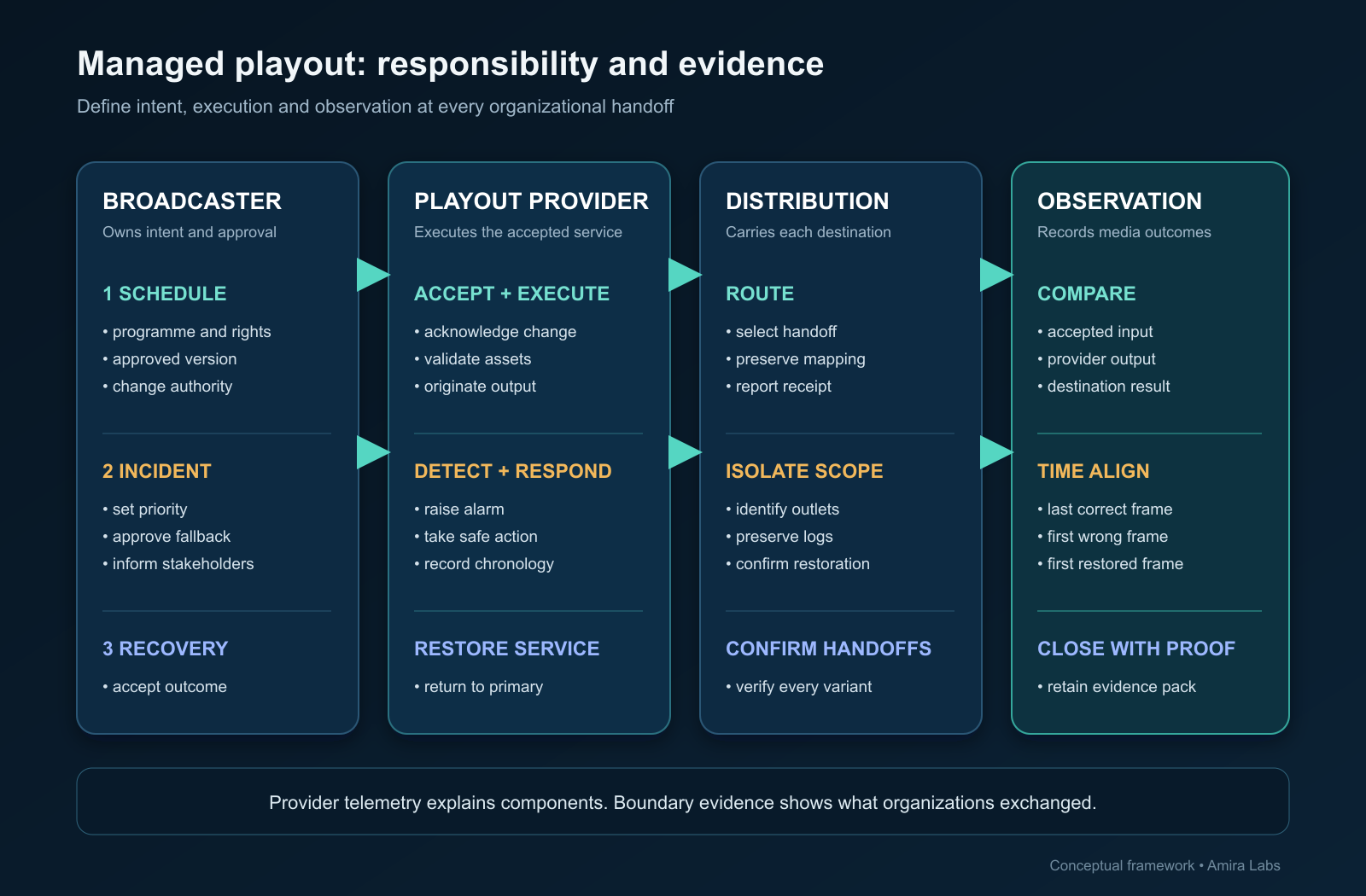
Independent observation does not require hostility toward the supplier. It gives both parties a common record when systems disagree. The supplier's telemetry explains its platform. Boundary and endpoint observations show the media outcome.
How should late schedule changes be verified?
Verify late changes as transactions with a requested state, an accepted state and an observed on-air result.
Live sport, news and entertainment routinely change close to transmission. Grass Valley describes small misalignments and late changes that fail to carry across as common playout risks. Its March 2026 discussion also notes that modern playout must keep linear, OTT, FAST and web versions aligned.
A useful change record should answer:
- Who requested the change and through which authorized path?
- Which services, regions, languages and platforms were in scope?
- Which schedule or asset version did the provider accept?
- When did the provider acknowledge it?
- What was the last safe execution time?
- Which downstream outputs showed the changed result?
- Which outputs remained on the prior plan, intentionally or otherwise?
- What happened to advertising, captions, graphics and programme return?
Rehearse at least three types of change: replacing an item before air, extending a live event across a fixed junction and making a change to one regional version without changing its siblings. The test should include the resulting media, not only screenshots from the scheduling system.
How do regional and platform variants change acceptance?
Each materially different version needs its own service identity, expected attributes and evidence path.
A “channel” may now mean a national linear service, several regional feeds, an OTT simulcast, a FAST version and multiple language or accessibility variants. The playout layer may share many components across those outputs, which is efficient. Shared components also create the possibility that one configuration change propagates too far or not far enough.
Create a destination register with one row per output:
Field | Why it matters |
|---|---|
Stable service ID | Prevents similar display names from being confused |
Destination and handoff | Defines where delivery responsibility changes |
Video format | Makes frame rate, resolution, HDR and aspect expectations testable |
Audio map and language | Exposes swapped, missing or silent services |
Captions and accessibility | Identifies required services and expected carriage |
Graphics and regional policy | Separates local branding, sponsorship and legal inserts |
Advertising behavior | Distinguishes network ads, local avails, slate and pass-through |
Delay and synchronization | Defines acceptable relationships among parallel outputs |
Monitoring point | States where the signal is sampled and retained |
Incident owner | Gives master control one accountable contact |
The EBU guidance specifically recommends monitoring regional variants distinctly. That principle remains valuable even when the underlying delivery architecture is shared.
What belongs in a playout service acceptance pack?
A playout service acceptance pack should connect the agreed service to repeatable tests, timecoded media evidence and named owners.
At minimum, include:
- a current architecture and handoff diagram;
- the destination register for every contracted output;
- a responsibility matrix for routine operations, late changes and incidents;
- approved reference video, audio, graphics, captions and metadata;
- a clock and timestamp policy across broadcaster, provider and distributors;
- normal-operation tests and deliberately injected fault tests;
- disaster-recovery and return-to-primary procedures;
- alert routes, escalation contacts and communications templates;
- retention periods for schedules, logs, recordings and incident material;
- a report template with detection, acknowledgement, mitigation and restoration times.
For every test, record five things: stimulus, expected outcome, observed outcome, evidence location and disposition. “Passed in demo” is not enough. A later operator must be able to repeat the case and recognize the same failure.
Test the business-critical details that a color-bars exercise misses. Use a live overrun, a regional opt, a replacement promo, a caption loss, an audio-layout change, a missing asset and a distribution-handoff interruption. Run destructive cases only in a staging, rehearsal or otherwise authorized test path.
The acceptance pack should also say what is out of scope. If the provider's responsibility ends at a contribution feed, do not imply that it guarantees a television receiver or mobile app. Instead, document the downstream owner and the observation needed to trace a fault across that boundary.
What should an incident report prove?
An incident report should prove what viewers or downstream partners received, when the service diverged, which boundary first showed the fault and how normal service was restored.
Start the chronology with evidence, not interpretation:
- Last confirmed correct output.
- First observed incorrect output.
- First relevant alarm and the system that raised it.
- Operator acknowledgement and initial classification.
- Changes, failovers or manual actions taken.
- First confirmed correct output after mitigation.
- Stable restoration and any return to the primary path.
Then add scope. Name the channels, regions, platforms, audio services and time windows affected. Separate known impact from suspected impact. A national origin fault and one affiliate fault may look identical to a viewer but require different owners.
Avoid using mean time to repair as the only number. Track detection time, acknowledgement time, time to safe output and time to full restoration separately. A slate may restore a technically valid signal quickly while the intended programme remains unavailable.
Connect the incident ticket to the retained schedule version, relevant configuration changes, alarms and timecoded recordings. This gives engineering, operations and the supplier a common basis for the review.
How should disaster recovery be tested?
Test disaster recovery as a complete viewer service, including the transition into recovery and the controlled return.
Encompass says its Channel 4 agreement includes disaster recovery and that services are planned across facilities in London and Riga. The Altitude Playout Plus announcement describes distributed cloud and on-premises operation. Those architecture choices can support resilience. They do not tell another broadcaster whether its own recovery procedure works.
An acceptance test should answer:
- Which event triggers failover, and who may initiate it?
- Does the recovery path have the current schedule, assets and live inputs?
- Are graphics, captions, audio maps and regional variations preserved?
- What happens to an item already on air when the transition occurs?
- Which monitoring and control tools remain available during a site or cloud failure?
- Can teams operate if the normal identity, network or communications service is unavailable?
- How is the return to primary authorized and verified?
Measure visible and audible discontinuity, lost or repeated programme time and the behavior of every downstream handoff. A recovery platform that starts successfully but originates stale content is not a successful service recovery.
When is the provider dashboard enough?
The provider dashboard may be enough for routine control when its data is timely, trustworthy and matched to the decisions operators must make. It should not be the only evidence used to settle every service boundary.
Independent monitoring has limits too. A probe can confirm signal presence and analyze observable media, but it may not know why a schedule was approved, whether rights permitted an event, whether a distributor remapped a service later or what every viewer device displayed. Sampling also creates gaps. An unobserved outlet cannot be declared correct merely because neighboring outlets passed.
The sensible pattern is complementary evidence:
- provider telemetry for component state and internal diagnosis;
- broadcaster or jointly governed records for approved intent;
- boundary probes for the media exchanged between organizations;
- endpoint samples for representative audience outcomes;
- human review for editorial, contractual and ambiguous cases.
Amira Labs belongs at the media-observation boundary. Timecoded evidence from live feeds can help teams find, compare and review what appeared at selected handoffs. It does not replace the playout provider, the broadcaster's scheduling authority, distributor telemetry or legal agreement.
What should you ask managed playout vendors at IBC?
Ask each vendor to demonstrate an incident that crosses an organizational boundary, not only a normal channel launch.
- Show how one late schedule change moves from request to acknowledged execution and observed output.
- Show how national, regional, OTT and accessibility variants are identified and monitored separately.
- Explain exactly where your service ends and which handoffs the customer must observe.
- Demonstrate a missing asset, lost live input, wrong audio map and stale regional instruction.
- Show what operators retain when a dashboard, site, cloud region or identity service is unavailable.
- Produce the incident package that a broadcaster receives after restoration.
- Explain how timestamps, service IDs and evidence can be exported for a joint review.
- State which service claims are based on internal telemetry and which are verified at an external boundary.
Use the same known-fault discipline in our AI broadcast monitoring buyer's checklist. If the operating model crosses cloud, edge and facility boundaries, pair it with the broadcast inference placement guide rather than reopening the cloud-versus-on-premises debate from scratch.
What can your team do before the next provider meeting?
Pick one high-value channel and draw the path from accepted schedule to three representative destinations. Mark every organizational handoff.
Give each output a stable ID. Write the expected video, audio, graphics, captions, advertising and timing attributes beside it. Then identify which system holds intent, which system reports execution and which observation confirms the media result.
Finally, bring one failure scenario to the meeting. A useful case is a live overrun followed by a regional junction and a disaster-recovery transition. Ask the provider to show who acts, what each dashboard reports and what evidence survives for review.
Managed playout can reduce the burden of operating complex channel infrastructure. The broadcaster still needs a defensible answer to the simplest master-control question: what actually went out?
Sources
- TV Tech: Encompass Partners with Grass Valley to Launch Altitude Playout Plus, August 28, 2026
- Encompass: Grass Valley AMPP Provides an All-Encompassing Approach to Advanced Channel Origination, August 28, 2026
- Encompass: Selected by Channel 4 to Deliver Managed Linear Playout Services, July 28, 2026
- IBC: Master Control Cloud accelerator project and published findings, accessed September 5, 2026
- IBC2026: From Satellite to IP at Scale, scheduled September 13, 2026
- EBU Tech 3316: Monitoring of Access Services, May 2006
- Grass Valley: Playout at the Center of Multi-Platform Channel Delivery, March 23, 2026
- IBC: PlayBox Technology Innovation Studio presents industry transformation research, July 10, 2026