

DRM key rotation can interrupt a healthy live stream: six playback tests
Dek: A live HLS stream can keep delivering playlists and video segments while viewers lose playback at an encryption-key boundary, so operators must test the license and decryption path as carefully as delivery.
A live stream can look healthy in the origin and CDN dashboards while a viewer's screen freezes. One cause worth isolating is a content-protection transition: the next encrypted segment arrives, but the player cannot obtain or apply the key needed to decode it.
This is an engineering failure scenario, not a claim that any named streaming service suffered an outage this week. It is also distinct from an expired signed CDN URL. An authorized HTTP request for an encrypted media segment does not by itself establish that the player has a usable decryption key.
Why it matters
Apple's HLS documentation separates media delivery from client responsibilities for key retrieval, authentication and decryption. Its guidance explicitly describes players discovering new encryption keys as live playlists update. That creates an additional dependency outside ordinary segment availability.
AWS's MediaPackage V2 encryption API, reviewed November 16, 2026, documents a live key-rotation setting. When configured, the service retrieves keys as required during the workflow. The documented minimum interval is 300 seconds. That number is a configuration constraint, not a recommended universal rotation cadence.
A five-minute rotation interval can create repeated opportunities for a failure to appear. The relevant metric is not merely whether a license server responds, but whether every supported client survives a key change without losing the program.
What a green dashboard misses
The delivery path and the decryption path have different evidence. A CDN may return HTTP 200 for the playlist and media segments while a DRM license request fails, a key identifier changes unexpectedly, or a client cannot interpret the new signaling.
Apple's CMAF/HLS guidance documents encryption signaling, including SAMPLE-AES and 'cbcs', as well as discontinuity behavior. A packager or player change can therefore affect playback without changing the upstream contribution feed.
The operational conclusion is straightforward: monitoring must include a representative protected playback session, not only the transport and manifest.
Six tests before a protected live event
1. Record the actual encryption contract. For each output, identify the encryption method, DRM system, key provider, key identifier behavior and configured rotation interval. Do not assume every device uses the same DRM implementation.
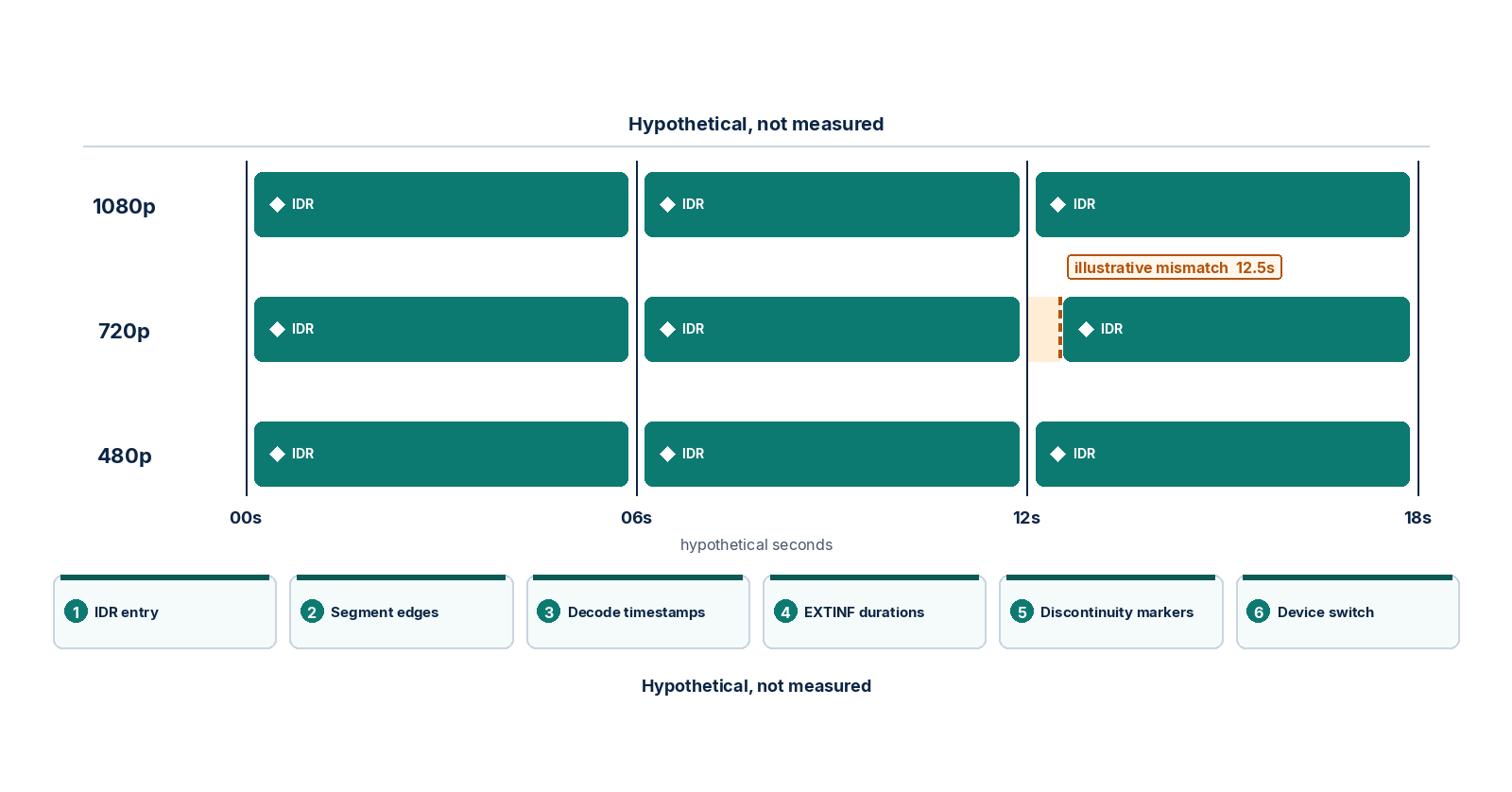
2. Cross a rotation boundary on purpose. Run a protected test channel long enough to cross several key changes. Record segment timestamps, manifest revisions, license requests and the precise point at which a player starts or stops decoding. A short smoke test that ends before the first rotation proves little.
3. Separate HTTP delivery from license authorization. Capture segment status codes independently of DRM-license request status, authentication outcomes and client errors. Confirm that an HTTP 200 media response does not mask a license denial or key mismatch.
4. Test discontinuities and packaging changes. Exercise a controlled stream switch or encryption-state transition supported by the intended workflow. Compare the new initialization metadata and playlist signaling against the player's expected behavior. The HLS specification, RFC 8216 (August 2017), defines the playlist rules that make this comparison reproducible.
5. Exercise realistic devices and sessions. Repeat the test on the actual supported browsers, connected TVs and mobile devices, including a session started immediately before rotation, a newly joined session and a player resuming from pause. Record platform-specific failure codes rather than flattening them into 'buffering'.
6. Prove recovery and alarm ownership. Temporarily deny a license request in a controlled test environment, then restore access. Determine whether the player retries, how long recovery takes and which team receives the actionable alarm. Distinguish entitlement failures from a shared key-service incident so operations does not unnecessarily restart a healthy encoder.
The engineering takeaway
Key rotation is a coordinated change across packaging, entitlement, licensing and player behavior. A transport-only monitor cannot prove that coordination works. The useful acceptance criterion is whether a valid subscriber continues seeing and hearing the intended program through multiple key changes, with diagnostic evidence when it fails.
Before the next protected live event, ask one question: Can we correlate the exact failed playback timestamp with the key identifier, license transaction, manifest version and affected device? If not, a successful segment request may be hiding the fault.
Image credit: Derrick Coetzee, Front of server racks at NERSC, CC0 1.0. Archival infrastructure photo, not a depiction of an actual DRM outage. Planned adaptation: landscape crop and JPEG recompression.