
A transmitter can be healthy, the incoming media can look valid, and viewers can still lose the service. TV Globo's experimental TV 3.0 deployments in Brazil offer a specific example of why next-generation broadcast monitoring must follow a program beyond its transport stream.
What happened
In a November 2, 2026 first-person TV Tech account, TV Globo infrastructure executive Jonas Ribeiro described using Triveni Digital's StreamScope XM in Brasília, São Paulo and Rio de Janeiro. The software was used in laboratory and field trials to examine signaling, protocols and media streams at several points in the delivery chain.
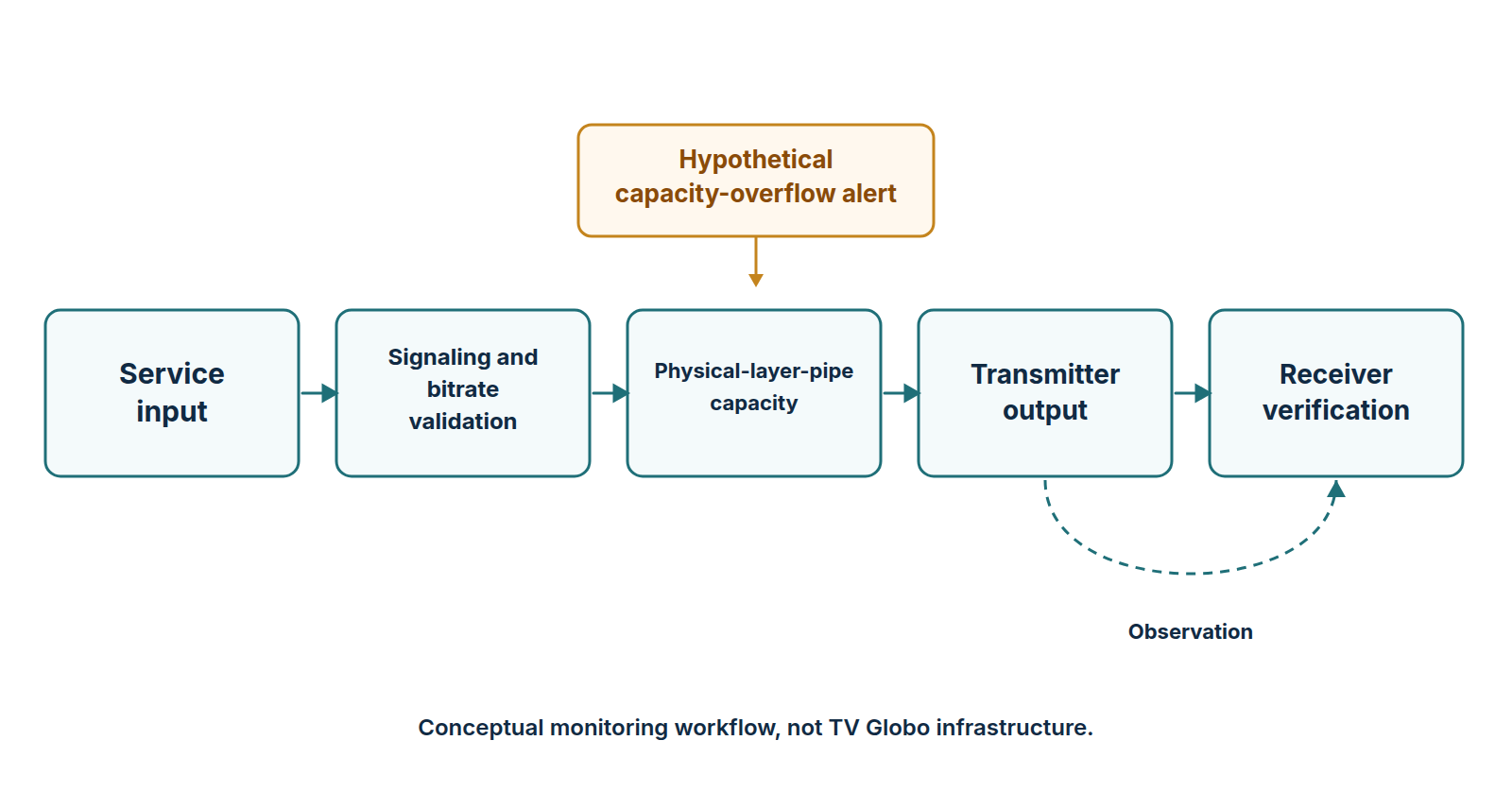
During live football coverage, engineers investigated bitrate anomalies that caused available physical-layer-pipe throughput to be exceeded. Ribeiro reported that the overflow led transmitters to mute their outputs. The team used analyzer evidence to isolate and correct the problem, then verified the correction.
This is a broadcaster-authored deployment account, not a controlled comparison of monitoring products. The deployment itself had been announced in August; the newly published account adds a useful failure scenario.
Why it matters
Monitoring an encoder output is not the same as proving a receivable service. Next-generation television adds signaling, multiplexing, physical-layer capacity and receiver behavior to the list of things operators must verify. An alarm that only reports video presence or packet continuity may miss a downstream condition that makes the service unusable.
For a master control director, the important distinction is between a valid input and a valid output. An IP contribution feed can be present while the broadcast multiplex exceeds its permitted capacity. An apparently recovered transmitter can still be carrying incorrect service information.
Five acceptance tests for TV 3.0 monitoring
- Capacity envelope: Exercise representative peak video, audio, signaling and application loads. Compare total required bitrate against the configured physical-layer-pipe capacity, with an agreed operating margin.
- Service signaling: Verify that announced services, component identifiers and receiver-facing metadata agree with the actual streams.
- Output verification: Observe the transmitter output and a representative receiver, not only the upstream analyzer. A cleared upstream alarm is not proof of restored reception.
- Failure evidence: Record the first threshold crossing, affected service, transmitter behavior, operator notification and the exact recovery action. Preserve timestamps across monitoring points.
- Regression and failover: Repeat the tests after changing encoder rates, multiplex settings or distribution paths. Confirm that monitoring follows the active service after a switchover.
These are proposed commissioning tests, not a description of Globo's undisclosed internal acceptance criteria. Their thresholds must come from the deployed transmission design and applicable Brazilian TV 3.0 specifications.
What buyers should ask
Can the monitoring system explain where a service failed, not merely that a device is online? Can it correlate a bitrate-capacity problem with downstream transmitter behavior? Can an engineer replay the evidence and prove the corrected output reached a receiver?
TV Globo's example is a reminder that service quality is an end-to-end property. A clean signal at one checkpoint is only one piece of evidence.
Image credit: Original Amira Labs editorial diagram, November 3, 2026. Conceptual workflow, not TV Globo's actual network.