
A live channel can carry valid SCTE-35 messages into an encoder and still miss an advertising opportunity downstream. The failure may occur when the encoder removes cues, a packager filters events, a personalized manifest omits markers or a player receives the wrong break behavior.
Why it matters: Ad insertion is a chain of independently configurable systems. A green ingest monitor and a cue count at the input establish only that a signal arrived, not that the intended advertisement or blackout reached viewers.
What the standards and vendor documentation establish
The SCTE 35-1 2023r2 standard catalog describes cueing for advertising, program and distribution control. It is signaling, not proof of completed ad playback.
AWS's MediaLive processing documentation, reviewed November 19, 2026, documents a particularly consequential default: for most outputs, SCTE-35 messages are removed unless passthrough is enabled. MediaPackage outputs are an exception.
The MediaLive passthrough guide also explains that passthrough is configured per output and that the default input selection can take the first available SCTE-35 PID when multiple are present. An engineer who verifies only the source PID can miss an output-specific omission.
Downstream, MediaPackage's SCTE-35 settings distinguish ignoring messages, enhanced ad-marker generation and passthrough. These are different behaviors. A successful TS ingest is not a guarantee of equivalent manifest signaling.
Six tests across the handoff
1. Establish the expected cue contract. Record the service, source PID, cue command, segmentation type where applicable, event ID, intended break duration, and expected downstream action. Separate advertising from blackout and program-boundary cues. A cue's presence alone is not evidence that it represents a payable ad avail.
2. Compare input and output at the encoder. Capture a controlled cue before and after processing. Confirm that the intended output carries the cue or an explicitly configured manifest representation. Repeat for every output group rather than assuming a channel-level switch applies everywhere.
3. Check timing, not just counts. Compare cue presentation time, nearby video access points, segment boundaries and the expected splice point. A marker that arrives late or falls awkwardly against segmentation can be unusable even when its syntax is valid.
4. Inspect the origin playlist. Capture the HLS media playlist before personalization. Match the expected break to the marker representation configured on the packager, its start time and duration. Compare that capture with the encoder output to identify the first handoff where the cue disappears.
5. Inspect a personalized viewer session. AWS MediaTailor's marker-passthrough guide, reviewed November 19, 2026, states that personalized HLS manifests omit origin ad markers by default unless marker passthrough is enabled. Crucially, enabling passthrough does not rewrite an unfilled 60-second cue to zero. Do not equate a cue in the personalized manifest with a filled ad pod.
6. Verify playback and recovery. Observe a test client through the entire break and return to program. Record ad decision response, ad segment delivery, audio and video continuity, captions, program return and any player error. Repeat with an empty ad response and a missed cue. These are different failure modes with different owners.
The operational takeaway
Build one evidence timeline per test break: upstream cue, encoder output, packager manifest, personalized manifest, ad decision, delivered segments and decoded playback. Assign a pass or fail at each boundary.
This is an engineering recommendation, not a claim that any particular broadcaster has suffered an outage. The highest-value alarm is often not "SCTE-35 absent" but "expected break event did not reach the agreed downstream boundary within its timing window." That distinction directs master control toward the failing handoff and avoids blaming the encoder for every missing advertisement.
Before the next live sports event, ask one practical question: can your operations team identify exactly where a single expected break disappeared, without relying on an ad-server dashboard alone?
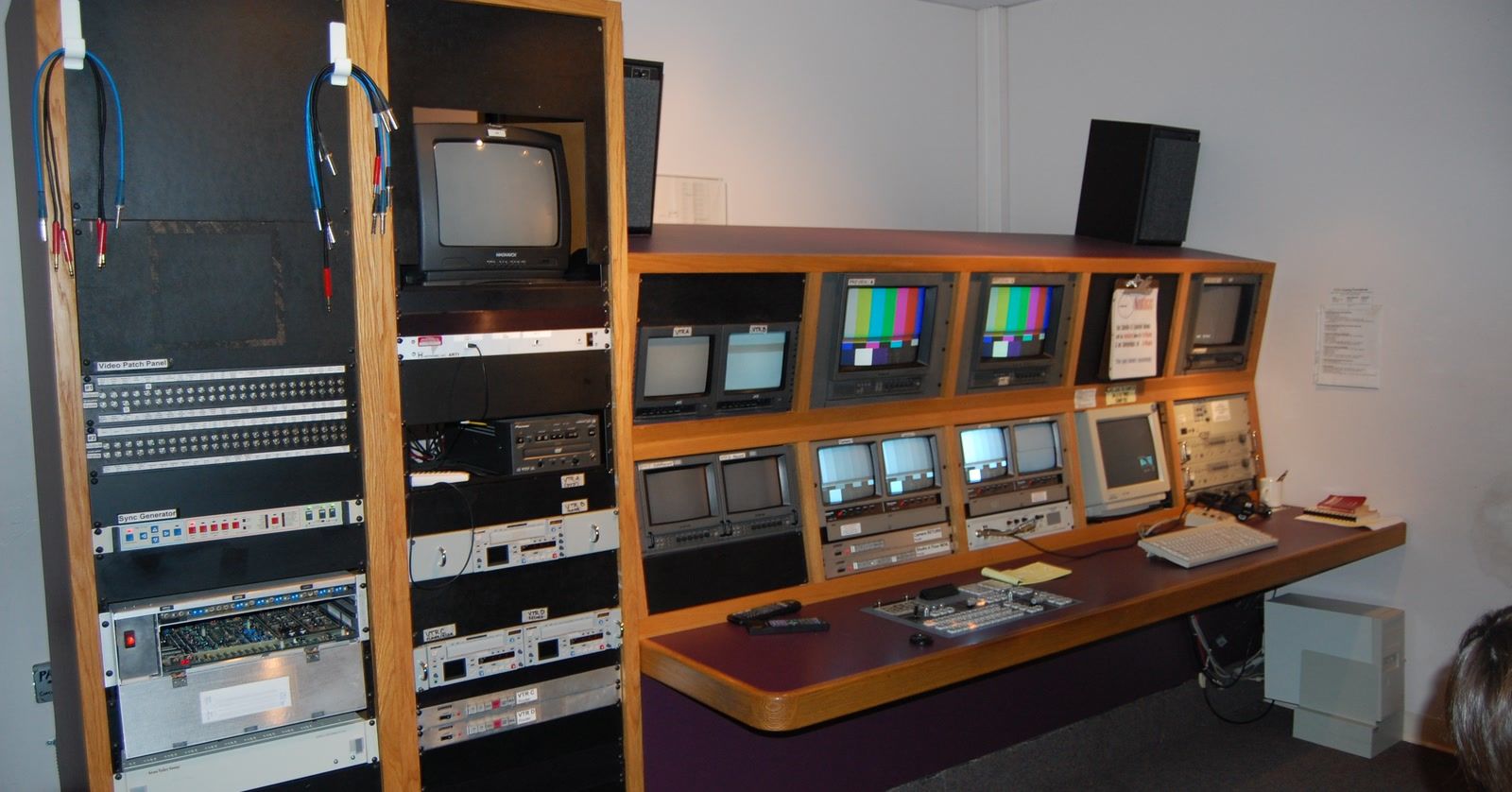
Photo: TV Station Control Room by Bluedisk. Archival illustration. Cropped and JPEG-encoded. CC BY-SA 3.0 applies to this derivative.