


A viewer chooses Spanish. The player menu changes. The commentary stays in English.
That is one way multilingual live sports can fail while the video keeps playing. Another is harder to spot: the correct language reaches the correct destination, but the commentary names the wrong player or reverses a referee's decision. Both deserve attention. They need different tests.
For producers and distribution teams, each language output is a service to verify, whether its commentary comes from people, translation software or a combination of the two. Language identification establishes what language is being spoken. Linguistic review checks meaning. Delivery checks establish which audience actually receives the result.
Before adding another language, define that output's expected content, timing and fallback. Then test the version a viewer will hear and see.

Original AI-generated editorial illustration of independent language-output checks. Not a real facility, broadcast feed or Amira product rendering.
What must a multilingual live sports feed get right?
A multilingual live sports feed must preserve the intended meaning, maintain an acceptable relationship between sound and picture, and reach the intended audience. Passing one of those checks does not establish the others.
Recent coverage shows why that distinction matters. SVG Europe's August 24, 2026 report describes the Bundesliga's proof of concept for localized world feeds. The work included translated graphics, translated commentary and separately generated commentary based on match data. It also identifies unresolved latency, integration and language-quality problems. The reported language-localization work was not ready for production; it should not be presented as a completed rollout. SVG Europe, Adrian Pennington.
The operational need extends beyond AI-generated audio. On August 26, TV Tech reported that 18 Gray Telemundo affiliates had rights to two Spanish-language Atlanta Braves broadcasts. Its account names human presenters and does not establish that the broadcasts use AI translation. Language distribution is already a production responsibility, whatever creates the commentary. TV Tech, George Winslow.
With IBC2026 running September 11–14 in Amsterdam, this is a useful lens for localization demonstrations. Ask what a system can verify after the language version has been created. IBC event information.
Separate the kinds of commentary
Human commentary, translated commentary and commentary generated from event data have different reference points.
A translator should preserve the meaning of the source commentary, including uncertainty and corrections. A data-driven commentary system should be checked against the approved event data and editorial rules. An independent commentator may describe the same action differently without making a translation error.
Write that distinction into the evaluation. Comparing every output word for word with an English transcript will reject legitimate editorial variation and can still miss an incorrect match fact.
Give every destination a written specification
Create one record per output or supported playback combination. Include the program identifier, destination, expected spoken language, audio-track assignment, caption source and relevant graphics version. Name the person who owns acceptance and the permitted fallback.
Record language variants and pronunciation preferences where they matter. A country flag is not an adequate language specification. Likewise, “Spanish audio” does not describe whether the track contains full commentary, a translation, or occasional interpretation over the original voice.
This output record becomes the reference for engineering tests and editorial review. Keep it synchronized with actual routing and packaging changes; an outdated reference can make a correct feed appear wrong.
How do you test live sports translation quality?
Test whether the output preserves the important information in the source, then assess whether it sounds appropriate for the audience. Fluent delivery can conceal a meaning error.
The MQM Council's current Multidimensional Quality Metrics framework separates accuracy, terminology and linguistic conventions, among other categories. Its accuracy category includes additions, omissions and mistranslations. Those distinctions provide a useful vocabulary for review, but MQM does not supply a universal pass mark for live sports commentary. MQM error typology, accessed August 31, 2026.
Use the following as proposed sports-specific test cases, not a formal certification scheme.
Test material | What the reviewer should check |
|---|---|
Similar player names and a late substitution | The correct person is named and subsequent references remain consistent. |
A decision reversed after review | The reversal reaches the audience; the earlier decision does not remain the final account. |
Negation and uncertainty | “No penalty” stays negative, and “may be injured” does not become a confirmed diagnosis. |
Score, match clock and statistics | Numbers retain their meaning and refer to the correct team, period and event. |
Overlapping voices and crowd noise | Important speech is preserved where intelligible; missing evidence is not replaced with invented commentary. |
Code-switching and quoted speech | A speaker changing languages is handled according to the editorial brief. |
These examples are illustrative. Build the real set from authorized material representative of your sport, commentators and language pairs.
Listen to the produced audio
Review source and target audio together, with the relevant video and event context. A correct intermediate text translation does not prove that the spoken output pronounced a name correctly or delivered the full sentence. Conversely, a monitoring transcript can misrecognize otherwise correct audio.
Use reviewers who understand both languages and the sport. Ask them to identify the affected meaning, severity and supporting time interval. Agree on how to resolve disagreements. Reserve material that has not been used for tuning so that the final review tests more than memorized examples.
Treat a source commentator's mistake separately from a translation error. If the commentator gives the wrong score and the translation faithfully repeats it, a translation-only check may pass. Decide whether factual cross-checking against approved match data is also in scope, and who can authorize a correction.
Keep scores tied to the audience risk
Record errors by category and severity, along with the amount of material reviewed. A wrong scorer, reversed decision or invented injury deserves its own entry even if most of the commentary is good. Agree which failures block rollout before seeing the results.
Do not turn a model's confidence value into a claimed probability of editorial correctness unless that relationship has been validated. Automated evaluation can help prioritize passages for review; the acceptance decision still needs evidence appropriate to the risk.
For a workflow that uses automatic speech recognition, evaluate that stage separately too. Our broadcast ASR model-selection guide covers source-recognition choices. A strong transcription result alone does not qualify the translation or spoken-language output.
How do you verify timing, tracks and captions at delivery?
Measure each language version at the agreed delivery point, and test actual playback combinations. An accurate translation at the production output can still be late, mislabeled or paired with the wrong captions downstream.
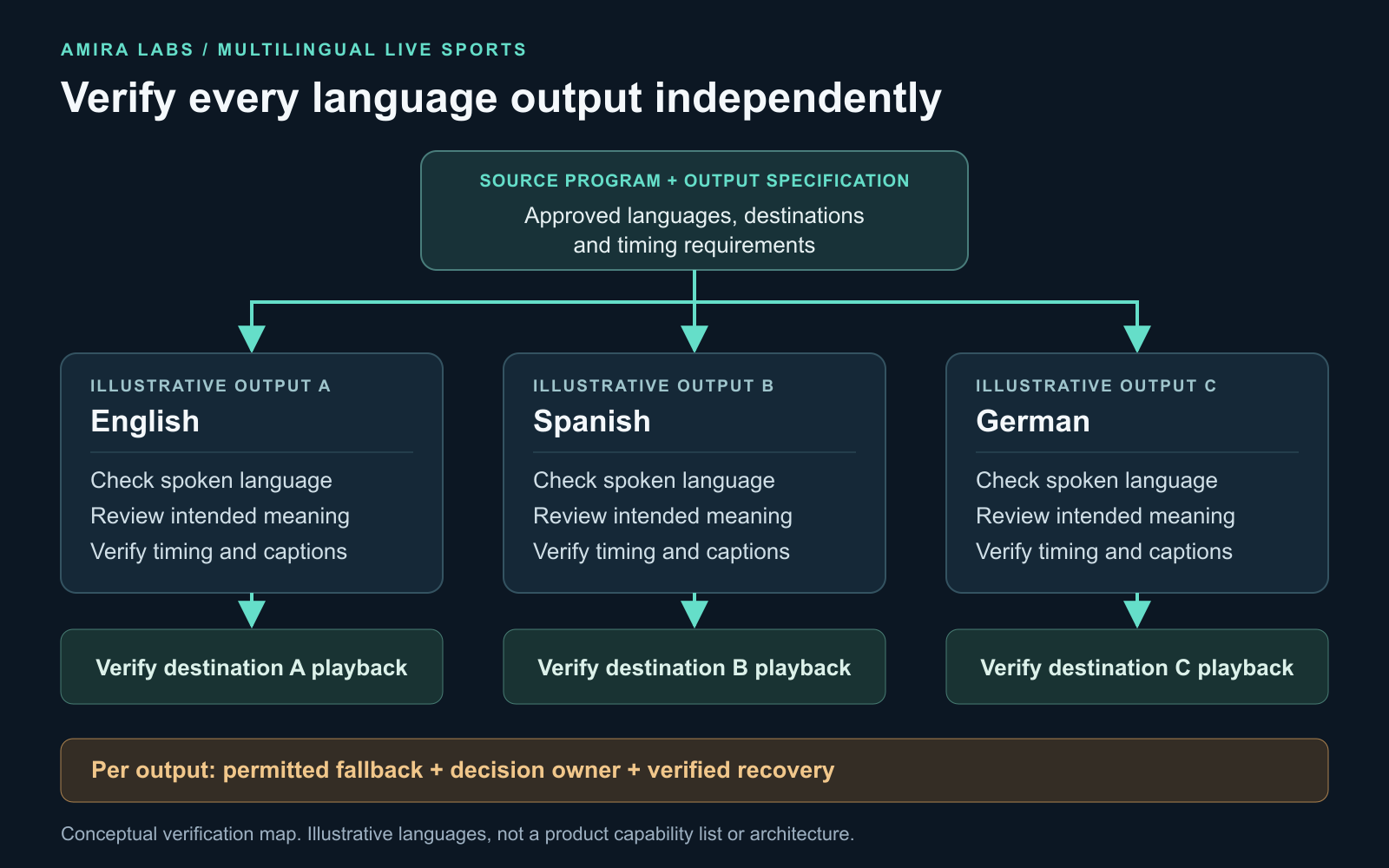
Conceptual verification map. The language examples are illustrative, not a product capability list. Each output needs an assigned fallback and recovery owner.
Distinguish event delay from audio/video alignment
Source-to-viewer delay measures how long an event takes to reach the audience. Within a language version, audio/video alignment describes the relationship between the displayed action and the commentary heard alongside it. Captions have their own relationship to speech and picture.
Do not require spontaneous commentary to coincide exactly with the action it describes; human commentary naturally follows events. Instead, define acceptable behavior for the program and measure the additional delay introduced by localization and delivery. Interviews may also require a separate lip-sync assessment.
Identify the observation points. Record when the relevant source phrase occurs, when its translated meaning is available in the produced audio, and when that audio plays at the receiver. Where useful, record phrase completion as well as first-word onset. A prompt first word does not show when the decisive part of a sentence arrived.
If language branches have different delays, one common video delay will not necessarily align all of them. Per-language buffering or separate program outputs may help, but they change the delivery design and can increase overall latency. Test the chosen arrangement rather than assuming a fixed offset solves variable translation delay.
Test a continuous sequence
Research gives a concrete reason to go beyond short clips. In a paper revised August 6, 2026, Yulin Xue, Siqi Ouyang and Lei Li report accumulating delay in several long-form speech-translation test conditions. Their evaluation includes conference talks and synthesized speech, not live sports broadcasts. The finding motivates a sustained test; it does not establish how a particular sports-localization service performs. Long-form speech-to-speech evaluation paper.
Run an uninterrupted, representative sequence that includes excited commentary, pauses, corrections and a restart. Track delay over time and retain late or missing translations in the results. Resetting the system between every short clip can hide an accumulating backlog.
Report the range and distribution as well as the average. A July 2025 ACL Findings paper similarly warns that average latency can mask large variations in simultaneous speech-translation evaluations. Neither research metric is automatically your audience-facing latency measure. Document the definition used in your acceptance test. Iranzo-Sánchez and colleagues.
Check what the player selects and renders
For HTTP Live Streaming, RFC 8216 defines language and selection attributes for alternate media. LANGUAGE identifies the rendition's primary language; NAME supplies its readable label; DEFAULT and AUTOSELECT guide selection behavior. These describe the delivery configuration. They do not inspect the speech to prove that the labeled track contains the expected language. RFC 8216, section 4.3.4.1.
Check fresh playback, an explicit language change, reconnect and return from a break on the supported receiver or app profiles. Verify the media actually played, not just the menu state. Use the applicable equivalent checks for other delivery formats.
Keep captions and graphics in the same review. Record whether captions follow the original commentary or the translated audio. Test text rendering, clipping, reading order and placement in the target language. Our live caption QC guide covers caption-specific checks; a translated commentary track does not settle accessibility requirements by itself.
What should happen when one language output fails?
A failed language output needs a predefined response for that audience. The response should preserve the outputs that remain healthy wherever the delivery design permits it.
Do not make silent substitution the default assumption. An original-language feed, an alternate commentator or an effects-only track may be technically available yet unsuitable for a particular destination. The permitted choice belongs in the output specification agreed with production and distribution partners.
Use an output acceptance record
The following is a proposed record to complete for each destination. It joins editorial acceptance to the delivered service without treating them as the same test.
Record field | What to document before launch |
|---|---|
Destination and program | Where the version goes, its event identifier and the approved source. |
Spoken language and track | Expected language/variant, commentary method, track assignment and any approved exceptions. |
Captions and graphics | Which source they follow, expected language and required presentation checks. |
Timing | Measurement points, accepted delay/alignment limits and the behavior allowed during recovery. |
Meaning and terminology | Reviewer, approved names/terms, blocking error categories and escalation contact. |
Fallback and recovery | Permitted substitute or other response, decision authority and conditions for returning to normal. |
A simple count helps scope the work. In a hypothetical service with three language choices, two supported caption configurations and four playback profiles, the full set contains 3 × 2 × 4 = 24 playback combinations. That is a planning example, not a claim about any product. Breaks, reconnects and failure conditions add test cases beyond those combinations.
If fewer combinations are supported, make that explicit. Count delivered configurations rather than advertising languages alone.
Rehearse failure and return to service
In an isolated test environment, interrupt one language source, swap two audio assignments and delay one branch. Confirm that the incident identifies the affected output and reaches the person authorized to respond. Test a stale caption source and a monitoring failure separately.
Then restore the branch. Check whether queued old commentary plays over current pictures, whether timing has changed, and whether the player still identifies the selected language correctly. Recovery is incomplete until the restored service meets its specification.
Retain enough timecoded source and output evidence to investigate disputed results, under the agreed access and retention controls. Do not let an automated monitor rewrite commentary or change routing simply because it reports a possible mismatch.
Recognize where automation is insufficient
Silence and crowd noise may not support a language decision. Short utterances can be ambiguous. A correctly identified language may still contain a serious mistranslation, while an independent commentator's different wording may be perfectly appropriate.
If the workflow cannot meet the agreed quality or delay limits, keep that language in a reviewed or non-live workflow, retain human commentary, or defer the addition. There is no obligation to put an experimental output on air because other language pairs passed.
What should you ask at an IBC localization demo?
Ask for a demonstration of the complete language output using material and delivery conditions relevant to your service. A successful translation in isolation answers only part of the buying question.
Before the meeting, prepare authorized source material, an output record and examples of critical errors. Name a linguistic reviewer and an operations owner. Include clean examples as well as difficult commentary, and keep final acceptance material separate from setup material. Agree how unresolved meaning, missing output and delayed recovery will be recorded.
Bring these questions:
- Which source-to-target language pairs have been tested on our type of commentary? Request the test conditions and limits, not just a language count.
- Can we review meaning, timing and receiver playback separately? Require evidence for each acceptance decision.
- Can the demo run continuously without resets? Observe how delay behaves during sustained speech and corrections.
- What happens when one language path fails and recovers? Inspect the fallback, affected captions and return to current pictures.
- Who signs off on the delivered version? Assign editorial and operational responsibility before adding another output.
Expand language coverage only as fast as your team can verify and support the resulting services. Every new audience should receive a version someone has actually checked.
Sources
- SVG Europe: Bundesliga places AI at the centre of its media strategy. Adrian Pennington, August 24, 2026. Reported proof of concept; not a completed production deployment.
- TV Tech: Gray's Telemundo stations get rights to two Atlanta Braves games. George Winslow, August 26, 2026. No AI-translation use is established by this report.
- IBC: IBC2026 event information. September 11–14, 2026; checked August 31, 2026.
- MQM Council: The MQM error typology. Current framework accessed August 31, 2026; used for terminology, not as a broadcast certification.
- Xue, Ouyang and Li: A Practical Evaluation Method for Long-Form Simultaneous Speech-to-Speech Translation. Version 2, August 6, 2026; research conditions differ from sports production.
- Iranzo-Sánchez and colleagues: Going Beyond Your Expectations in Latency Metrics for Simultaneous Speech Translation. Findings of ACL, July 2025.
- RFC Editor: RFC 8216, HTTP Live Streaming. August 2017, section 4.3.4.1; cited for alternate-media attributes, not as a complete current delivery specification.