

Bundesliga's virtual Bayern-Dortmund broadcast shows why an animated sports feed needs independent checks for tracking data, synchronization, editorial correctness and delivery.
What actually aired
On October 31, 2026, Bayern Munich and Borussia Dortmund drew 2-2. Alongside the conventional match coverage, Bundesliga distributed a full-length alternative broadcast that recreated the players and ball as Playmobil-style characters. The league's October 31 recap confirms that the virtual feed was carried across a wide international partner network, including platforms in the United States, United Kingdom, Canada and Germany.
This was not simply a cartoon overlay on camera footage. The Playmobil and Bundesliga announcement, dated October 26 says the production used the league's real-time three-dimensional player tracking. Its digital skeleton model represents each player with 21 body points, technology also used for semi-automated offside detection.
SVG Europe's October 26 engineering report identifies Sportec Solutions as the official tracking-data provider, EA TRACAB as the virtual renderer and AWS as the cloud backbone. It reported an expectation that the alternative feed would trail the conventional coverage by a few seconds. That was a pre-event report, not an independently measured end-to-end latency result.
Why this matters to operations
The Playmobil design is distinctive. The operational pattern is more general: a live sports event becomes a second program assembled from structured data, a rendering engine, audio, graphics and distribution systems.
A clean conventional feed does not prove the virtual output is correct. A tracking outage could leave figures frozen while the match continues. A delayed event feed could put the score ahead of the action. Commentary might describe a shot before the animated ball reaches the goal. These are plausible failure modes, not reported failures of Saturday's broadcast.
TVBEurope's October 27 coverage describes the production as an international alternative broadcast. That makes versioning and partner delivery part of the engineering story, not an afterthought.
Five acceptance tests for a data-rendered feed
1. Track data freshness, not just connectivity. At the ingest boundary, record source event timestamps, last-update age and continuity for players and ball. A connected socket or receiving process can remain healthy while useful motion updates stop. Specify a staleness threshold and what viewers should see when it is crossed.
2. Reconcile the event with the picture. Use known events such as kickoff, a goal, substitution or restart to compare conventional video, tracking data, virtual render and output encoding. Report the offset at each boundary. Separate tracking delay from renderer, packager and player delay. Avoid publishing one unexplained "live latency" number.
3. Verify commentary, graphics and accessibility. Test whether the virtual score, match clock, spoken commentary and any available captions describe the same play. Review a replay, VAR interruption and stoppage-time sequence. Captions or alternate-language tracks must be checked on the actual delivered version, not assumed to follow from the main feed.
4. Exercise graceful degradation. Simulate a short tracking-data gap, incorrect player association and renderer restart in a controlled environment. Define whether the service holds the last good scene, displays an explanatory slate, falls back to conventional coverage or stops. The fallback must be editorially truthful and approved by the rights holder.
5. Prove each distribution variant. Keep a market-by-market manifest of rights, platform, audio selection, caption availability, ad treatment and expected latency class. Test at least one real player in each materially different delivery configuration. A successful master output is not proof that a downstream app or partner feed is correct.
The missing evidence
Public announcements establish that the experiment took place, describe the underlying tracking approach and list distribution partners. They do not establish measured audience retention, a verified global latency distribution, fault rates, unit economics or an agreed operational SLA. Those should not be inferred from a successful launch.
For a broadcaster considering similar feeds, ask the supplier for a synchronized capture of the source event, tracking payload, rendered output and receiver playback, plus a recorded recovery test. The most useful question is not whether a virtual stadium can be rendered. It is who detects and owns a wrong virtual play while the real game continues.
The same distinction between source timing and viewer timing appears in our multiview sports synchronization field guide. Start with one event, one alternate output and a documented failure response before expanding the product.
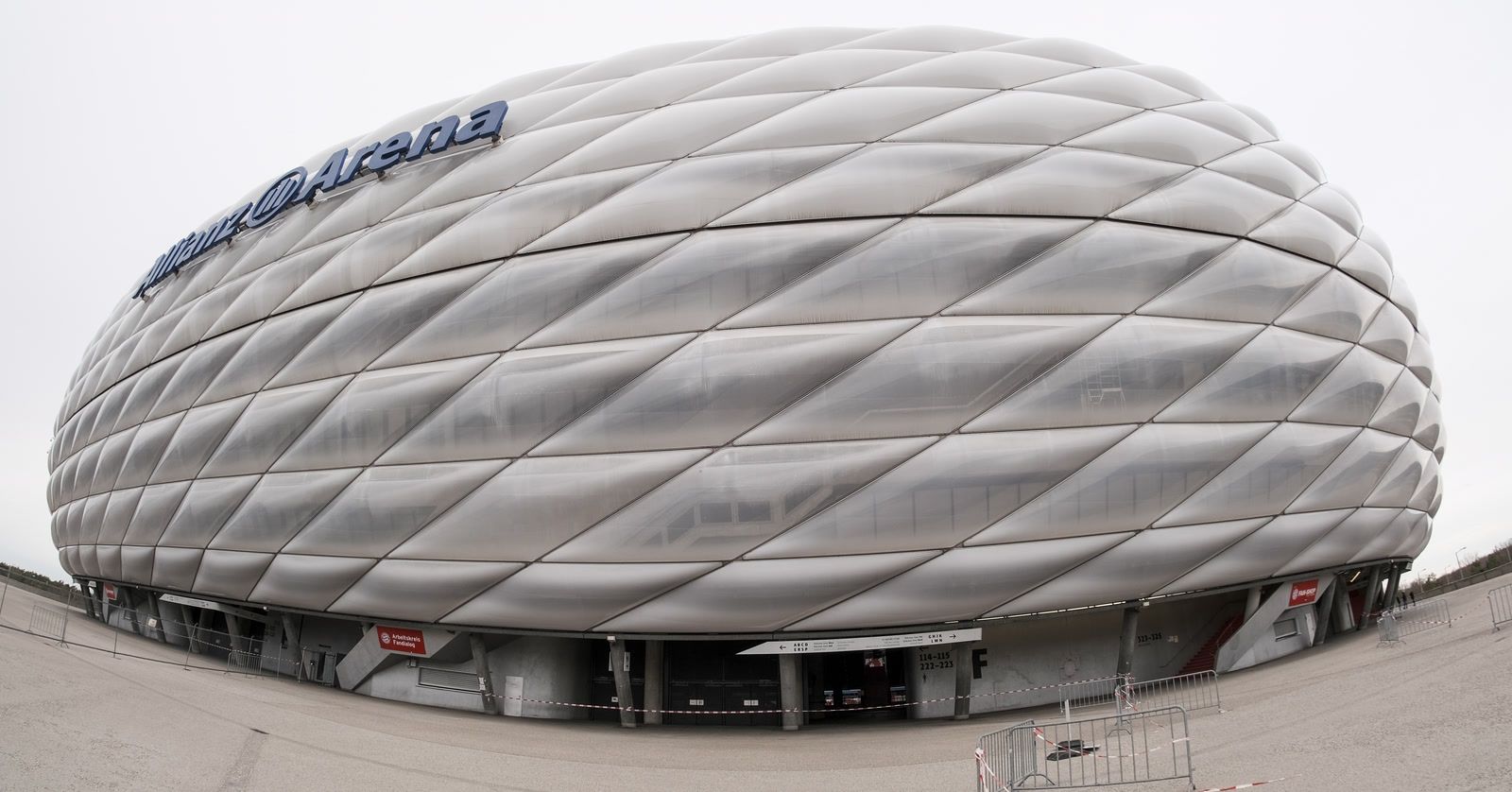
Image: Allianz Arena München, photographed January 5, 2024 by Håkan Dahlström, CC BY 2.0. Adapted to a 1600×838 landscape crop for this article. This is an authentic historical venue photograph, not a depiction of the October 31, 2026 game or its Playmobil virtual broadcast.