
Dek: ATSC's B2X candidate standard describes how a receiver finds a new broadcast waveform, but a field trial must separately prove that the intended service reaches an endpoint.
A receiver can find a signal without finding a usable service. That distinction should shape any broadcaster's first Broadcast-to-Everything (B2X) field trial.
ATSC's October 21, 2026 standards update reported a revised B2X System Discovery and Signaling Candidate Standard. Its purpose is to establish an entry point into a proposed B2X physical-layer waveform. It is not an announcement that a complete B2X television, mobile or data service has entered commercial operation.
Why it matters
The risk is testing the easiest part of the chain and mistaking it for the whole result. A successful bootstrap decode establishes that an endpoint can recognize and enter a waveform. It does not establish that service descriptions are correct, media is accessible, timing survives transitions or a receiver recovers after interruption.
ATSC's candidate-standard listing identifies A/391 as the B2X discovery and signaling specification, approved September 10, 2026, with its candidate period extending to June 30, 2027. Candidate status is a request for implementation feedback, not a guarantee of interoperability. ATSC's October 21 update makes that distinction explicit.
What changes from ATSC 3.0
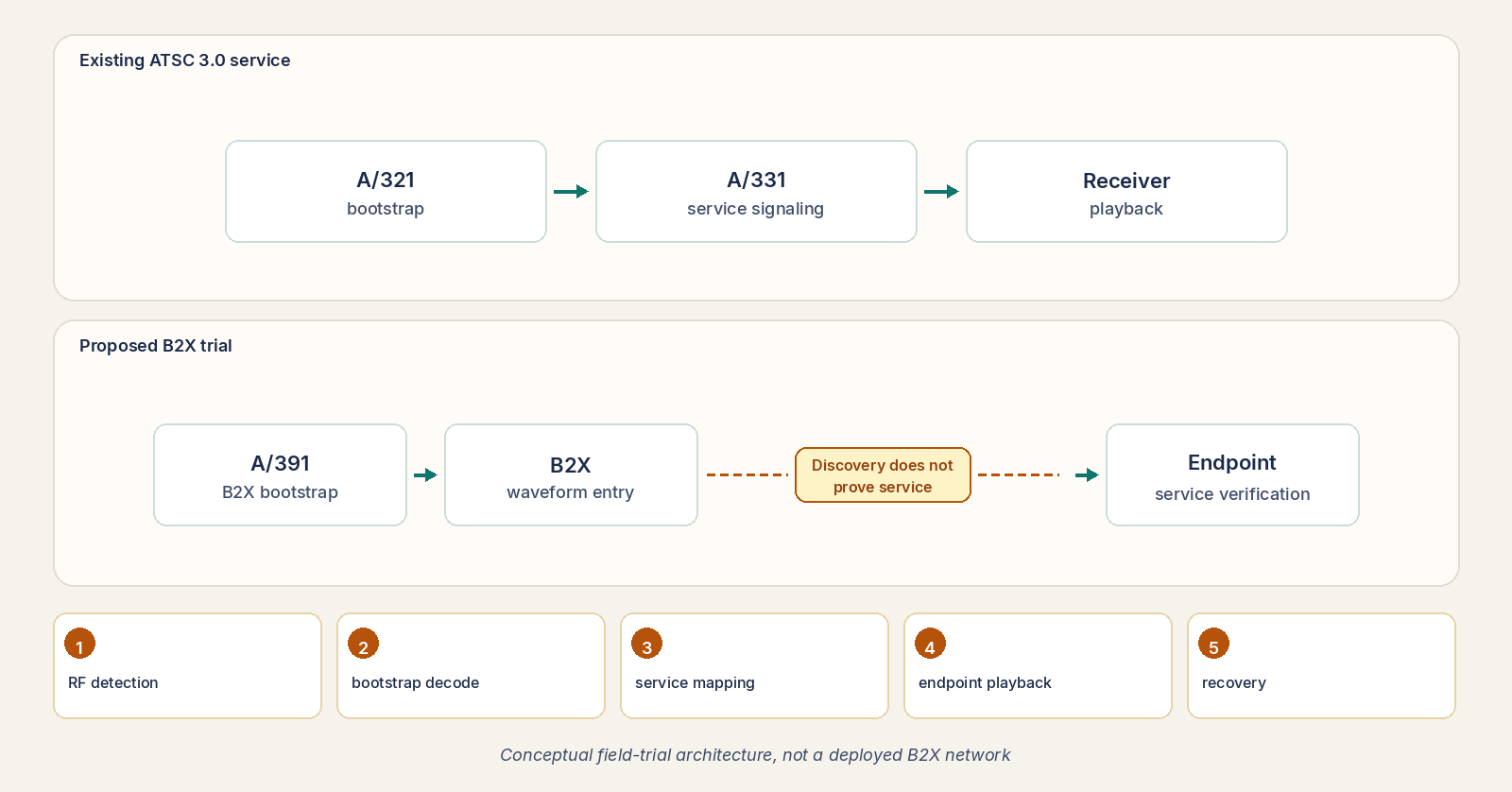
B2X builds on a familiar discovery concept but is not simply a renamed ATSC 3.0 service. The existing A/321 System Discovery and Signaling standard, updated June 11, 2026, defines a bootstrap that gives receivers an entry point to an ATSC 3.0 physical-layer waveform.
A/391 uses related ideas for B2X virtual frames and endpoints, including the prospect of operation in broadcast and mobile telecommunications bands. ATSC says A/391 does not modify A/321 or the existing ATSC 3.0 standards. That is a meaningful boundary for engineers designing parallel trials: a receiver's behavior on one waveform should not be assumed for the other.
Five acceptance checks for a B2X trial
1. Separate RF detection from service success. Record whether the endpoint detects the waveform, decodes its bootstrap and progresses to the intended service. Log each state independently so a discovery success cannot mask a delivery failure.
2. Validate signaling against intended service inventory. Maintain a trial manifest listing the services, versions, endpoint classes and expected availability. Compare what each endpoint discovers with that manifest. The exact service-layer mechanisms depend on the rest of the trial architecture, not on A/391 alone.
3. Test actual endpoint behavior. A protocol analyzer and a consumer-facing device answer different questions. Confirm that representative endpoints can access the intended payload or application, not merely display an RF lock or successful bootstrap indication.
4. Interrupt and restore the path. Rehearse loss of signal, a changed configuration and receiver restart. Measure reacquisition and restoration using trial-defined targets. Do not invent a standards-mandated recovery time where the cited discovery document supplies none.
5. Keep existing ATSC 3.0 service assurance separate. Monitor the current broadcast chain on its own terms. ATSC's 2026 standards index lists A/331 for signaling and delivery alongside A/321 for discovery. Neither an existing A/331 service check nor a B2X bootstrap check is a substitute for independent output verification.
Questions for the trial review
Ask which exact specification revisions are implemented; what counts as an endpoint passing; how failures are timestamped; and whether the trial produces reproducible traces from RF detection through service presentation. Also ask who owns the evidence when two vendors disagree about where a failure occurred.
The engineering takeaway: Make waveform discovery a checkpoint, not the finish line. A credible B2X trial should produce a service-level acceptance report that remains useful even if the candidate specification changes before standardization.
Image credit: Original Amira Labs editorial engineering diagram, November 7, 2026. Conceptual illustration, not a real B2X deployment.
Source documents: ATSC standards update, October 21, 2026; ATSC A/391 Candidate Standard, September 10, 2026; ATSC A/321 revision, June 11, 2026; ATSC A/331 listing, April 14, 2026. Links provided inline.