
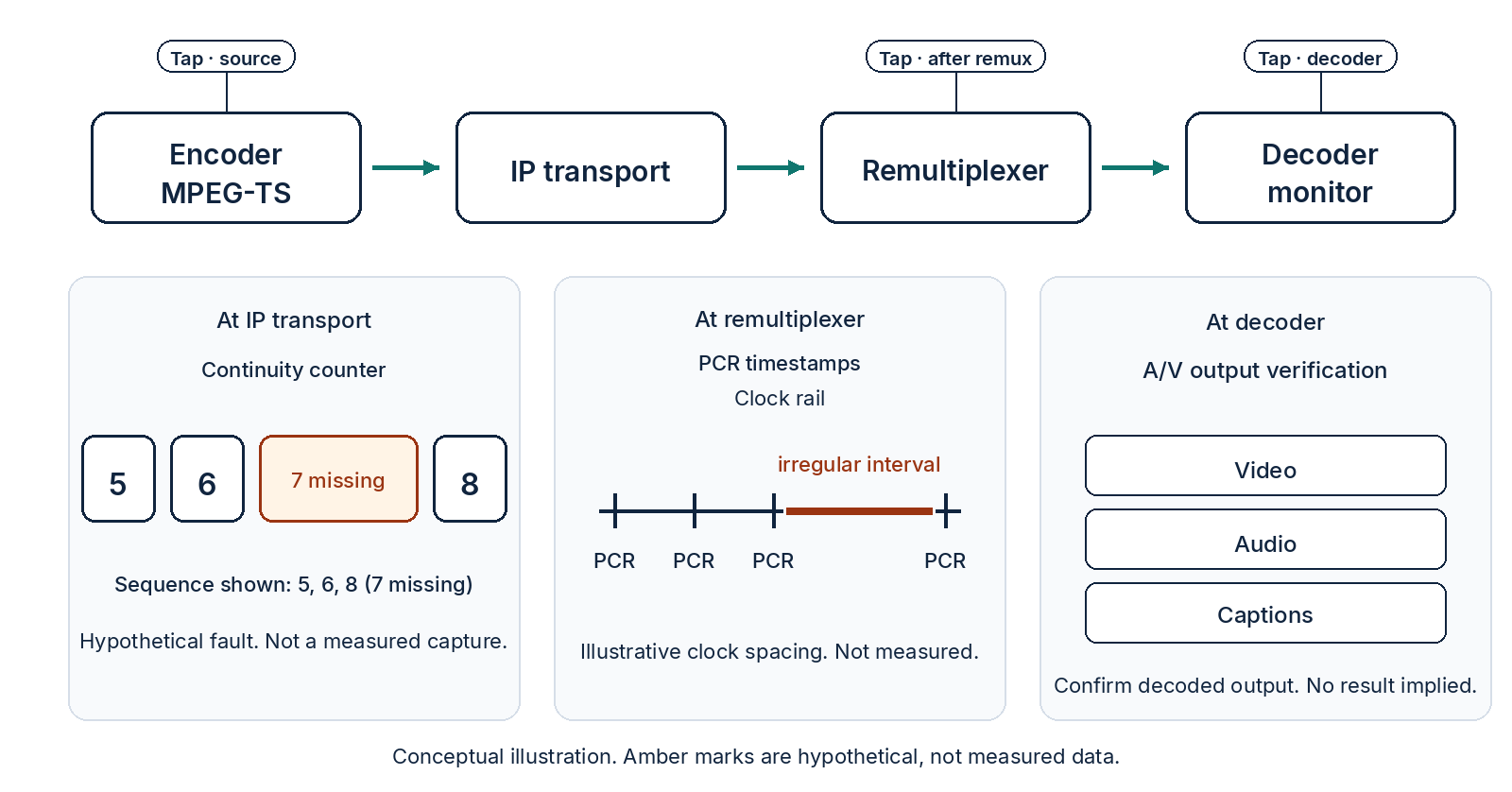
A transport stream can look healthy at the network interface and still produce decoder glitches. Packet continuity, program clock timing and actual decoded output answer different questions, so broadcast acceptance testing needs all three.
Why a clean network graph is not enough
A stable IP connection and an unchanged transport bitrate do not establish that every MPEG-TS program is decodable. A missing transport packet can interrupt an elementary stream; a remultiplexer can alter clock behavior without dropping the connection; and a decoder can show faults that upstream packet counters never describe.
The ITU-R BT.2389-1 report (March 2024) uses ETSI TR 101 290's error priorities to distinguish service unavailability, degradation and other impairments. Those classifications are a useful starting point, not a guarantee of good pictures or sound.
Five tests for a real commissioning window
1. Inject a continuity-counter discontinuity. On a controlled service, remove or reorder a transport packet and record which PID and program the analyzer flags. Confirm the decoder's visible or audible response. Account for legitimate discontinuity signaling, adaptation-only packets and duplicate-packet handling rather than treating every counter change as corruption.
2. Inspect PAT, PMT and PID mapping after a remux. Confirm that program association and mapping tables point to the intended video, audio, caption and PCR PIDs. Change the program configuration in staging and verify that alarms reflect the active mapping rather than a cached version. A present PID is not necessarily the correct PID.
3. Disturb PCR timing without changing average bitrate. Program Clock Reference values support reconstruction of the decoder's 27 MHz clock. Introduce a controlled timing irregularity and compare measurements at encoder output, after transport and after remultiplexing. The ETSI TR 101 290 measurement guidance distinguishes PCR repetition, discontinuity and accuracy. Its older editions contain thresholds that should not be blindly copied into a modern acceptance sheet.
4. Separate packet arrival jitter from PCR accuracy. Network jitter, analyzer timestamping and encoded PCR values are not interchangeable measurements. The Tektronix PCR explanation describes how the decoder uses PCR to reconstruct timing. Compare measurements using a documented observation point and clock reference; a noisy network graph alone cannot prove PCR corruption.
5. Verify output through a real decoder and failover. Run the same test on primary and backup paths, then switch while observing video, audio and captions. Record recovery time and any discontinuity. Test a sustained stream, not just a short green status snapshot. Different receiver implementations may expose different symptoms from the same transport defect.
What should the NOC record?
Keep the service ID, affected PIDs, analyzer location, transport-path identity, timestamp basis, continuity and PCR observations, decoder output evidence, and the exact configuration change that restored service. Separate a detected transport error from confirmed viewer impact.
The TR 101 290 technical overview explains why Priority 1, 2 and 3 indicators have different preconditions. A lower-priority indicator may be meaningless during synchronization loss. Alarm logic should suppress misleading downstream diagnoses rather than present a wall of unrelated red indicators.
The operational decision
Before signing off a contribution or distribution path, ask: can we identify the first point where the fault appears, reproduce it, and prove that the decoded service recovers? A clean bitrate chart is supporting evidence. It is not an acceptance test by itself.
Image credit: Original conceptual engineering diagram, Amira Labs editorial (2026). Not a production installation or measured incident.