A November 2 W3C draft sharpens the vocabulary for diagnosing encrypted playback. OTT operators should test license and key transitions at the screen, not just confirm that segments reach the CDN.
A green CDN is not a playable channel
A live stream can deliver every segment successfully and still show a black screen. The missing piece may be a decryption key, a rejected license or an output-protection restriction rather than a transport fault.
The W3C Encrypted Media Extensions Working Draft dated November 2, 2026 describes the browser interface used to negotiate content-decryption capabilities and exchange license messages. It includes key-status states such as usable, expired, output-restricted, output-downscaled, status-pending and internal-error. It also describes waitingforkey, an event that can accompany blocked playback.
This is a Working Draft, not a newly mandated DRM standard. It does not define Widevine, FairPlay or PlayReady, and it does not prove that a particular streaming service is experiencing faults.
Why it matters
A live event can cross multiple crypto-periods while the viewer remains in one playback session. The packager must signal the right protection information, the application must obtain an appropriate license, and the device must be able to use the key when encrypted samples arrive.
The DASH Industry Forum's CPIX guidelines explicitly model key rotation with content keys and key periods. That makes rotation a coordination problem between key services, packagers, manifests and players, not just a security setting.
Apple's HLS authoring specification separately defines FairPlay-related packaging requirements, including SAMPLE-AES and the com.apple.streamingkeydelivery key format. These requirements are not interchangeable with every DASH and DRM combination.
An operator watching only segment HTTP responses or a source encoder could miss an authorization failure that affects one device family, account state or display connection.
Six acceptance tests for encrypted live playback
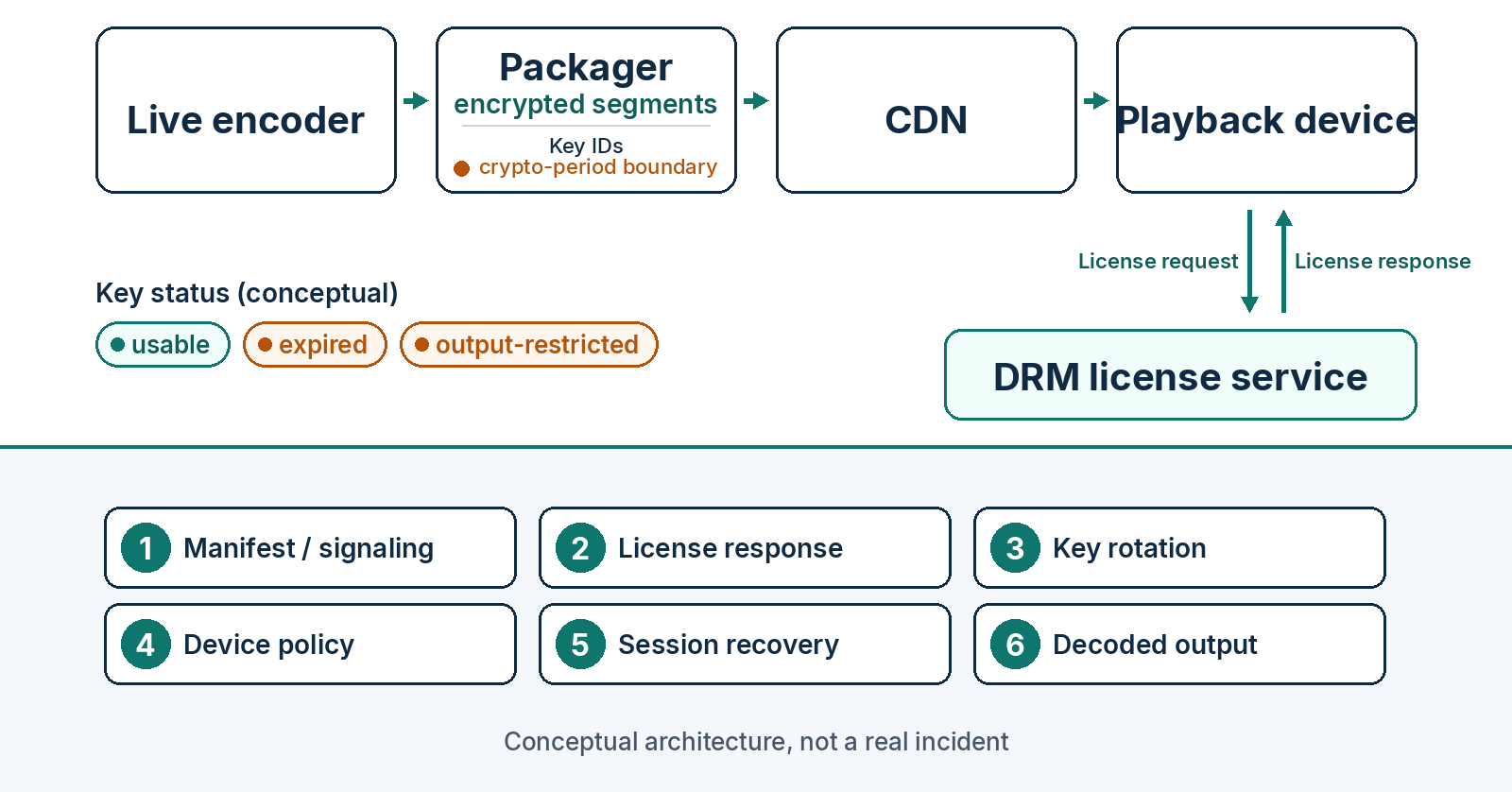
1. Inspect signaling before tuning. Verify the intended protection scheme, key identifiers, encryption tags and initialization data in each supported HLS or DASH representation. Compare against the keys actually provisioned. A syntactically valid manifest does not guarantee that its encryption metadata is correct.
2. Exercise license failures deliberately. In a controlled environment, test expired authorization, unavailable license endpoints, rejected entitlements and slow responses. Record player error codes, license round-trip time and visible outcome without logging raw keys, tokens or personally identifying account details.
3. Cross a real rotation boundary. Keep playback running before, during and after a planned key change. Check that the next key is obtainable in time and that audio and video continue without freezing. Repeat after joining immediately before rotation, when the available recovery window is shortest.
4. Vary device and output policy. Test representative browsers, connected TVs, mobile devices and HDMI display paths. Distinguish unsupported protection systems from an output-restricted key state. Do not infer that a failure on one firmware version affects every device.
5. Recover a long-running session. Suspend and resume the app, renew authentication, change renditions and reconnect after a brief network interruption. Confirm that the player can reacquire the needed license rather than remaining stuck on a stale session.
6. Verify decoded output. Observe actual picture, audio and continuity after each test. A successful license HTTP transaction is not proof that the CDM decrypted the right samples or that the user saw a frame. Apple's CMAF/HLS guidance also describes initialization and key-prefetch signaling relevant to these transitions.
Put the evidence in one incident timeline
For each test, correlate manifest version, key ID (not key material), crypto-period boundary, license outcome, device model, player state, and first decoded frame after recovery. Use synchronized timestamps. Report startup failures separately from mid-session interruptions.
This is an engineering recommendation, not a claim about any specific vendor's implementation. A practical acceptance gate is whether each supported device can start, survive a rotation and recover without manual intervention under the agreed operating conditions.
The next time an encrypted live channel appears healthy upstream but black on a television, ask which key the player needed, whether the license was usable at that instant and whether the display policy allowed presentation. That is a more actionable fault boundary than 'the CDN is up.'
Image: Original Amira Labs technical diagram. Conceptual DRM delivery and QC checkpoints; not a real outage or product screenshot.