
Dek: An HLS playlist can be syntactically valid while adaptive bitrate switching still freezes or skips frames because the renditions do not share reliable decoding boundaries.
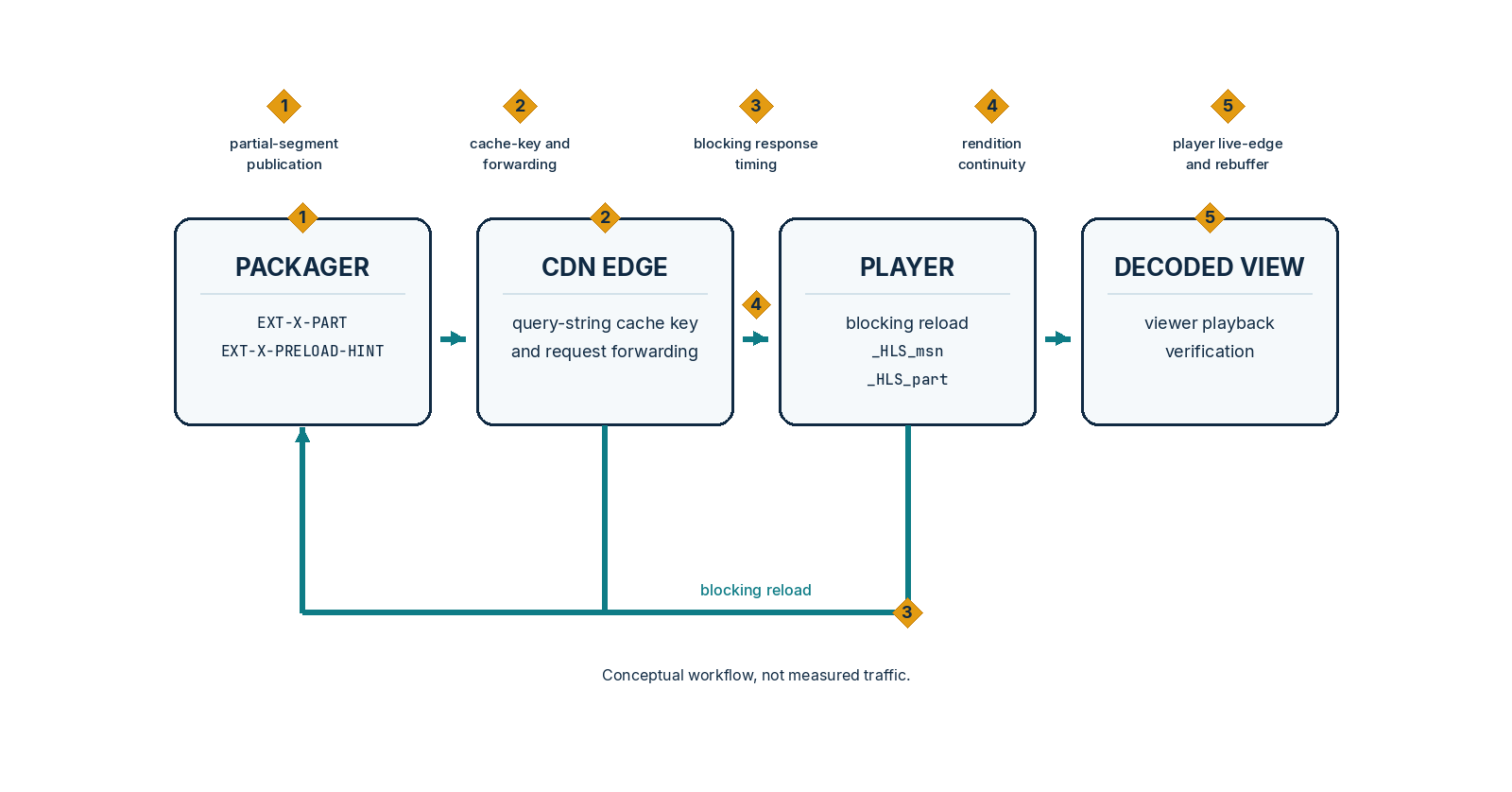
A viewer switches from a 1080p rendition to 720p as bandwidth drops. Both playlists load. Every segment returns HTTP 200. The picture nevertheless stalls for several seconds. That is a different failure from the CDN blocking-reload problem covered in yesterday's field note: the media itself may not offer a safe place to switch.
Why it matters
Adaptive bitrate (ABR) is supposed to preserve continuity as network conditions change. The test is not whether each rendition plays from its beginning. It is whether a decoder can leave one rendition and enter another at the intended media time without missing reference pictures, duplicating frames or losing audio synchronization.
Apple's HLS authoring specification requires video segments to start with an IDR frame for its device profile, specifies continuous fragment decode times for fMP4 and recommends matching segment boundaries across audio/video variants. Those are related but distinct checks. A matching six-second duration in a playlist does not prove that the underlying samples begin at equivalent presentation times.
Six acceptance tests
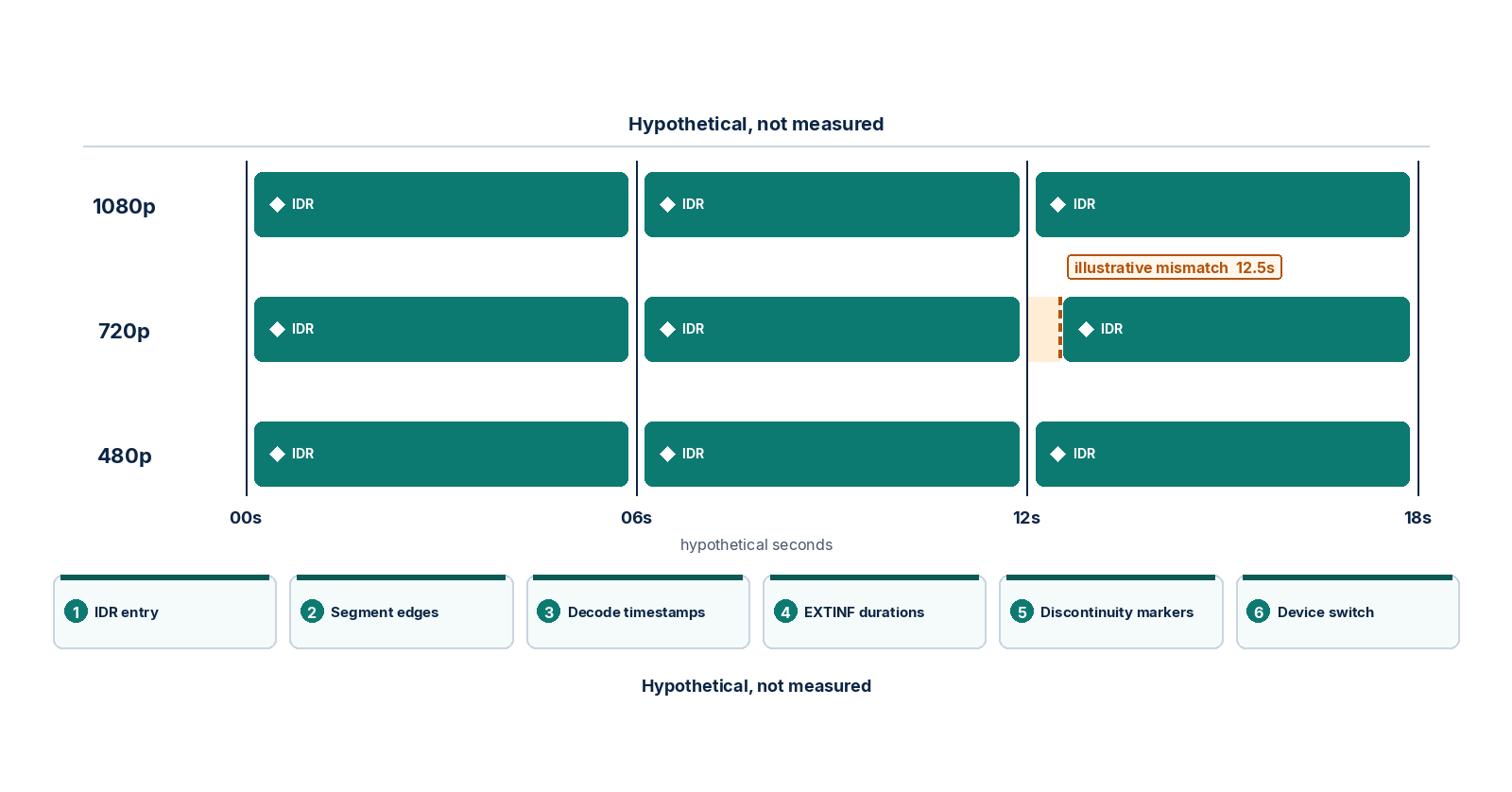
1. Inspect random-access entry points. Decode the first pictures of successive segments in each video rendition. Confirm the segment starts with the independently decodable entry point required by the target device profile. Do not infer this from a playlist tag alone. RFC 8216 explains why an H.264 segment without an early IDR may download pictures that cannot immediately be used.
2. Compare actual segment boundaries. Build a common media-time timeline for all renditions. Compare the first and last presentation timestamps, not just the filename sequence or rounded EXTINF values. A segment that starts half a second later in one rendition may make a switch produce a skip or repeat.
3. Verify decode-time continuity. For fragmented MP4, inspect the track-fragment decode-time information and sample durations. Apple's CMAF-with-HLS guidance explains initialization maps, independently decodable fragments and discontinuity handling. A correct EXT-X-MAP is necessary for initialization, not proof that the timeline is continuous.
4. Reconcile declared and measured durations. Compare EXTINF durations with the samples carried by the media. Apple's authoring guidance calls for accurate durations and matching target durations across audio and video playlists. A tiny recurring mismatch can accumulate into a switch-time gap or growing synchronization error. Keep measured sample durations and manifest declarations in the test evidence.
5. Test discontinuity signaling. Switch across a planned ad boundary, encoder restart or source replacement. Confirm the affected renditions mark genuine encoding or timestamp discontinuities consistently, and check EXT-X-DISCONTINUITY-SEQUENCE where required. RFC 8216 defines the relevant playlist semantics; Apple adds device-oriented authoring requirements. Do not add a discontinuity tag merely to conceal an unexplained timestamp error.
6. Exercise real ABR decisions. Use a representative player and network shaping to force downshifts and upshifts during motion, live junctions and periods of sparse scene changes. Record rendition IDs, segment URLs, download times, buffer occupancy, decoded frames and audible output. Repeat with separate audio renditions. A manifest validator can find structural errors, but only playback evidence demonstrates the viewer's outcome.
What operators should ask
When a switch stalls, identify the first boundary where the two renditions diverge. Is the problem in encoder GOP alignment, packager segmentation, manifest durations, timestamp discontinuity handling or a player-specific policy? Which system owns the fix, and which measured timeline proves recovery?
Do not use one fixed GOP interval as a universal requirement: encoding frame rate, segment policy and supported devices determine the actual configuration. The acceptance criterion is the observable, correctly signaled switch boundary.
The engineering takeaway
Monitor ABR as a cross-rendition property, not as a collection of individually healthy video tracks. A practical commissioning report should include a boundary comparison, a timestamp trace and at least one device-side forced-switch capture. The Apple HLS documentation hub provides the relevant authoring and validation starting points.
Image credit: Original Amira Labs editorial diagram, November 10, 2026. Hypothetical segment timeline, not a production capture. PNG must be rendered from the accompanying specification before publication.
Sources reviewed November 10, 2026: Apple HLS authoring specification (revision history last dated June 26, 2025); Apple CMAF with HLS documentation; RFC 8216 (August 2017); Apple HLS documentation hub. These are existing technical references, not newly announced November 2026 standards.