
An app can stay available in the Roku Channel Store while viewers take a different route to the same show. The search result, the home-screen tile, and the default destination behind a program listing each send traffic somewhere. After the Fox–Roku acquisition closed on November 6, 2026, those routes became important commercial measurements for any publisher that also competes with Fox for viewers or advertising. Fox confirmed the closing. Its June 15 announcement valued Roku at about $22 billion in enterprise value. Fox said at closing that Roku’s platform reached more than 100 million households worldwide and projected roughly $400 million in annual run-rate cost savings within two years. That figure is a company forecast. The U.S. Department of Justice separately said it closed its antitrust investigation after reviewing the transaction and described four commitments from Fox. For streaming executives, the immediate work is to establish how discovery, distribution, data access, and ad delivery function today. Then make those observations reproducible when the next platform release, rights change, or contract renewal arrives.
What did the Fox–Roku acquisition change on closing day?
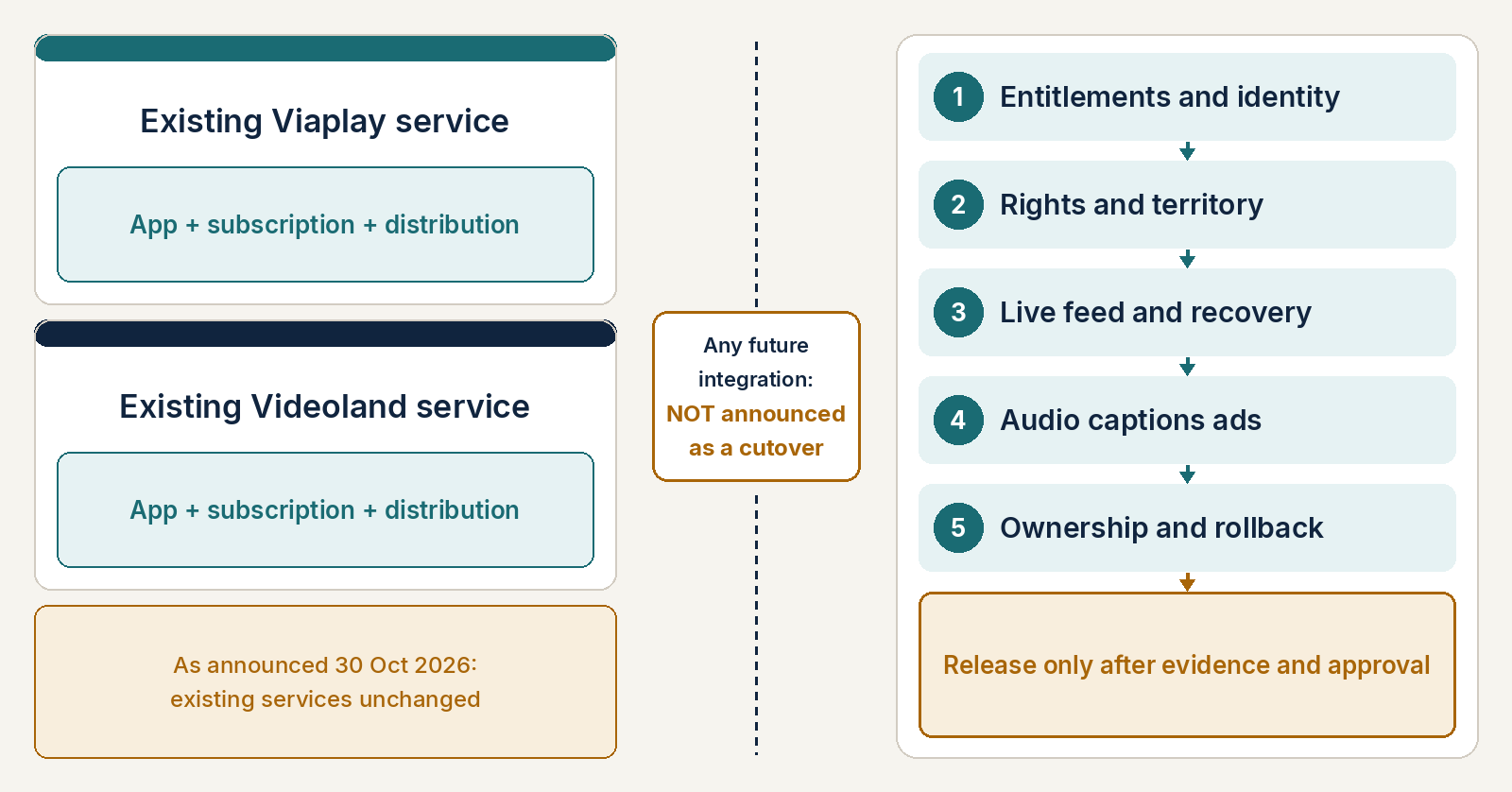
The transaction put Roku, Tubi, and FOX One in the same corporate group. Fox’s November 6 release placed them in a new Fox Digital Platforms division alongside Red Seat Ventures and other businesses. Publishers that distribute through Roku now share a route to viewers with several services whose owner also owns the platform. A combined organization can explore sales and operating efficiencies across those businesses. It still has to show which operational changes it actually makes. Treat the $22 billion figure as the June announcement’s enterprise valuation. The November closing release separately gives the consideration as $95.30 in cash plus 0.9799 Fox Class A shares per eligible Roku share. A fixed dollar headline and a cash-plus-stock payment describe different things. The value of the stock component varies with Fox’s share price. Ownership also tells an operator very little about a specific viewer session. A broadcaster may distribute a subscription app, a free ad-supported streaming television channel, and event highlights through different arrangements on the same device. Each can have its own entitlement rules, guide listing, and commercial owner. Begin with the paths a customer can actually take, then attach the agreement that governs each path. Treat any future ad or product integration as a separate development that needs its own evidence.
What did Fox commit to for competing publishers?
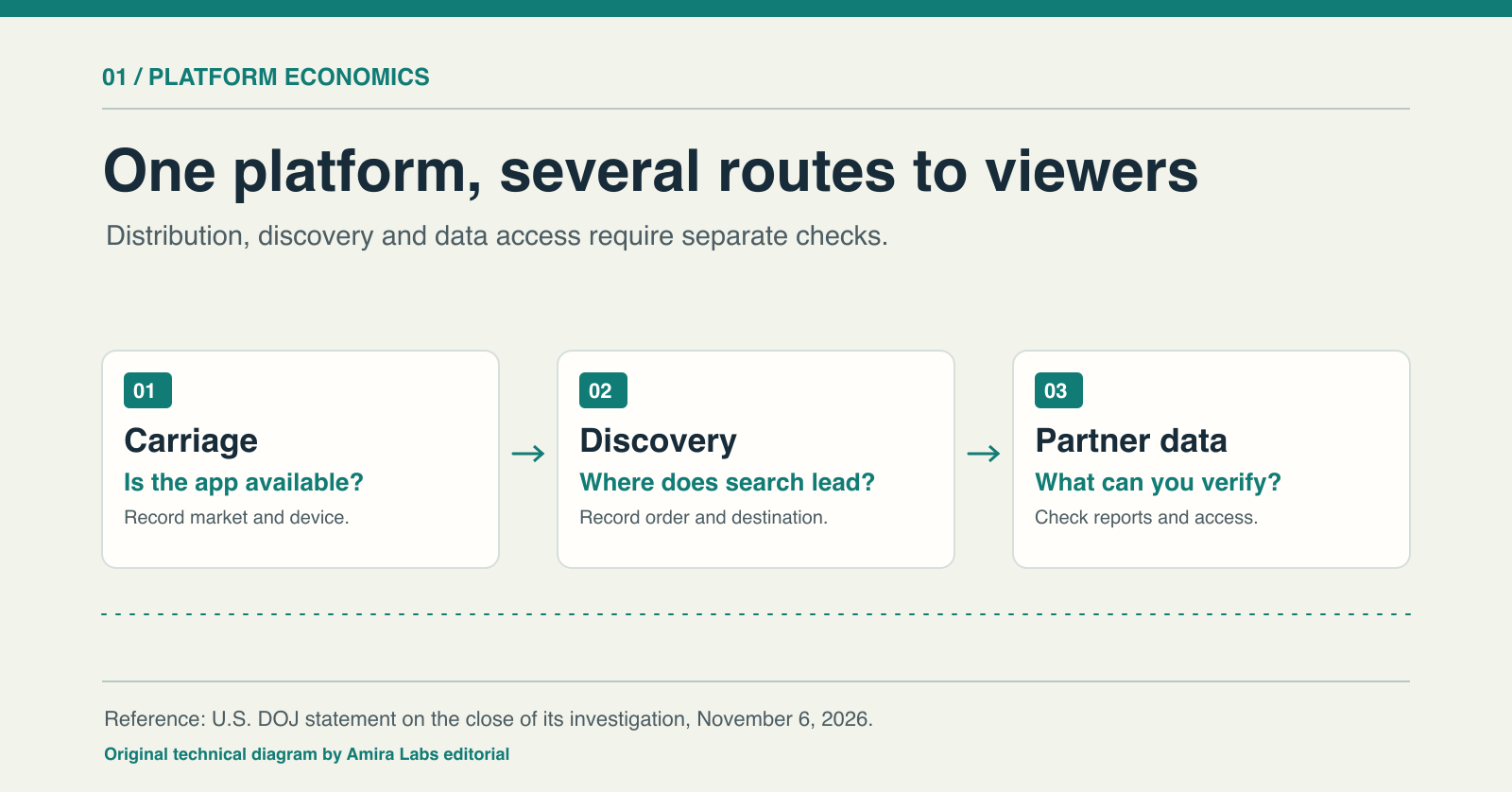
The Justice Department’s November 6 statement says Fox committed to continued carriage of non-Fox content for at least three years in line with historical practice. It also describes nondiscrimination in search, continued user control over app arrangement on the home screen, commercially reasonable access to third-party data products in line with Roku’s standard distribution agreement, and preservation of existing contractual firewalls for competitively sensitive non-Fox content data for at least three years.
What the DOJ described | What a publisher can observe or request |
|---|---|
Continued carriage for at least three years, consistent with historical practice | Track app availability and updates. Record differences by territory, device support, and account state. |
Search nondiscrimination and continued user control of home-screen app arrangement | Compare equivalent searches under repeatable conditions. Verify that a user’s app arrangement persists where expected. |
Continued provision of data products on commercially reasonable terms consistent with the standard agreement | Record available datasets, fields, reporting delays, commercial terms, and the route for disputes. |
| Existing contractual firewalls for sensitive non-Fox content data for at least three years | Ask which teams and service accounts can use partner data, for what purpose, and what evidence supports those controls. | The duration appears explicitly on the carriage and firewall commitments in the DOJ statement. The agency said it could act as facts or circumstances change. The statement describes Fox’s commitments and the close of an investigation. For an individual publisher, the distribution agreement remains the document to review for definitions, escalation rights, and the scope of access to reports. Read the search and home-screen language separately. A user’s ability to move an app tile addresses a different feature from an editorial recommendation or sponsored placement. A test of one surface gives evidence about that surface. Ask the platform to identify which settings control each placement so the commercial team can put complaints in the right queue.
How can a publisher measure changes in discovery?
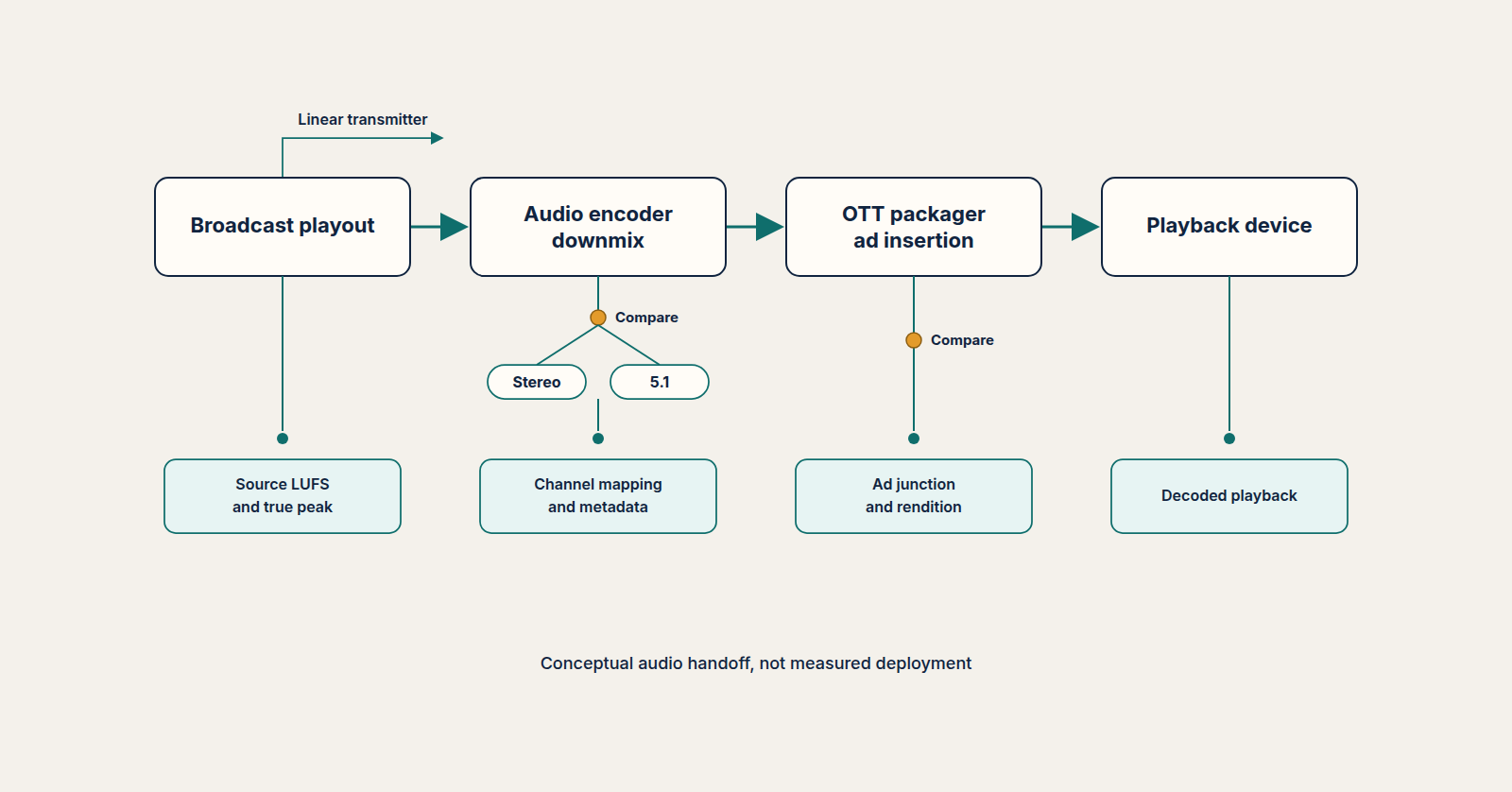
A publisher can build a small panel of repeatable searches and record where they lead. Pick titles for which your app and at least one other app have verifiable rights in the test market. Include a live event, a catalog title, and a title with multiple episodes. Keep a dated record of the rights and entitlement state so a test operator knows which destinations should be available on that date. Separate the device conditions. Start one pass with a clean account and a second with a returning subscriber whose app is already installed. Log device model, software version, locale, account state, query wording, time, and the apps installed. Save the result order and the destination of each deep link. Note when a sponsored or editorial surface is visibly identified. If a link opens the right app at the wrong episode, record both outcomes. Availability and routing are different measurements. A useful result set includes a pair of controls. One is a title exclusive to an app, which checks whether search finds a valid destination at all. The other is an unaffected title with multiple valid destinations, which helps show whether a change is specific to a service or part of a broader release. Run both controls before treating a drop in one title’s position as an account-level event. Repeat searches at comparable times and through software updates. Use a fixed panel to preserve continuity and a rotating panel to catch new rights windows. A change observed on one television can justify a support ticket. It takes a stronger design to explain that change. Rights expiration, inconsistent program metadata, a changed query, a stale cache, or a product experiment can produce similar symptoms. Document the competing explanations and ask the platform which it can confirm. Measure a week of ordinary use before prioritizing the tentpole event. A baseline that includes only a major sports night can confuse a predictable change in demand with a change in the path viewers use. Save the ordinary results alongside the event test. Discovery can also fail after the viewer has found the right channel. Guide data may say the program is live while the stream carries a different show. The FAST guide and schedule checks give distribution teams a way to compare scheduled and actual playback.
Which changes would show up first in the economics?
Changes in how viewers arrive and who can sell the available ads will usually matter before a combined-company financial result is useful to a partner. Separate the acquisition of viewing from the monetization of viewing. For acquisition, log launches by entry point, successful playback starts, and paid conversions or returning viewers where the publisher can observe them. For monetization, reconcile sellable opportunities, delivered impressions, sell-through, and net receipts after fees. Consider a hypothetical free channel with 1 million eligible opportunities in a month. At 80% sell-through and $15 net per thousand sold impressions, it would bring in $12,000. If opportunities rose 10% while sell-through fell to 75% at the same net price, revenue would rise to $12,375. More reach helped, although the $375 difference is smaller than a traffic chart alone might suggest. If the net rate slipped to $14 under the same new volume and sell-through, the result would be $11,550. These are invented inputs for a worksheet. Keep the opportunity definition and excluded inventory consistent across periods before comparing real invoices. For an app with subscriptions, start with qualified playback and subscriber contribution. A search link that sends an existing subscriber straight to a live match can be valuable even if it creates no sale. A prominent placement that drives installs from people outside the relevant rights territory may look good in acquisition reporting and produce little viewing. Retain those cohorts separately. If platform data groups them together, ask for a separate breakdown or measure the available events in your own player. Fox’s cost forecast belongs in the transaction story. Your worksheet should use the terms and delivery numbers of your own agreements. Revisit the model when a sales arrangement, fee, placement, or reporting term actually changes.
Where will a partner’s own measurements fall short?
A publisher can check a route to content and reconcile many commercial outputs. It generally cannot infer internal access to data from a screen recording or a shift in traffic. Those questions require contractual definitions and evidence from the company operating the systems. The same limit applies to an unexplained recommendation change. An external observation can establish the symptom with precision. It rarely establishes motive on its own. Make the distinction explicit in an escalation. Provide the observed state, the time window, the affected titles and devices, and the impact on viewers. Put the question about cause in a separate field. For a data issue, identify the particular field or product, when it last arrived, and which clause or published description governs it. A partner manager can escalate that more readily than a general complaint about neutrality. A broad test matrix can also consume effort without affecting a decision. Give priority to the devices and territories that drive meaningful viewing, revenue, or customer obligations. Schedule around renewal and rights milestones. A smaller publisher with limited Roku distribution may reasonably start with a handful of high-value titles and a monthly export of the reports it relies on. Increase frequency when the tests find a persistent issue or the stakes rise.
What should distribution and advertising teams do this week?
Create a single owner list with one name for app availability, one for ad reconciliation, and one for contract and data escalation. Record the current agreement and the latest operational contact next to each name. Then take a dated snapshot of your current search results, deep links, and reports. Store enough context for a second operator to repeat the check. Ask the platform to show which partner data products your agreement covers and how access issues are handled. Ask your own finance team for the baseline it uses to reconcile sold impressions and net receipts. Run one deliberately expired entitlement through the viewer test, so the team can recognize a correct denial during a later incident. At the next renewal, bring a real month of evidence. Include one discovery result, one reporting reconciliation, and any unresolved differences with their history. That gives both sides something specific to price, fix, or write into the agreement.