
The FCC's upper C-band clearing plan is pushing TV networks and affiliates to rethink satellite delivery. The immediate job is to test replacement paths, not just price new circuits.
Why this matters now
On October 29, TVNewsCheck reported that broadcast technology executives are evaluating Ku-band, terrestrial IP and hybrid approaches as the U.S. upper C-band transition approaches. The discussion involved leaders from Nexstar, Gray Media, Amagi and Zixi. Those are reported industry views, not evidence that any one replacement architecture has won.
The regulatory change is real. In its July 2026 final rule, the FCC set aside 160 MHz at 3.98-4.14 GHz for terrestrial wireless use in the contiguous United States. It also designated a 20 MHz guard band at 4.14-4.16 GHz, leaving 4.16-4.2 GHz for continuing satellite downlinks. An auction is required by July 4, 2027. The main satellite clearing milestones fall in December 2030 and June 2031.
The immediate planning deadline belongs to eligible satellite operators, not every TV station: their initial transition plans are due November 5, 2026. The FCC's October 26 notice opens those plans for stakeholder comments through November 30 under GN Docket 26-289.
A satellite replacement is a service replacement
C-band has historically provided wide-area distribution of the same network feed to many affiliates. Moving an individual station to another path changes more than the transport bill. It can change who monitors continuity, how a backup is activated, what happens when two routes share infrastructure, and which party pays for recovery.
Ku-band remains a candidate, but rain fade and dish requirements must be engineered for the actual receive site. Terrestrial IP can offer flexible routing, yet two providers may share a physical fiber route. Bonded cellular or low-Earth-orbit connectivity can add diversity without guaranteeing the same sustained performance as a dedicated primary path.
These are engineering tradeoffs, not claims that any particular provider has failed.
Five tests to run before choosing a new path
- Map the complete dependency. For every network service, record its source, satellite/transponder or IP endpoint, receive equipment, local handoff, decoder, audio/caption services, downstream outputs and contract owner. Identify feeds that have no independently usable fallback.
- Prove physical diversity. Ask both circuit providers for route-diversity evidence, including last-mile entrance, conduit, shared carrier facilities, power and upstream dependencies. A pair of different ISP invoices is not a diversity test.
- Verify the media, not merely the connection. At the station decoder and at a representative downstream output, confirm expected video, audio language/layout, captions, program timing and ad-cue behavior where applicable. Record MPEG-TS service identifiers or other applicable service identities so a working link cannot mask a wrong feed.
- Rehearse a controlled failover. In an authorized test window, simulate loss or impairment of the primary route and measure first alarm, operator acknowledgement, switch time, media interruption and clean return. Include the backup's behavior during sustained congestion, packet loss or adverse weather where practical. A link ping is not an on-air acceptance test.
- Price the operating model. Separate dish/decoder installation, circuit setup, recurring connectivity, data transfer, support, monitoring, backup capacity and periodic drills. Record who pays for each element after the transition.
The reimbursement question needs its own owner. The FCC's October 19 preliminary cost-catalog notice describes reasonable and necessary transition costs and a per-site lump-sum option for eligible incumbent earth stations. A lump-sum election is irrevocable. The catalog is preliminary, and eligibility or reimbursement of a proposed long-term IP bill should not be assumed. Reply comments on that catalog are due November 9.
What should the chief engineer ask this week?
Pick one high-priority network feed and request a single-page migration evidence pack from the distribution provider. It should show the intended primary and backup routes, shared dependencies, expected media attributes, alarm destinations, test dates, measured restoration behavior and five-year costs. Ask who owns the incident when a provider reports a healthy connection but the affiliate is off air.
A useful acceptance gate is simple: can the station receive the correct service through an independently tested alternate path, and can operators prove the recovery? The FCC schedule creates urgency, but no spectrum order can answer that station-specific question.
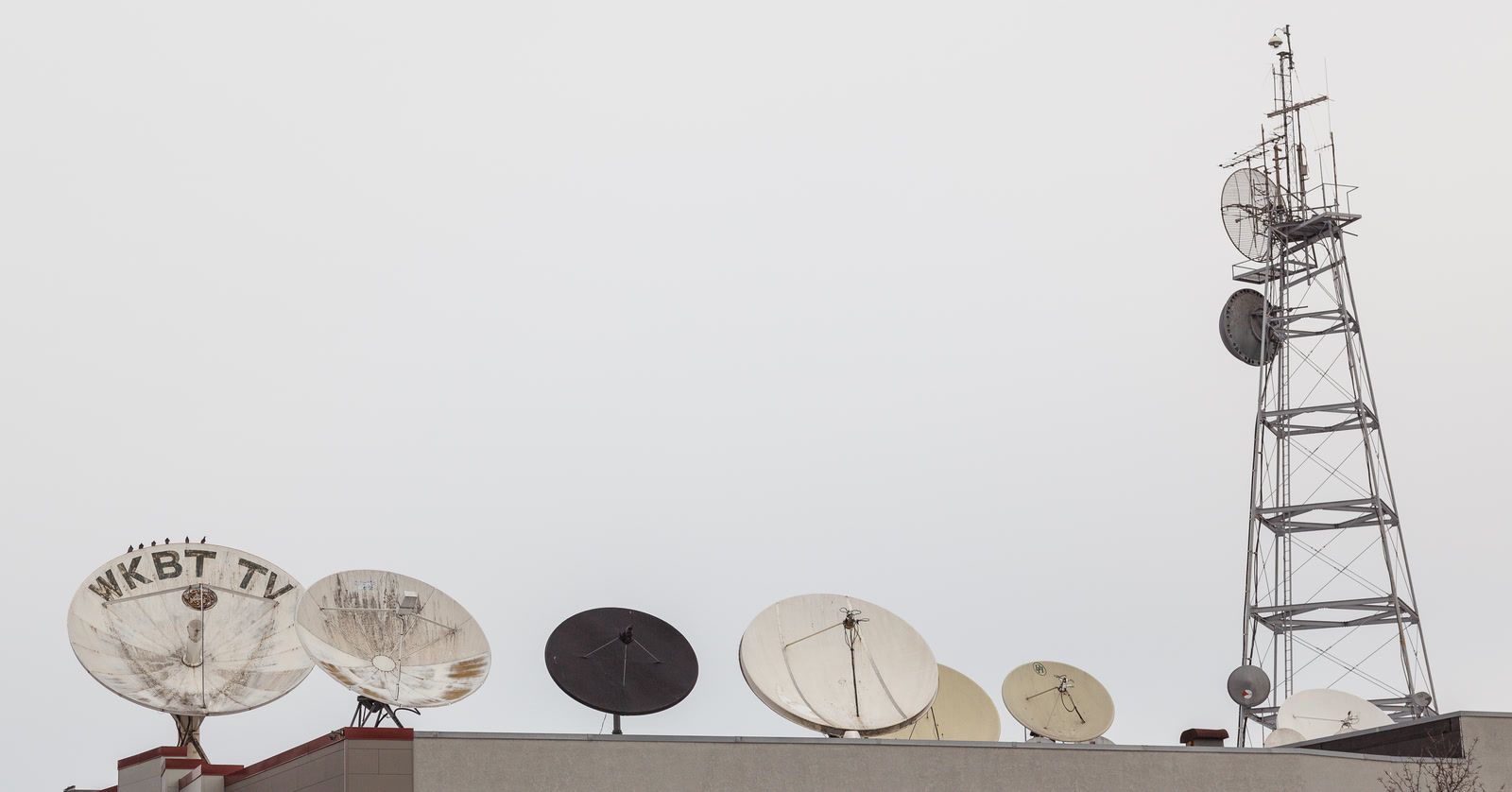
Photo: [Tony Webster, “WKBT-TV News 8 Satellite Dishes - La Crosse, Wisconsin” (January 27, 2016)](https://commons.wikimedia.org/wiki/File:WKBT-TV_News_8_Satellite_Dishes_-_La_Crosse,_Wisconsin_(24363495350).jpg), CC BY-SA 2.0. Illustrative historical station photo, not an image of a 2026 migration. Hero crop from the original is an adaptation licensed under CC BY-SA 2.0; no endorsement implied.
Related reading: Managed playout monitoring: what broadcasters still need to verify.