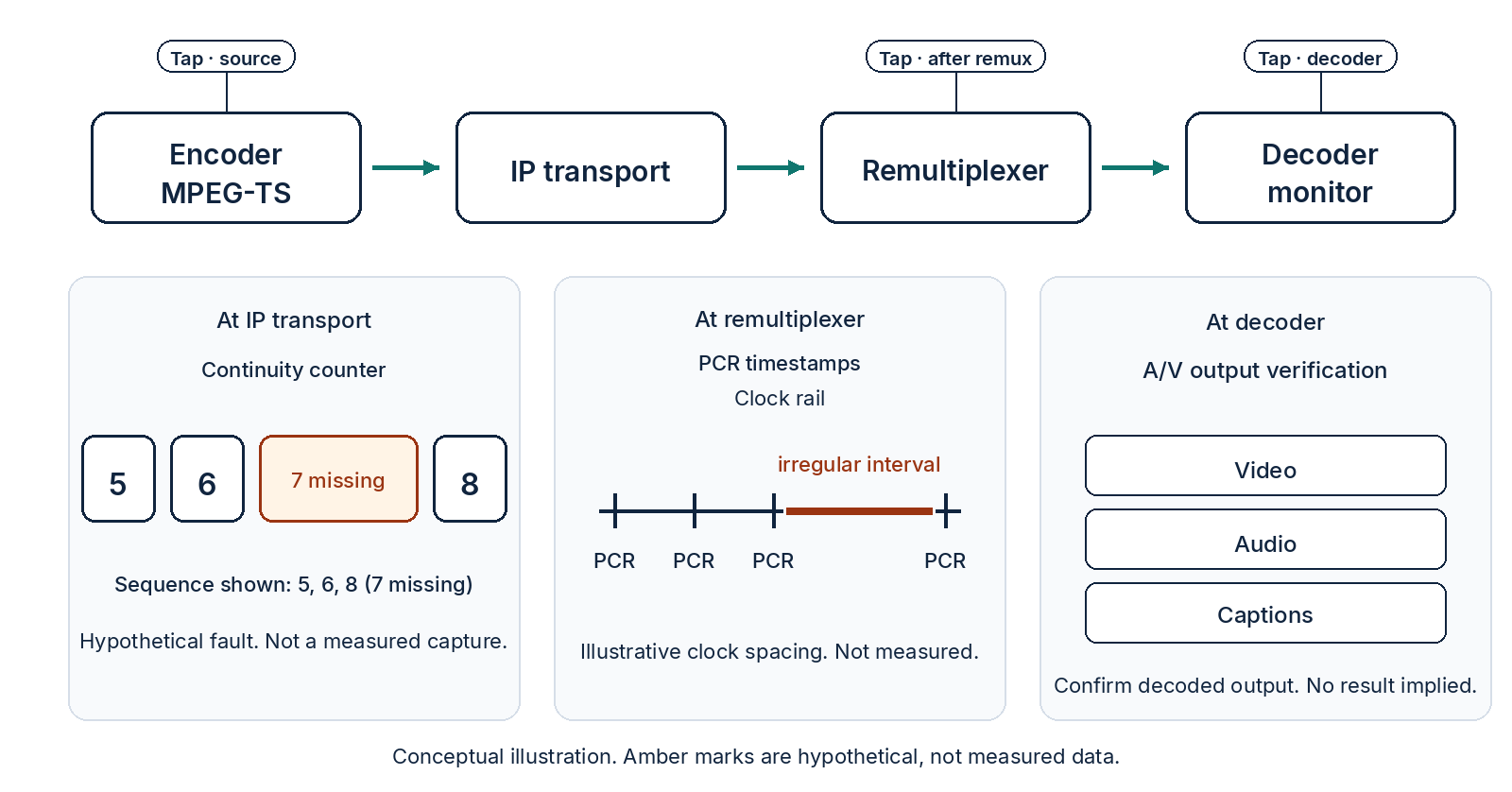

A DVB subtitle PID can be present, correctly labeled and free of obvious transport errors while the viewer sees nothing. Reliable acceptance testing must follow the subtitle service all the way to the rendered receiver image.
For a master control operator, "subtitle PID present" is useful evidence, not proof of accessibility. DVB subtitle services can fail at service selection, page assembly, presentation timing or rendering even when transport-level counters appear normal.
Why it matters
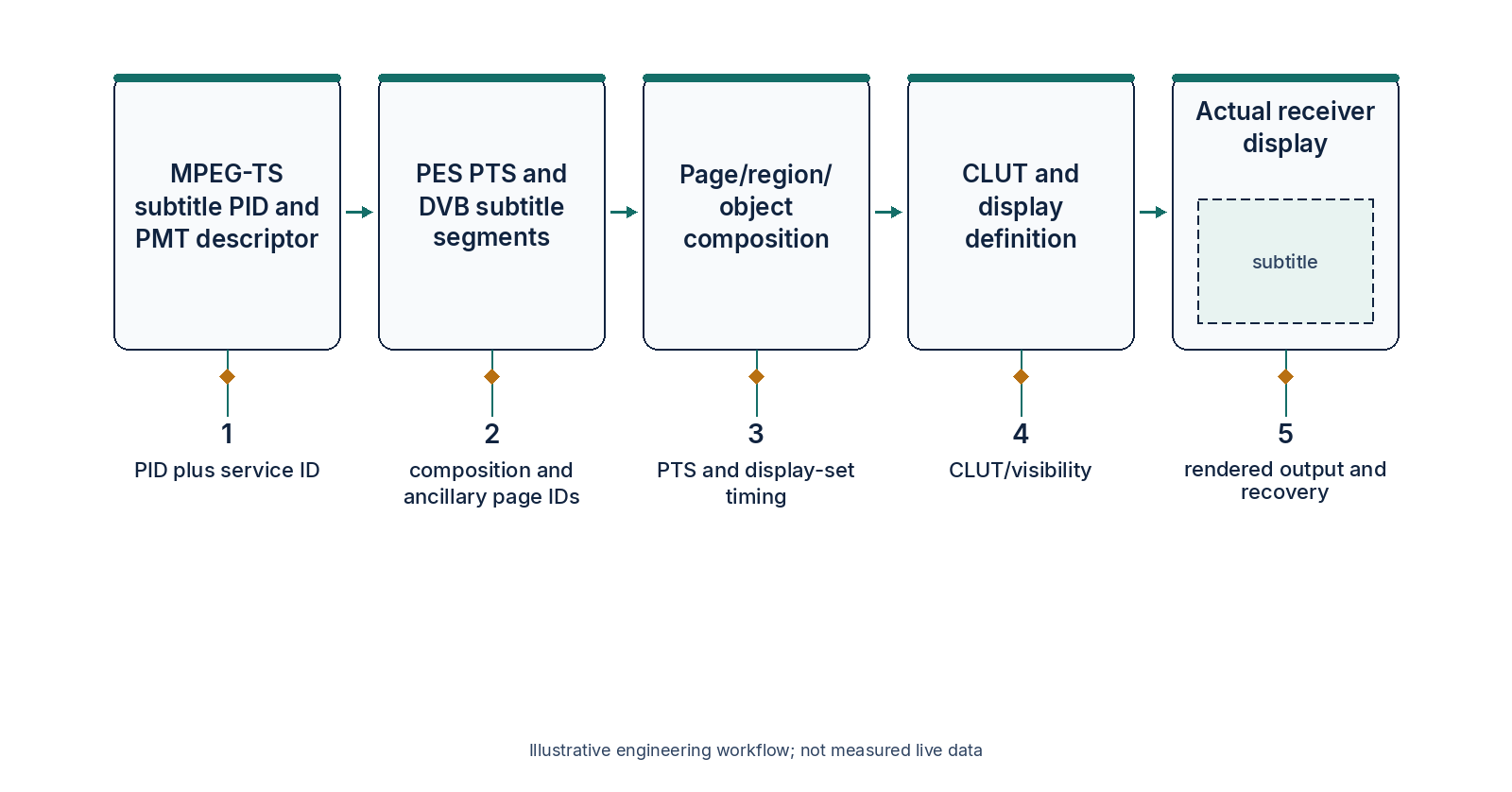
The distinction is structural. DVB subtitling is not simply a UTF-8 text track inside an MPEG transport stream. ETSI EN 300 743 V1.6.1 (October 2018) defines timed subtitle pages assembled from regions, objects, display definitions and color lookup tables, or CLUTs. The service information descriptor separately tells a receiver which language and page identifiers to use.
A network probe can establish that packets arrived. It cannot, on that evidence alone, establish that the intended words appeared at the correct time, in a readable location, on the target receiver.
Five checks beyond packet presence
1. Match the service, not only the PID. Inspect the program map table and its subtitling descriptor. Record the ISO 639 language code, subtitling type, composition_page_id and ancillary_page_id. A single carrying stream can hold multiple subtitle services. A receiver selecting the wrong page can show the wrong service or nothing useful. ETSI EN 300 468 V1.17.1 (July 2022) specifies these descriptor fields.
2. Decode a complete display set. Verify the expected page-composition, region-composition and object segments, including any applicable ancillary page. Count a missing object or an inconsistent page reference separately from a missing transport packet. A payload can be syntactically present without constructing the intended image.
3. Compare presentation time with program playback. Capture PES presentation timestamps and the associated subtitle display sets at the monitoring point. Check when a subtitle appears, persists and clears against speech and picture. A healthy stream rate does not prove correct timing. Test discontinuities, restarts and service switches rather than a steady-state sample alone.
4. Verify that pixels are actually visible. A subtitle object may decode yet become unreadable because of a CLUT, transparency, scaling or placement problem. Check color and alpha handling, display definition and region positioning on the target display profile. The DVB BlueBook A009 (November 2017) documents CLUT signaling and compatibility considerations. A simple decoded-object count cannot replace a rendered-frame check.
5. Test the receiver's recovery behavior. In a controlled feed, introduce a page update, subtitle-service change and short interruption. Verify that the receiver does not retain stale subtitles or remain blank after valid content resumes. Record both the transport capture and a time-aligned view of actual decoder output. The Library of Congress DVB subtitle format overview (reviewed as a reference in November 2026) distinguishes the graphical DVB subtitle format and its supporting signaling standards.
What an acceptance report should prove
Use a short test fixture with known words, a clean control and at least one deliberately broken case for each layer. Record the program and subtitle PID, service descriptor values, page IDs, segment and PTS evidence, decoder model and software version, and the visible result. Keep failures classified as transport, service signaling, composition, timing or rendering. Those categories point to different owners and prevent a generic "captions missing" ticket from bouncing between teams.
Operational takeaway: make the receiver display the final acceptance point. Monitoring at the MPEG-TS input can narrow the fault, but a rendered check is what proves that the audience can actually read the subtitles.
This is an engineering test design, not a claim that every DVB decoder behaves identically. Verify the supported subtitle profiles and the current applicable requirements for each distribution platform.
Image credit: Original Amira Labs editorial diagram specification, November 8, 2026. Conceptual illustration, not a photograph or measured production output. PNG rendering required before publication.