
A 500-feed monitoring budget depends on what each probe does, where the video travels and what capacity stays ready during a failure. Price those choices separately.
Five hundred continuous feeds produce 360,000 feed-hours in a 30-day month. That number can describe a lightweight packet check or a full decode with speech analysis, recordings and redundancy. Start with a coverage matrix, then price the same matrix in each location. Otherwise the cheapest bid may simply test less.
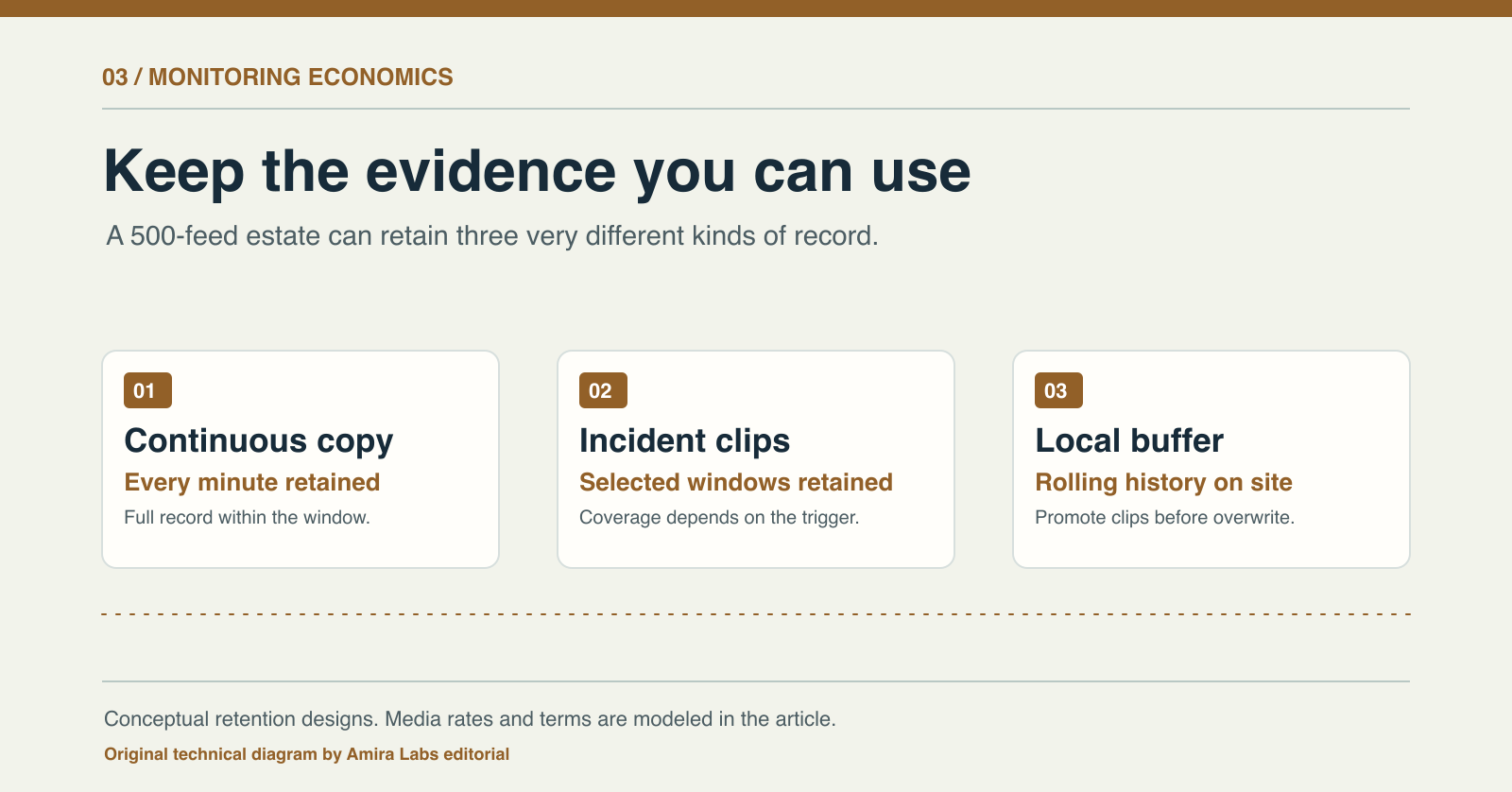
Why it matters. A monthly total divided by 500 is useful only when every option meets the same detection and recovery requirements. Specify which feeds need continuous transport and decoded audio/video checks, which need intermittent content analysis and which need evidence retained. Quote the inspection frequency and maximum time to detect each fault.
What does a 500-feed baseline cost?
Here is a worked scenario in USD, using hypothetical workload and facility inputs. It covers continuous first-pass checks and a second probe pool sized for the full workload. It excludes GPU analysis, media transfer, evidence storage, taxes and staffing. The proposed capacity of each pool is a test assumption. Benchmark it against your actual codecs and bitrates during failover before using the figures.
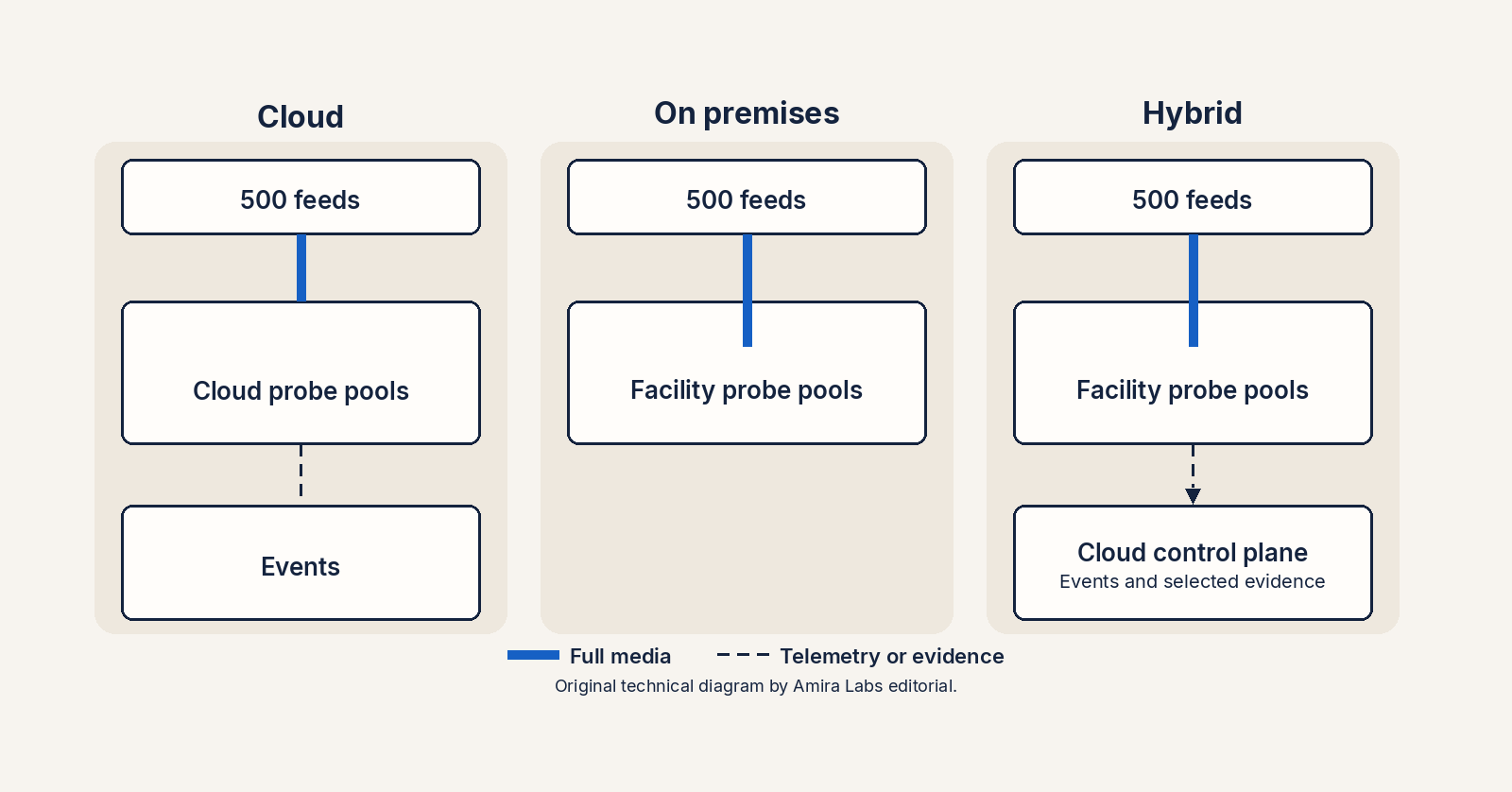
- Cloud. Assume 25 workers per pool, with 20 feeds per worker. Two pools run 50 Linux/x86 Fargate tasks, each with 1 vCPU and 2 GB RAM. Using the Northern Virginia example rates AWS displayed November 5, 2026, each task costs 3600 × ($0.000011244 + 2 × $0.000001235) = $0.0493704 per hour. Fifty tasks × 720 hours = $1,777.33. Budget $50 for 100 GB of Standard log ingestion at $0.50/GB before allowances, with retention and queries priced separately. Subtotal $1,827.33, or $3.65 per feed-month. AWS Fargate pricing · Amazon CloudWatch pricing.
- On premises. Assume two hosts can each sustain all 500 checks, with distinct failure domains already available. Illustrative hardware at $18,000 combined over 36 months is $500/month. Combined average draw of 0.65 kW × 720 hours × $0.15/kWh adds $70.20. Add an assumed $300/month for rack space, cooling and hardware support. Subtotal $870.20, or $1.74 per feed-month. Price a second site separately if the facility has a shared point of failure.
- Hybrid. Keep both probe pools local and send events to a cloud control plane. Add four of the same cloud tasks and the same log allowance to the local subtotal. The result is $870.20 + $142.19 + $50 = $1,062.39, or $2.12 per feed-month. This assumes remote operators can work from telemetry and retrieve evidence when needed.
Which omitted costs can change the order?
Map every copy of the media. At an assumed 6 Mb/s per feed, one continuous 500-feed copy is 3 Gb/s, or 972 TB in 30 days using decimal units, before network overhead. Multiply the volume on each metered leg by its actual rate. Price egress and cross-zone paths separately from ingest. AWS’s architecture guide shows why the services and Availability Zones on a route affect what gets billed. In a hybrid design, price evidence uploads, remote playback and exceptional raw-feed forwarding. AWS Architecture Blog, data-transfer costs, June 2021.
Size GPU and labor from a replay. Divide peak concurrent analysis streams by measured streams per GPU at the required latency, round up, then add tested spare capacity. Track active and reserved GPU-hours separately. For staffing, even an illustrative 20 hours of monthly incident review at a $75 loaded rate adds $1,500. Add upgrades, on-call and service support where the contract or operating team actually carries them.
Before procurement, replay a peak event and a pool outage. Record detection delay, worker and GPU occupancy, billable bytes, retained evidence and operator minutes. Rerun the model with seasonal hours if the cloud pool can actually scale down. The cloud repatriation playbook covers the migration and rollback work if the measured economics favor a different location.