
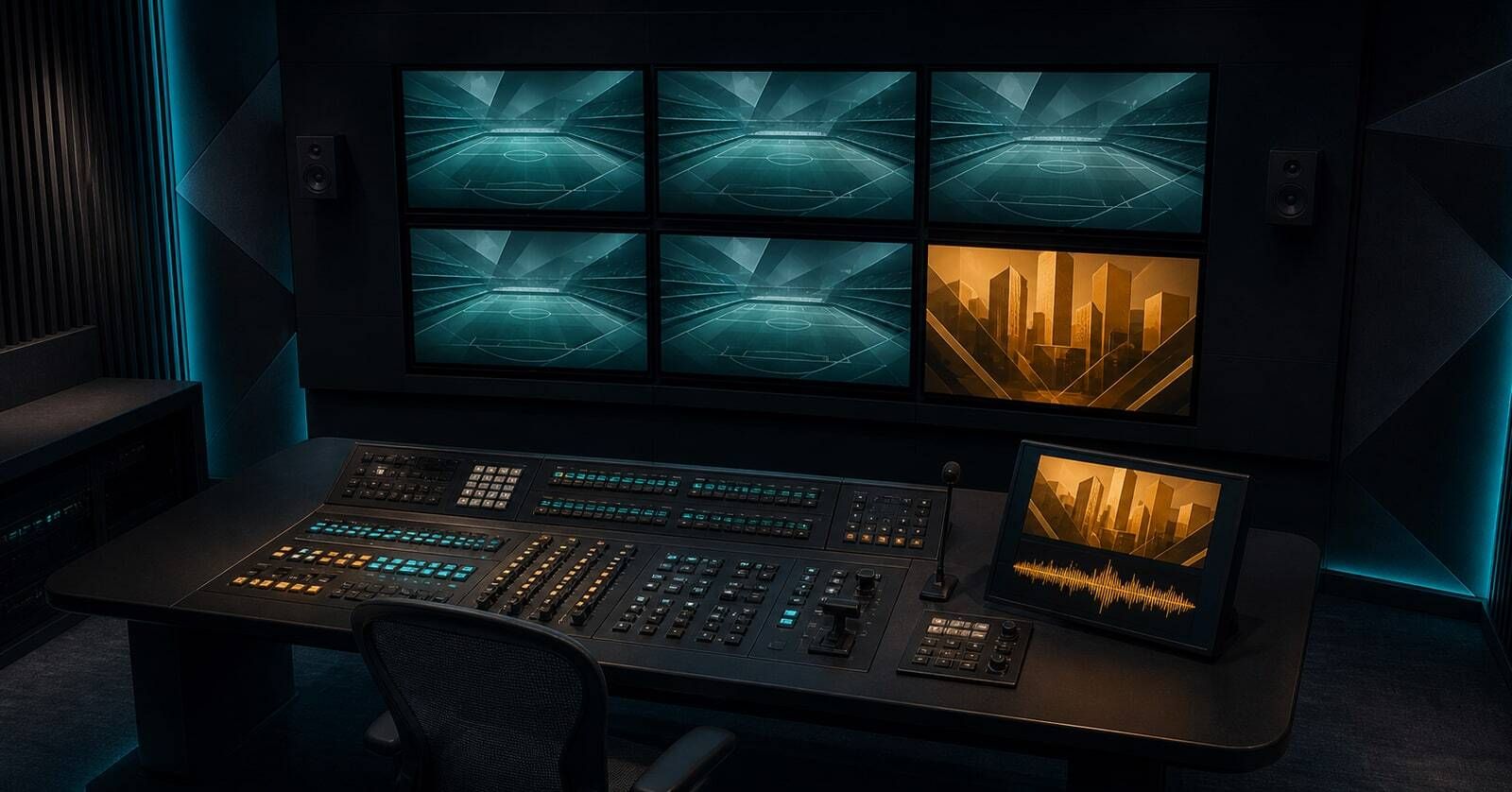
The pictures move. The audio meters look normal. The wrong regional feed is going out.
That is a useful starting point for an AI broadcast monitoring evaluation. A system can confirm that media is arriving without establishing that viewers are receiving the intended program, commentary or captions. Your buying decision should separate those questions.
Before a demonstration, define the faults that matter to your service, the evidence an operator needs and the time available to act. Then test the complete path from a known fault to a usable incident. Include clean programming, ambiguous material and failures of the monitoring system itself. A highlight reel of successful detections cannot establish how the system will behave through an ordinary shift.

Original AI-generated editorial illustration. This is a fictional facility, not an Amira product interface.
What should AI broadcast monitoring prove before you buy?
AI broadcast monitoring should demonstrate a measurable improvement on your existing workflow: an important problem detected, useful evidence delivered, or less operator effort without an unacceptable increase in missed incidents. The baseline matters as much as the new system.
The timing is practical. IBC2026 takes place September 11–14 in Amsterdam. TV Tech's August 27 preview of TAG Video Systems' monitoring plans puts latency and live-production monitoring on the show-floor agenda. Those are vendor announcements, not independent acceptance results. IBC's official event information; TV Tech's TAG preview.
The operational question extends beyond a product demonstration. In an August 11 SVG Europe contribution, Sportcast technical manager Firas Ajjawi argues for connecting monitoring signals with incident ownership and coordinated response. It is a practitioner's argument, not a measured comparison between vendors. SVG Europe.
Define the service before the detector
Write down what each destination should receive. Include its service identifier, program source, audio track, expected language and caption service. Record legitimate exceptions, such as a regional opt-out or a bilingual interview.
A correct signal for one destination can be the wrong signal for another. A detector needs an authoritative reference for the intended output: a maintained schedule, routing state, approved reference feed or another source your operators trust. An AI-generated description cannot establish intent by itself.
Keep existing transport, timing, audio and picture checks in the test. Some faults are best detected by deterministic rules, which apply explicit conditions. Others may benefit from speech or visual analysis. Do not assume an established monitoring product lacks content-aware features, or that every useful content check requires AI.
For each proposed detector, ask what it adds beyond the installed baseline. Where it repeats an existing alarm, compare accuracy, response time and handling effort before assigning value to the duplication.
Which faults belong in a broadcast monitoring checklist?
Use controlled faults that represent your distribution obligations, with a known expected result for each. Run them on authorized recordings or an isolated test path. Live shadow monitoring can observe a production copy; it is not permission to inject faults into an on-air service.
The following is a proposed acceptance checklist, not an industry certification or a report of Amira test results. Agree on the failure duration, expected detection window and escalation policy before running it.
Test condition | What to change in the test copy | What to inspect |
|---|---|---|
Wrong program or regional feed | Substitute another valid feed while preserving normal technical characteristics. | Does the incident identify the affected destination and the reference establishing a mismatch? |
Unexpected commentary language | Replace the expected spoken-language track with another supported language. | Does the result identify the correct track and distinguish a mismatch from insufficient speech? |
Stale captions | Hold an earlier caption while fresh speech continues. | Does the evidence show the caption interval and corresponding audio, rather than caption presence alone? |
Caption/audio mismatch | Pair current speech with captions from another segment. | Can the operator verify the mismatch and distinguish it from accepted caption delay? |
Related alarms | Create one documented upstream fault with several downstream symptoms. | Are symptoms grouped usefully without concealing a separate, concurrent incident? |
Analysis failure | Stop the analysis process or deny its input while the monitored program continues. | Is lost coverage visible, with affected checks and the last successful analysis time? |
These tests cover different capabilities. A product may pass some and explicitly leave others to another system. That boundary is useful purchasing information.
Include material that should not trigger an incident
Pair the fault tests with clean examples that look similar. Include a planned program switch, an approved regional substitution, a bilingual interview, music without speech, static graphics and a caption that legitimately remains visible.
For language monitoring, specify how much speech is required before a decision is useful. Separate language identification from translation accuracy. Correctly identifying Spanish does not establish whether a Spanish translation preserves a speaker's meaning.
For captions, evaluate the audience-facing result as well as the presence of caption data. Our live caption QC guide covers the caption-specific evaluation questions in more detail.
Have an operator or relevant language specialist review the test labels. Keep a holdout set that is not used to tune thresholds. Otherwise, you risk measuring how well the supplier configured the demonstration rather than how well the system handles unfamiliar programming.
Repeat the test under realistic load
Record the software configuration, enabled checks, channel count, audio tracks and analysis cadence. Repeat across your important program types and busy periods. A result from one commentary track should not silently become a promise for every language or channel.
NIST's AI Risk Management Framework 1.0, published in 2023, supports testing in conditions resembling deployment and documenting the limits of generalization. The framework is voluntary, and NIST currently notes that a revision is in progress. Our broadcast checklist is an application of that evaluation principle, not a NIST-prescribed test suite. NIST AI RMF Core, Measure 2.3–2.5.
Which measurements belong in the acceptance report?
Report timely detection, misses, operator-facing false alerts, evidence quality and handling effort separately. An overall accuracy percentage can hide the failure mode that matters most to your service.
Use an event-level definition agreed before testing. Define when repeated notifications count as one incident, how detections are matched to injected faults and what happens when a correct alert arrives after its useful deadline.
Measurement | Working definition for the pilot | Important qualification |
|---|---|---|
Timely event detection | Fault events correctly identified within the agreed window, divided by all eligible fault events. | Break out results by fault type, language and operating condition. |
Late detections and misses | Report detected-after-deadline events and undetected events separately. | Do not remove misses from the report because they have no detection timestamp. |
Operator-facing false-alert rate | Human-reviewed false incident notifications divided by monitored channel-hours. | Declare which checks were enabled and also retain raw detector-alert counts. |
Evidence completeness | Incidents containing every agreed evidence field, divided by incidents reviewed. | A clip must show the relevant event and be accessible to the responder. |
Operator handling time | Time spent reviewing, verifying and disposing of an incident. | Separate this from waiting for another team and from restoration time. |
Monitoring coverage | Time each required check was actually functioning on each required output. | Service availability does not prove that every analysis check was running. |
Measure delay from a declared starting point
For a fault injected at a known location, record fault onset, arrival at the monitoring input, detector decision, incident delivery and evidence availability. Use synchronized timestamps or document the timing uncertainty. Source timecode and wall-clock time need an explicit mapping.
The buyer-facing interval is often fault onset to an actionable incident. Its components can include transport, buffering, an observation window, processing queues, inference and notification. Report the component measurements alongside the total, including any intentional persistence threshold used to suppress brief changes.
A multiviewer's input-to-output delay and an AI detector's end-to-end alert delay answer different questions. A fast display path does not establish how quickly a language or caption mismatch will produce a correct incident. Conversely, a deliberate observation window can improve the usefulness of a content decision.
Report the median and tail delay, such as the 95th percentile, alongside sample counts. If only a few events were tested, show individual results rather than presenting a tail percentile as a stable production prediction. Always show misses beside latency.
Repeat at the intended concurrent load and with reduced analysis capacity. Our broadcast AI inference placement guide explains why the path between media and analysis belongs in that evaluation.
Translate false alerts into shift workload
Consider a hypothetical planning example, not a vendor benchmark. A system produces 0.05 operator-facing false alerts per channel-hour while monitoring 100 channels continuously.
0.05 × 100 × 24 = 120 false alerts per day.
At an assumed two minutes of handling per alert, that is 240 operator-minutes, or four staff-hours per day. That effort may be scattered across the team and the day, making it harder to accommodate than one continuous block of work.
Replace every input with your measured values. Real incidents also require effort. Grouping notifications may reduce interruptions, but inspect what was grouped and whether a distinct fault disappeared inside another incident.
For the purchasing decision, compare the baseline and proposed workflow on the same material. Include configuration, escalation and maintenance effort. A detector that creates more work may still earn its place by finding a serious previously missed fault, but that tradeoff should be visible.
When should AI stay advisory in master control?
Keep AI advisory when the evidence is ambiguous, the supported operating conditions are unclear or an incorrect action could disrupt service. Detection and permission to change an on-air path require separate acceptance decisions.
Begin a pilot with observation and evidence collection. Then evaluate routing incidents to the right responder. A system that helps someone verify a fault can provide value before it has authority to alter a program output.
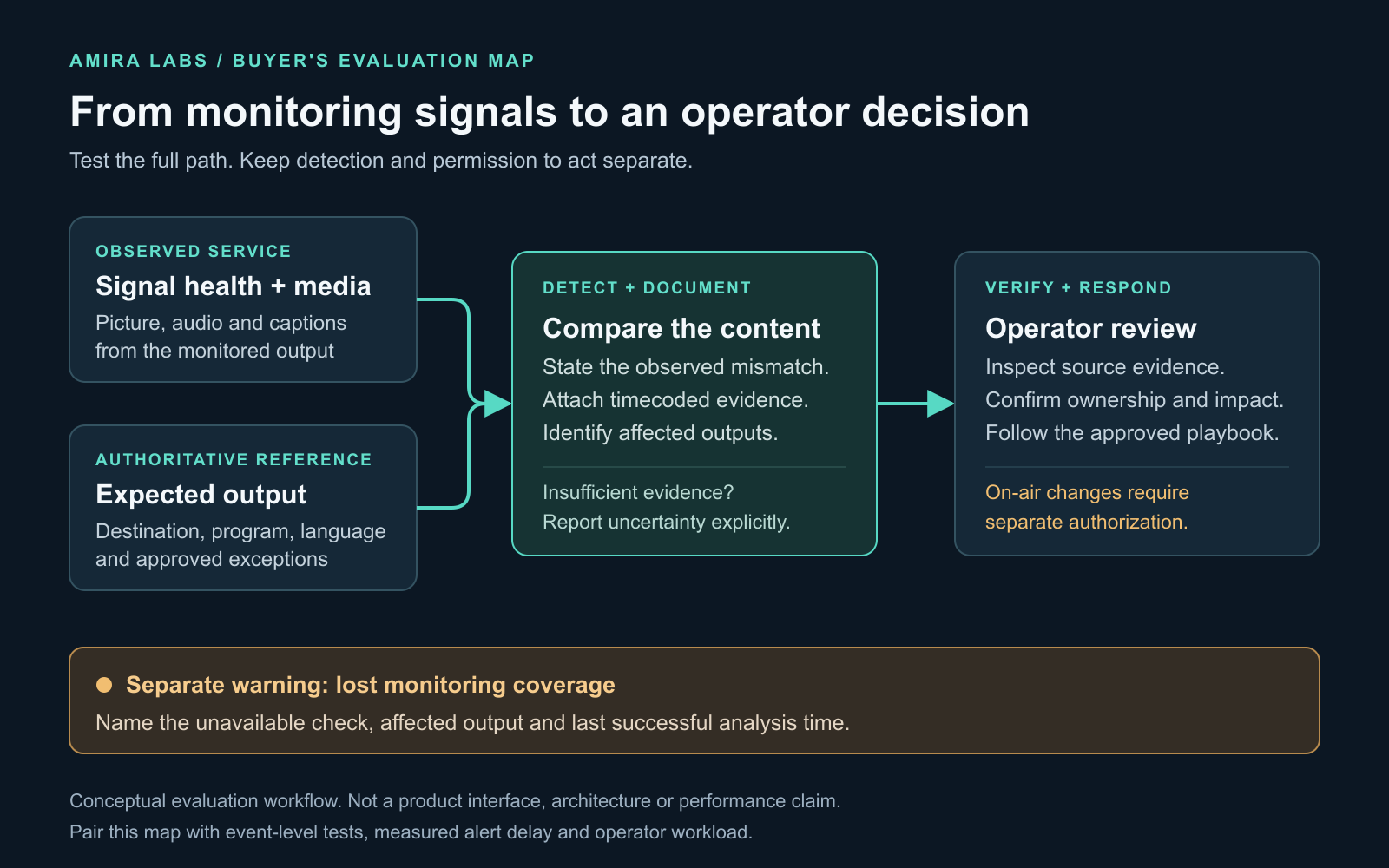
Conceptual evaluation workflow, not product architecture. Signal health and expected-output information inform analysis; supporting evidence reaches an operator before any separately authorized action. Monitoring failures require their own warning.
Require evidence that can be challenged
Ask for the affected service and destination, event time, expected condition, observed condition, accessible source evidence and the detector configuration. For uncertain results, the incident should say what could not be established. A polished generated explanation is not a substitute for the audio or frames being discussed.
Google's first-party account of its AI Alert work provides a useful adjacent example: it describes read-only alert enrichment with links back to supporting data. That is software-operations practice, not evidence of broadcast performance or a latency target for live television. Google SRE, accessed August 31, 2026.
Test whether the intended responder can open the evidence with their normal permissions. Define retention, permitted recipients and export behavior for clips or transcripts. Investigating an incident should not require sending rights-restricted media to an unapproved destination.
Make uncertainty and lost coverage visible
Silence, crowd noise or a short utterance may not support a reliable language decision. Conflicting schedule information may prevent a program mismatch from being resolved. Specify a distinct insufficient-evidence state and decide how it should be handled; do not silently treat it as a pass.
Similarly, no alerts can mean a clean service or a failed detector. Test loss of the input, stalled processing, delayed evidence and failure of the notification route. An operator needs to know which coverage is missing and which existing checks remain available.
Maintain established protection and fallback procedures. AI analysis should not disable them simply because an interpretation disagrees with a known technical fault.
Retain simpler tools where they pass the test
If a deterministic check reliably detects the condition you care about, compare against it. If a small, stable service is already monitored effectively, additional analysis may not justify its integration and operating burden. A buyer should be able to conclude that no new AI system is required.
Rehearse response as well as detection. Streaming Media's August 20 panel recap includes Corey Behnke's account of redundant power defeated by a failed failover mechanism, and his emphasis on testing and operator checklists. The example concerns production resilience, not an AI product test. Streaming Media.
What should you take to an IBC monitoring demonstration?
Take a small, authorized evaluation package with expected outcomes and a written definition of success. Give engineering, operations and the purchasing owner the same scorecard.
Before the meeting, choose representative material, label a clean set and a fault set, and record what your existing workflow detects. Agree who will review disputed results and what evidence they need. Keep the final test examples separate from setup material. None of this requires buying a new platform.
Ask every supplier these questions:
- Which of our faults can you detect today, and what reference data do you need? Record unsupported cases explicitly.
- Can we measure the full fault-to-incident interval at our intended load? Include late detections, misses and lost coverage.
- What reaches the operator when you are wrong or uncertain? Inspect the evidence and count the handling effort.
- Can we export results and repeat the test after an update? Retain enough configuration detail to make comparisons meaningful.
- What can the system change without approval? During the pilot, keep that authority bounded and test the fallback.
Leave with a testable commitment, named owners and a repeatable evaluation. A demonstration is useful when your team can reproduce the result.
Sources
- IBC: IBC2026 official event information. September 11–14, 2026; checked August 31, 2026.
- TV Tech: TAG Video Systems' IBC2026 monitoring preview. Phil Kurz, August 27, 2026. Vendor-announcement coverage.
- SVG Europe: Beyond Monitoring: Why live sport needs a modern operations centre. Firas Ajjawi, Sportcast, August 11, 2026. Practitioner contribution.
- NIST: AI Risk Management Framework Core. Version 1.0, 2023; current page checked August 31, 2026. Voluntary guidance; revision in progress.
- Google SRE: AI in SRE: How Google is Engineering the Future of Reliable Operations. First-party description, particularly “Enriching Alerts”; accessed August 31, 2026.
- Streaming Media: In Live Streaming, Redundancy Does Not Mean Resiliency. Steve Nathans-Kelly, August 20, 2026. Panel recap.