
A caption track can be selectable and active while carrying the wrong language or the wrong program. Check what viewers can read against the audio they selected.
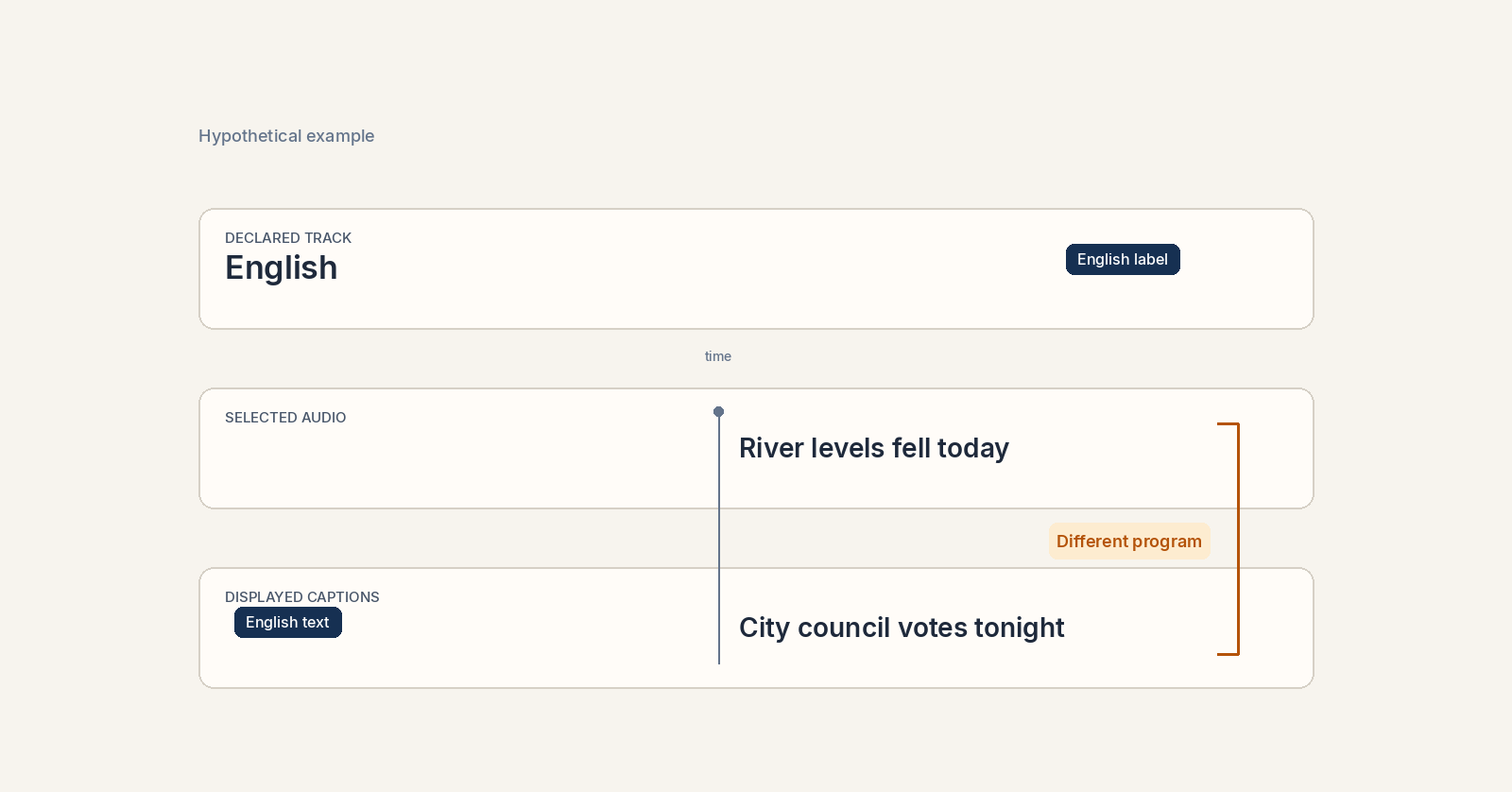
Picture an English news simulcast with an English accessibility track. The player lists English, captions advance on cue and the text itself is English. The words describe an interview on the sister channel. A track-presence alarm stays green. So does a language detector. Catching this failure takes a comparison between the rendered cues and the selected audio.
Why it matters. The label can be wrong, the text can be in the wrong language, or the text can belong to a different program. They require different fixes. A bad label belongs with packaging or track mapping. A wrong-language caption payload can originate upstream. Fluent captions for another feed point toward a binding or routing error.
Which language should the captions carry?
Write down the intended audio-to-text pairing for each output. Record the audio rendition ID, intended spoken language, caption service ID, expected text language and purpose. Same-language accessibility captions, translated subtitles and forced subtitles have different acceptance criteria. A Spanish interview with intended English translation can be correct on an English outlet. An English caption service tied to an English commentary track should instead reflect the commentary and meaningful audible cues.
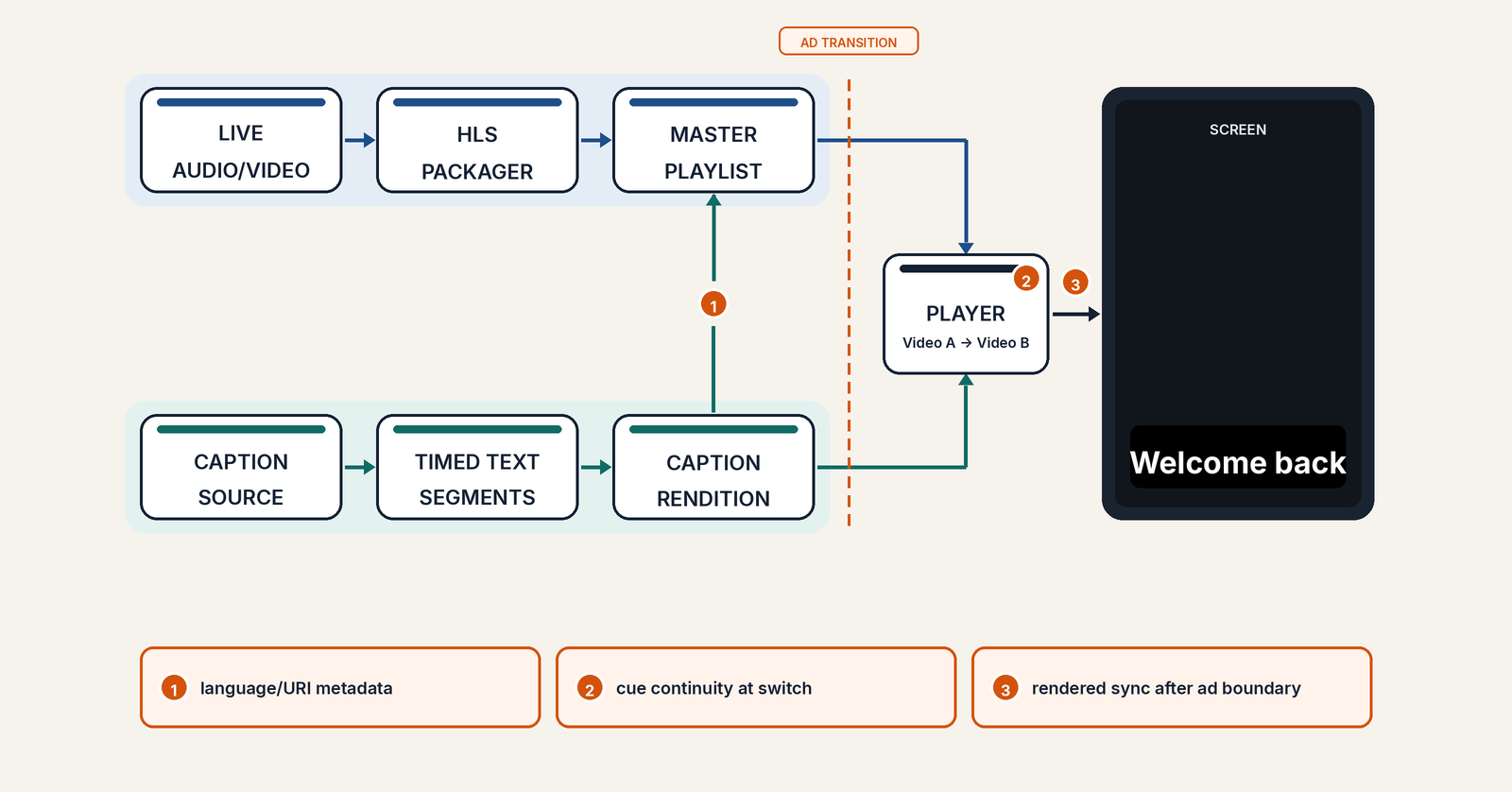
HLS RFC 8216 defines the language attribute on a rendition, and Apple’s HLS authoring specification requires a language attribute when declaring closed captions. A correct tag establishes what the player was told about the rendition. Verify the decoded content on a supported player with that audio and text pair explicitly selected. RFC 8216, August 2017 · Apple HLS authoring specification, checked November 5, 2026.
How do you detect correct-language captions for the wrong feed?
Compare several speech-rich windows on the same playback clock. Keep the selected audio, rendered text and cue timestamps together. Align each sample within the service’s allowed caption lag before comparing phrases. Look for anchored details such as a person’s name, the next location in a weather bulletin or a number spoken in the segment. An automated transcript can suggest mismatches. Send the audio clip and the original cues to an operator when the system cannot distinguish a delayed line from a different source.
For U.S. televised programming within its scope, 47 CFR § 79.1(j)(2) sets quality standards for accuracy, synchronicity, completeness and placement. A language match measures just one property of the payload. The adjacent live caption QC guide covers the wider review. FCC caption quality order, February 2014 · 47 CFR § 79.1, checked November 5, 2026.
What should a language acceptance test include?
Seed distinct faults and verify that each reaches the right owner. In a test output, swap two language labels while keeping the text intact. Then keep the labels correct and swap the payloads. Finally, attach a same-language caption feed from another program. Each test should produce a distinct diagnosis or an explicit review request. Add clean controls with names, short utterances, silence, code-switching and intentional translation. These show when the detector should defer to a reviewer instead of filing a mismatch.
Set a minimum evidence window from your own programming. Very short cues and multilingual speech can leave too little evidence for a confident automatic verdict. Track undecided samples separately from passes. Run the fixtures through the actual player for each selected audio-caption pair, then record the outlet, expected pairing, observed words, delay and responsible team. That gives the shift a reproducible fault and the next engineer a place to look.