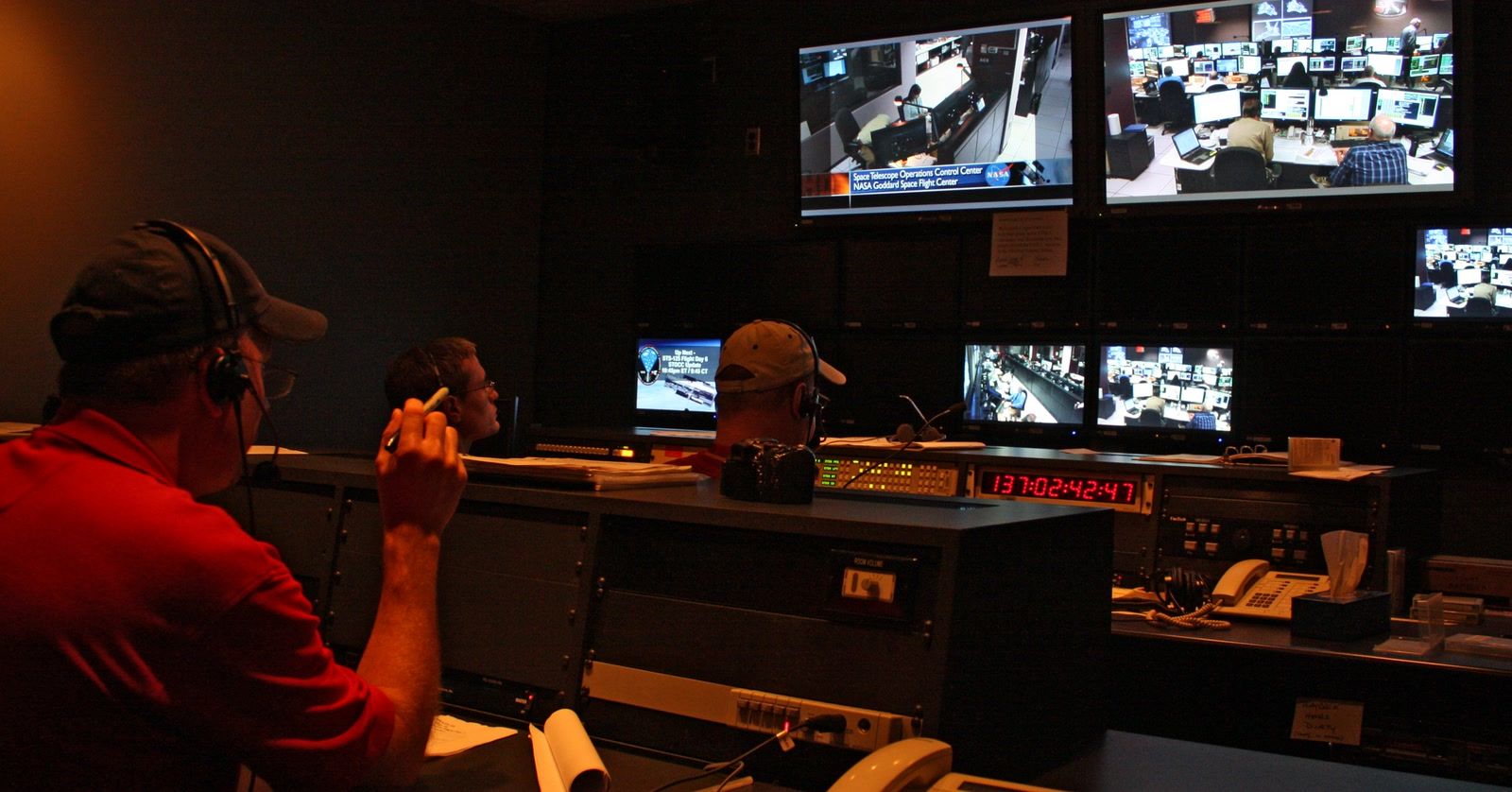

The backup feed is on air. Audio and picture look right, but a presenter finishes a sentence before its caption appears. Master control can see the problem on the return monitor. Which team should take the first call: caption origination, streaming operations or playback?
A useful failover test measures the gap between the same spoken cue and its caption at three points. It gives the operator a place to start even when every dashboard reports that the caption track is present.
Give both paths the same cue
Feed both paths the same captioned clip, or record parallel outputs carrying identical program material. Pick a distinctive word at the beginning of a caption and mark its audible onset. Identify the corresponding cue by its text. At each point subtract audio onset time from caption onset time. Positive means the caption trails the sound. A negative value means it leads. Keep the sign even if both results look wrong.
At ingest, compare the incoming caption's intended display time with the matching audio on that input's media timeline. At HLS output, compare the packaged cue's presentation time with the corresponding audio presentation time. At the viewer, measure the first frame on which the words are visible against the audible word in one recording. Segment arrival time and playlist fetch time answer different questions.
Find the interval where the gap grows
Suppose both ingest measurements are 1.0 second late. At the packager output, path A is 1.2 seconds late and path B is 2.9 seconds late. On the same reference player, A is 1.5 seconds late and B is 3.3 seconds late. These are illustrative values for a replayed cue. They represent neither a service target nor measurements from a customer.
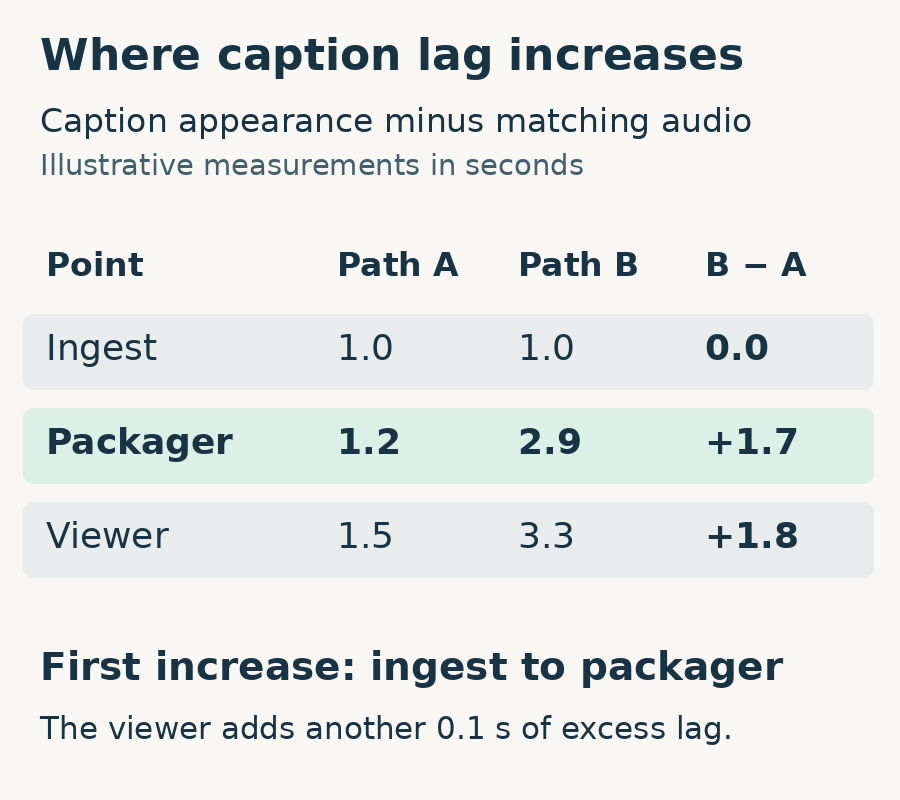
Figure by Amira Labs. Both paths carry the same cue. Values are in seconds.
The viewer picks up an extra 1.8 seconds after the switch. Of that, 1.7 seconds is already visible at packager output. Start with the interval between ingest and packaged output. Pull both caption segments, their matching audio segments and the playlists around the cut. The player adds only 0.1 second to the path difference in this example. Changing a player-wide offset would also change the good path.
Check the clocks before assigning the fault
A WebVTT cue has start and end timestamps. For HLS, check how those cue times map to the audio/video timeline, especially across a discontinuity. Capture the mapping on both paths. The WebVTT specification defines cue timing. RFC 8216, section 3.5 describes the timestamp map and what clients assume when it is absent. For Apple playback targets, also check the HLS authoring specification.
Repeat the measurement for several cues before and after the cut. If the difference changes sign or disappears once the decoder buffer settles, retain the range and identify which cues straddle the switch. If packaged timings agree but two players render differently, compare player versions, buffering and caption rendering on the same rendition. The incident handoff should name the cue, the first point where the paths diverged and the recordings that let the next engineer reproduce it.
Cover photograph: NASA Hubble Space Telescope, Television Studio Control Room, 2009. Archival photograph, cropped, CC BY 2.0.