
A DVB subtitle service can appear in a transport-stream inventory while the viewer sees no words, the wrong language or graphics that never clear. The first alarm may say the PID exists. That is not the same as proving the subtitle is usable.
Why it matters: For master control, the failure boundary is not simply "subtitle data present." It is the entire chain from programme signaling through timed bitmap decoding to the picture the audience actually receives.
What the standard actually carries
DVB bitmap subtitles are not plain text packets waiting to be displayed. The ETSI EN 300 743 V1.6.1 specification (2018) defines a graphical subtitle system with page composition, regions, objects, color look-up tables (CLUTs), display definitions and timing.
A subtitle stream is transported in MPEG transport packets associated with a PID, while individual subtitle services can be distinguished by their composition and ancillary page identifiers. PES presentation timestamps coordinate display with the programme. A receiver must assemble the relevant display set, interpret its graphics and render it at the correct time.
The DVB BlueBook A009 (November 2017) describes how display sets, epochs and regions work. The Library of Congress format overview independently documents DVB-SUB's transport and specification history.
Operational inference: A monitoring system that sees only PID continuity can miss failures inside valid-looking graphical data. Conversely, a temporary absence of subtitle graphics during speech-free content is not necessarily a fault. Good alarms need programme context and rendered-output evidence.
Seven checks before accepting a subtitle path
1. Confirm service signaling. Capture the PMT and subtitle descriptors. Record PID, ISO language code, subtitling type, composition page ID and ancillary page ID for every expected language. Verify that downstream remultiplexing preserves the intended mapping.
2. Decode, don't merely count packets. Use a reference DVB subtitle decoder to render the service against the actual video. Record visible output at the master-control monitoring point. A packet counter is useful for transport health, not a complete accessibility verdict.
3. Check presentation timing. Compare subtitle PES PTS values with the programme clock and decoded video. Look for late pages, early pages, repeated pages and subtitles that remain on screen after their intended display interval.
5. Verify CLUT and transparency. Test white-on-dark and colored graphics against bright and dark scenes. A wrong CLUT or alpha value can make technically decoded subtitles effectively invisible. Check both standard-definition and high-definition display configurations where applicable.
6. Stress programme transitions. Run controlled source changes, remultiplexer restarts and transport failovers. Verify that the new stream reestablishes the required subtitle state and that the receiver does not keep displaying the previous programme's last page. Record recovery time rather than treating a returning PID as sufficient.
7. Validate each language at the destination. A multi-language service should be checked language by language on the receiving decoder or distribution output. Confirm that the selected language matches the actual content, that timing survives the path, and that the subtitles remain legible on the intended screen geometry.
What to alarm on
A useful monitoring design separates three conditions: transport absent, subtitle graphics malformed or unrenderable, and expected subtitles missing from speech-bearing content. These conditions have different owners and different remedies.
For example, a PID disappearing at a remultiplexer suggests routing or signaling trouble. A present PID with invalid page composition suggests an encoding or stream-processing issue. A correctly decoded page arriving late suggests a timing or buffering problem. These are diagnostic hypotheses, not claims about a particular deployment.
The alert should include the programme, PID, language, measurement point, first affected timestamp and a short clip or image of the decoded result. Operators should also be able to acknowledge legitimate silence or programmes that are not scheduled to carry subtitles, avoiding a flood of false alarms.
The commissioning question
Ask the receiving team to show a recorded test in which the subtitle service survives a real source switch, renders the correct language and clears on time. If the evidence stops at "the PID is present," the acceptance test is unfinished.
This is particularly important when a linear DVB service feeds downstream repackaging or localization. Subtitle data can be healthy at one point and lost or misinterpreted at the next. Define the last accountable monitoring point before the audience-facing handoff.
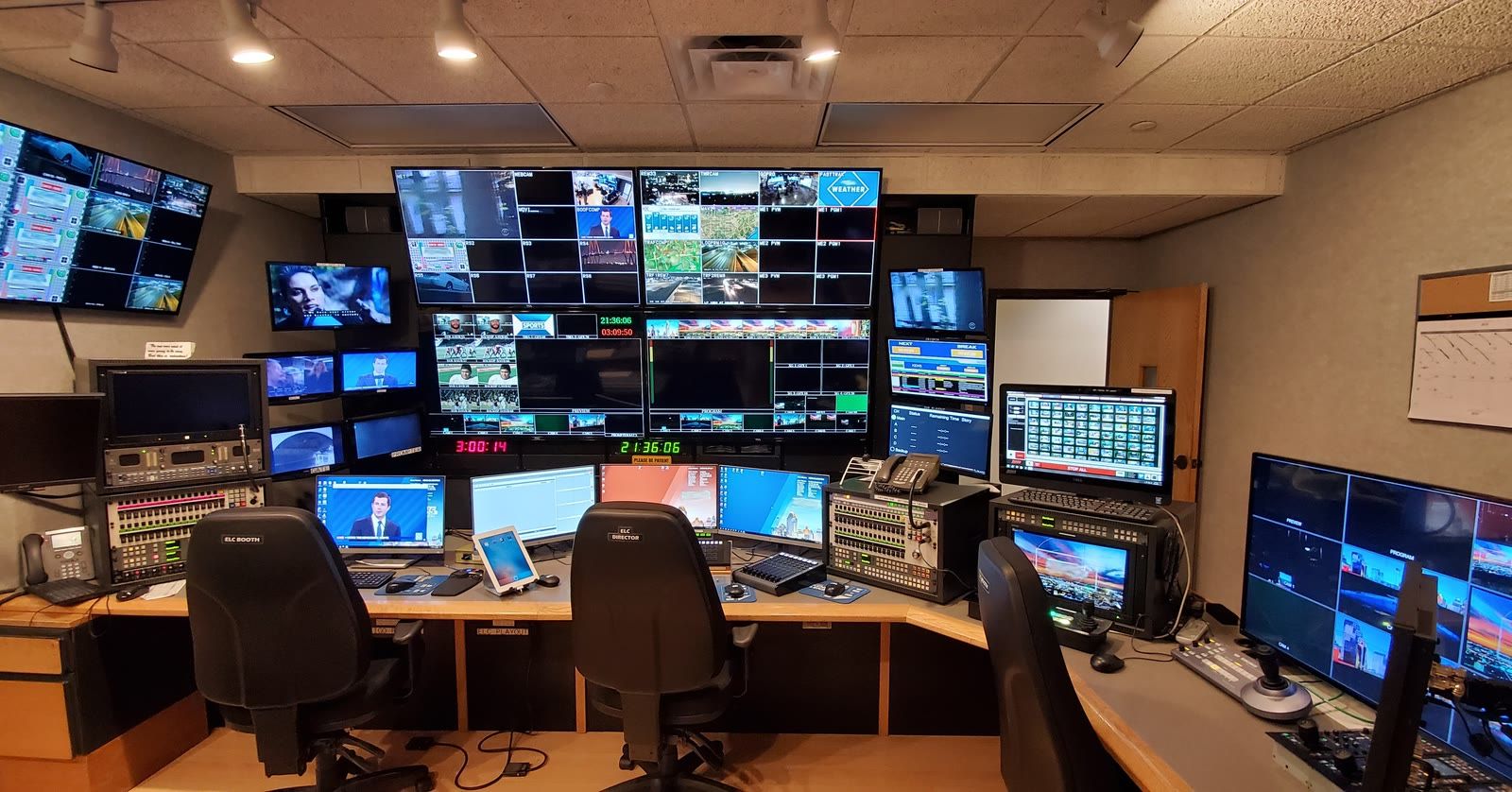
Image: Asterzenback, Television News Control Room, CC0 1.0. Archival photograph from September 2019, not a DVB subtitle fault or a current event. For publication, use a 1600 × 838 cropped JPEG derivative of the actual photograph, not a synthetic image.