
For already-captioned feeds, the break-even point depends on capacity reserved for peaks, the number of monitoring hours, redundancy and human review, not the price of speech recognition.
Monitoring is not caption generation
A master control director buying caption monitoring is purchasing detection and evidence: Are captions present? Are they continuous? Is the expected language present? Do they remain aligned with the program after a switch? This is different from paying to transcribe speech or generate new captions. The existing Amira Labs article on cloud ASR versus on-prem GPUs addresses that separate generation workload.
The useful unit for this purchase is a monitored feed-hour, with a specified sampling cadence, detection threshold, alert latency, retention period and failover design. A cheaper quote is not comparable if it silently drops secondary channels, provides less evidence or assumes someone else reviews alarms.
A comparable 120-feed scenario
Consider 100 feeds monitored continuously, plus 20 burst feeds active eight hours per day. At 30 days per month, that is 76,800 monitored feed-hours: 100 × 720 plus 20 × 8 × 30. Both alternatives provide independent monitoring capacity for failure recovery, the same retention, and the same staffed review coverage. The numbers below are illustrative USD per month, not vendor prices, measurements or Amira Labs quotes.
Monthly cost, USD | On-prem | Cloud |
|---|---|---|
Compute or hardware amortization | $1,200 | $2,400 |
Monitoring software and support | $900 | $900 |
Redundancy increment | $400 | $600 |
Network, logs and storage | $150 | $450 |
Operator review | $1,500 | $1,500 |
Total per month | $4,150 | $5,850 |
In this illustrative case, on-prem costs $1,700 less per month, about 29%, for the same service level. The model counts redundancy separately from primary compute and counts operator review once per architecture. Cloud transfer and observability are included in the network/logs line, not added again elsewhere.
Where the break-even moves
Define F as on-prem fixed monthly costs, v as its variable cost per monitored feed-hour, B as cloud reserved baseline cost, and c as cloud incremental cost per monitored feed-hour. At H monthly monitored feed-hours:
On-prem = F + vH; cloud = B + cH.
When c exceeds v, break-even H = (F − B) / (c − v), provided that result is positive and both architectures can actually deliver the same coverage. In real procurement, cloud reservations and on-prem capacity often change in steps, so calculate each capacity tier rather than treating the curve as perfectly linear.
A sensitivity test makes the procurement risk visible. If the 20 burst feeds require an additional $2,000 per month of reserved on-prem capacity, the on-prem total rises to $6,150, and cloud becomes $300 cheaper. Conversely, if burst feeds fit inside already-paid headroom, incremental on-prem cost may be small. Neither result is universal.
Five questions for the vendor trial
- What exactly counts as a feed? Ask whether the price follows transport inputs, caption services, language tracks, outputs or simultaneous monitored programs.
- What is the peak, not just the average? Test sports overrun, pop-up FAST channels and temporary simulcasts against capacity reservations.
- Where is the backup? Require a documented failure-domain design and measure whether alarms continue through node or zone loss.
- What data crosses the network? Monitoring transport streams or sampled audio/video remotely may cost much more than sending small, locally extracted caption events. Price actual ingress, egress and evidence retention.
- Who reviews the alerts? A false-positive-heavy deployment can erase infrastructure savings through operator workload. Compare the same escalation and evidence workflow.
The buying decision
AWS documents usage-based EC2 pricing and CloudWatch charges separately. Its data transfer pricing is another reminder to define the transport boundary. For a standardized evaluation, the AWS Pricing Calculator can help assemble one cloud scenario, but it cannot substitute for a vendor-specific feed-density test.
The next action is straightforward: request a 30-day, equal-service-level quote for baseline feeds, burst feeds and failover, then divide the all-in monthly total by monitored feed-hours. Ask vendors to show where their capacity step changes. The right answer is the lowest verified cost for the alerting and evidence quality the NOC actually needs.
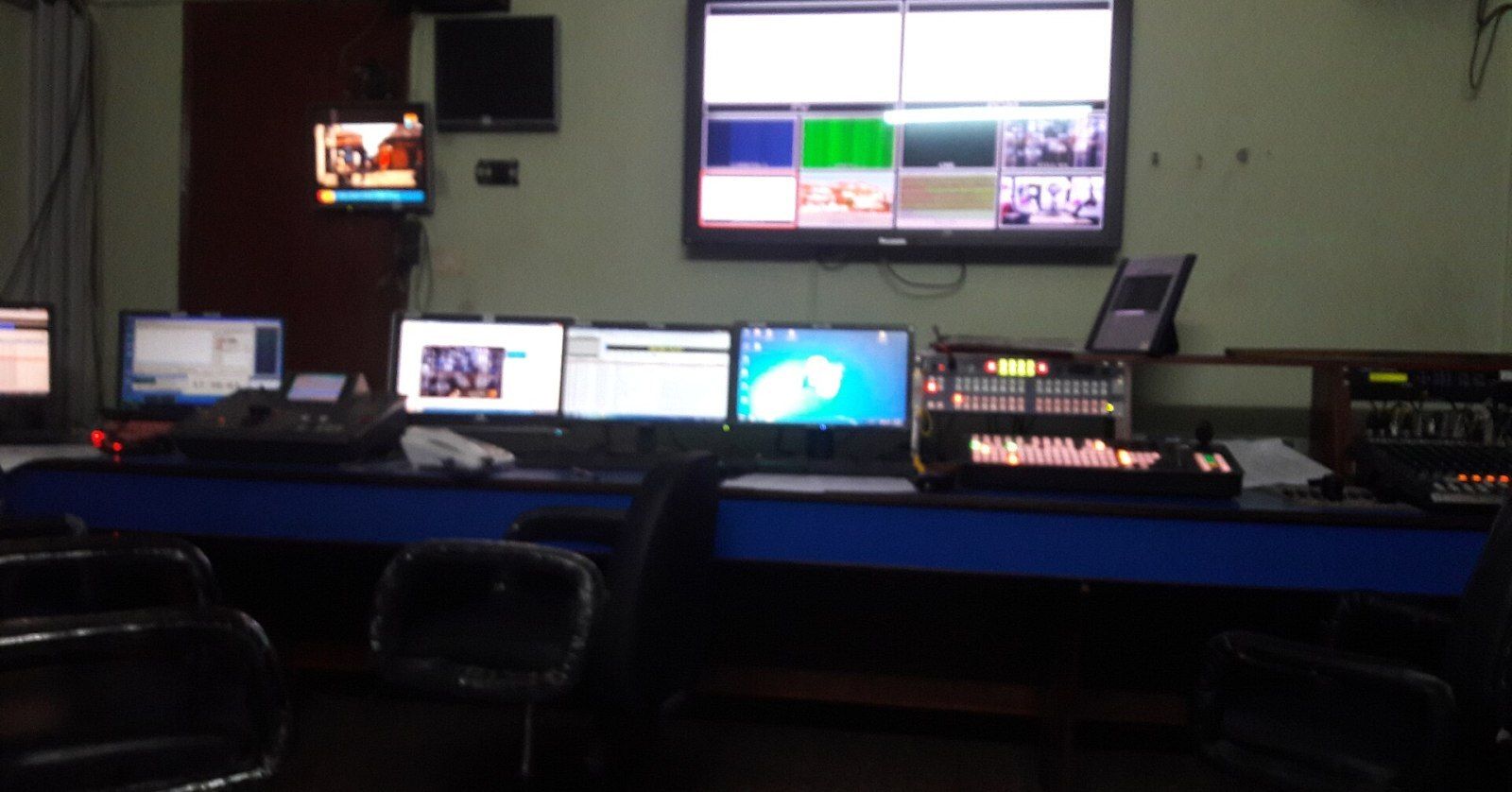
Archival cover: Master Control Room, Kathmandu, Nepal, photographed by BhattaraiAbhishek in 2017. Cropped and JPEG-encoded. The derivative is licensed under CC BY-SA 4.0.