

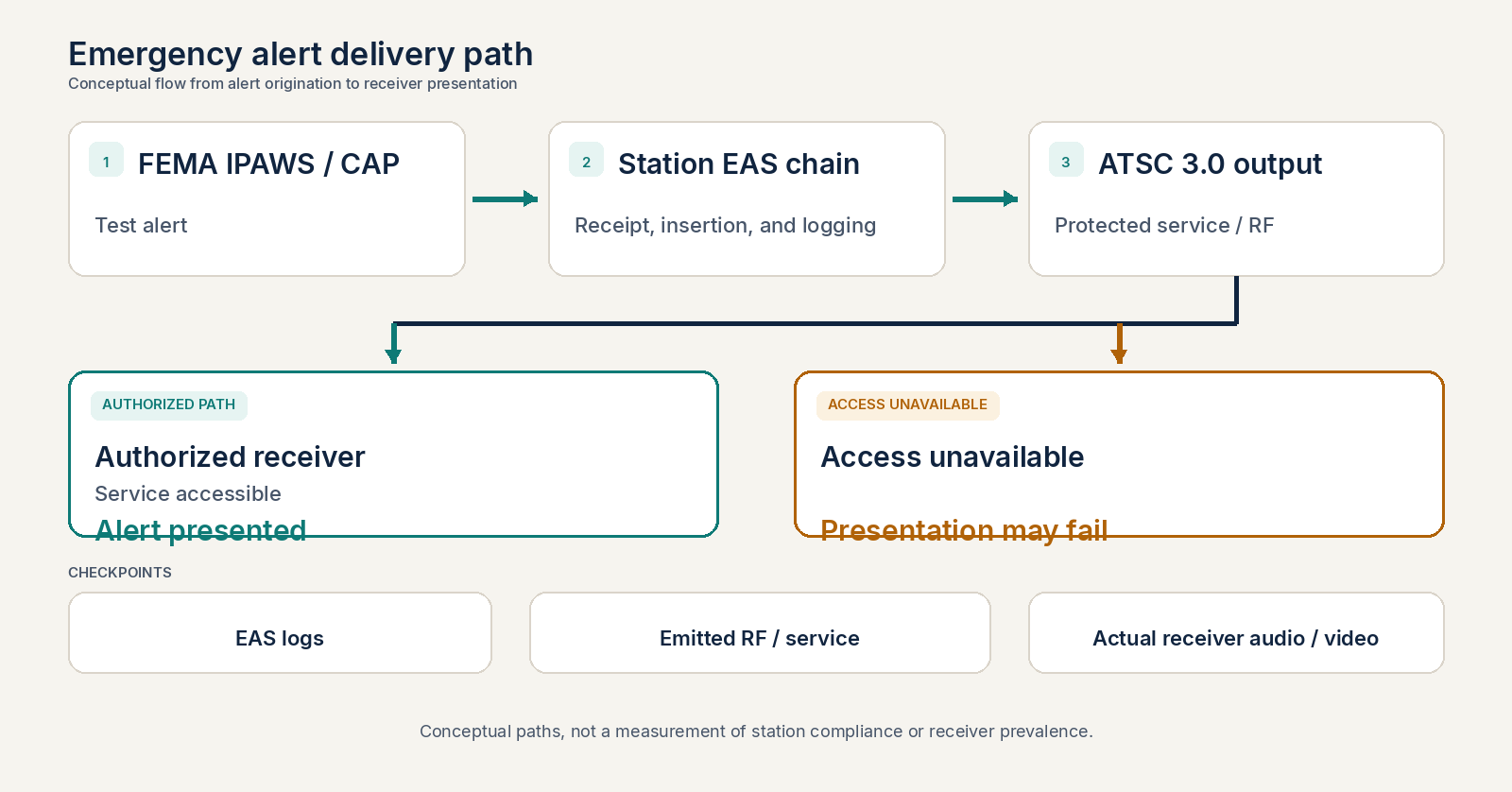
The November 17 nationwide EAS test has sharpened a dispute over ATSC 3.0 encryption. For station engineers, the practical question is whether an alert was transmitted and whether representative receivers could actually present it.
Why this matters now
The next nationwide Emergency Alert System test is scheduled for November 17, 2026, at 2:20 p.m. Eastern. A dispute over encrypted NextGen TV services has made the test about more than whether an EAS encoder fired correctly.
In an October 26 FCC filing, receiver maker SiliconDust renewed its request for broadcasters to suspend ATSC 3.0 digital rights management (DRM) around the test. SiliconDust argues that some otherwise capable receivers cannot present emergency alerts within encrypted services. TV Tech reported the dispute on October 27.
The National Association of Broadcasters disagrees. NAB argues that changing a station's normal encryption settings would undermine a test intended to reflect real operating conditions. The positions were described in NAB's October 20 response, reported by RBR+TVBR.
Neither side's position establishes that any particular station violated an EAS rule. The immediate engineering question is narrower: at which point could alert delivery fail?
Four checkpoints, four different answers
A station can document alert handling at several stages without proving the same thing at each:
- Origination and receipt: Did EAS equipment receive the correct alert and event code?
- Insertion: Was the alert correctly inserted into each intended service, including usable audio and on-screen information?
- Transmission: Did the appropriate ATSC 1.0 and ATSC 3.0 outputs carry it during the test window?
- Presentation: Could representative receivers tune, decrypt where necessary, and display or play the alert?
A pass at checkpoint two is not proof of checkpoint four. Record ATSC 1.0 and ATSC 3.0 results separately instead of assuming identical receiver behavior.
The ATSC A/360 service-protection standard addresses protected ATSC 3.0 services. A device's actual behavior also depends on its implementation and service authorization; one receiver's result cannot stand for all devices.
A receiver matrix worth running
Before the national test, document a representative set of devices and service configurations. Include authorized receivers, a relevant receiver without service authorization where permitted, firmware versions, and both ATSC generations where available.
For each case, record the service identifier, encryption state, test method, whether alert text appeared, whether audio played, and the observed time. If access limitations prevent a test, mark it not tested, not passed.
Use controlled, authorized test procedures. Do not inject a false public alert or change live DRM settings without appropriate engineering, legal and management approvals.
Retain separate evidence from the EAS equipment, RF or transport monitoring and actual receiver observations. A recording of the receiver answers a different question from an encoder log. An actionable incident record identifies the exact service and device state instead of simply saying "EAS passed."
October 30 filing deadline
The FCC's September 16 public notice sets October 30, 2026 as the EAS Test Reporting System Form One deadline for applicable participants. For the scheduled November 17 test, Form Two is due November 19 at 2:20 p.m. Eastern and Form Three is due January 4, 2027. If the test is postponed to the announced December 3 backup date, corresponding post-test filing dates change.
Stations should confirm filing obligations, EAS equipment readiness, monitoring assignments, clocks and documented procedures. These duties are separate from the unresolved ATSC 3.0 encryption disagreement.
Bottom line: A meaningful EAS test should produce a chain of evidence, not one pass/fail light. Show exactly what the station emitted and what representative viewers' receivers could present.
Hero diagram credit: Original Amira Labs editorial technical illustration, October 29, 2026. Conceptual paths, not measured station or receiver outcomes. No third-party imagery used.