
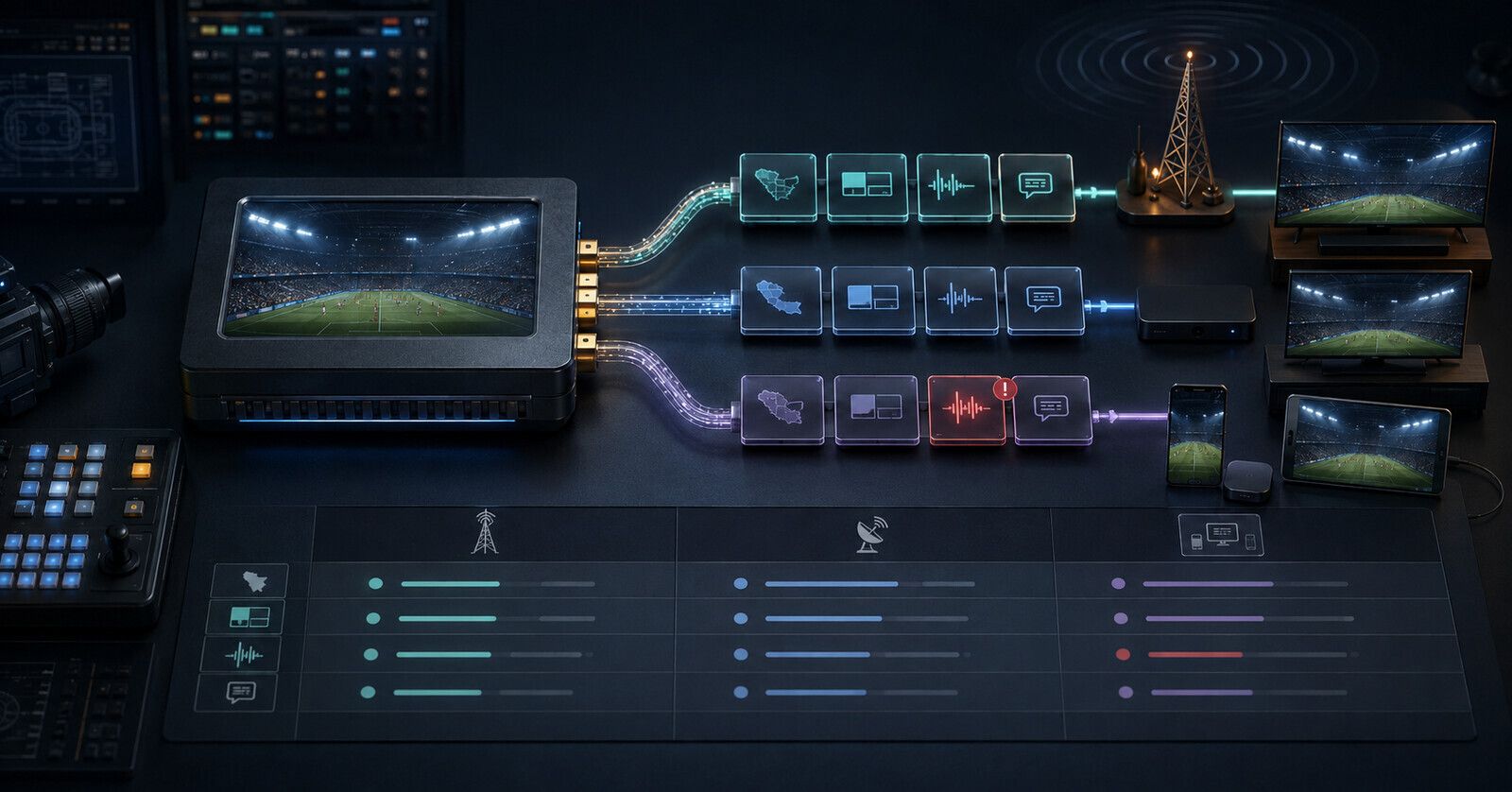
One game can be correct on cable, unavailable on a streaming app and carrying the wrong local break on an over-the-air affiliate.
That is the operating reality for a team-owned sports network. Taking control of production and distribution gives a club more authority over its fan experience. It also turns one telecast into several audience services with different partners, formats, advertising rules and failure paths.
A team-owned sports network therefore needs more than a game feed and a list of carriage deals. It needs a distribution-readiness plan that defines every outlet, the expected version at that outlet, who accepts it and what evidence closes an incident.

Why are teams taking more control of local distribution?
Teams are taking more control because the traditional regional sports network model is no longer the only reliable route to local fans.
Sports Video Group reported on August 25, 2026 that at least 14 U.S. teams across Major League Baseball, the NBA, NHL and WNBA had local game productions controlled by a team or team-owned media operation. Its examples included BravesVision, Rangers Sports Network, Kraken Hockey Network, Chicago Sports Network and Monumental Sports Network. That figure describes SVG's reported group, not a census of every rights arrangement.
Major League Baseball's current 2026 viewing guide shows how varied the result has become. Some teams use a traditional regional network plus a direct-to-consumer service. Others combine a team-branded network, free over-the-air games, cable or satellite carriage and an in-market streaming product. National exclusives still alter local availability.
The Atlanta Braves provide a current example. Their official viewing page says BravesVision produces more than 140 games in 2026 across a six-state territory, with distribution through cable, satellite, streaming, Braves.TV and selected Gray Media over-the-air stations. The Seattle Kraken say their team production reaches a five-state area through free local television, partner stations and a separate Prime Video arrangement.
The Kraken reported in February 2026 that the audience for Kraken Hockey Network had tripled across its five-state territory. That is a team-reported result from one market and operating model. It should not be converted into a forecast for another team.
What changes when the team owns the network?
The team becomes accountable for coordinating editorial, commercial and operational decisions that an external rights partner may previously have absorbed.
Atlanta Braves Holdings describes the shift in its June 30, 2026 quarterly filing. The company says BravesVision makes it directly responsible for affiliation agreements, advertising sales, production costs and other network expenses. It also says that, although third parties support production and distribution, the company retains ultimate editorial, commercial and operational responsibility.
The filing gives buyers a view of the cost profile. For the first six months of 2026, Braves Holdings reported a $10.9 million year-over-year increase in expenses associated with BravesVision production. It separately reported a $3.4 million increase in sales, marketing and administrative costs associated with BravesVision. Those are company-specific period-over-period increases. They are not a universal launch budget, and they do not represent every expense or revenue attached to the operation.
The same filing says media-related revenue declined by $10.0 million for the first six months compared with the prior-year period, primarily because of the timing of revenue recognition under BravesVision linear distribution agreements versus the previous agreement and changes in national media-rights arrangements.
Build the operating model around five accountable functions:
Function | Decision the team must own | Common partners | Acceptance evidence |
|---|---|---|---|
Production | Editorial treatment, talent, cameras, graphics and programme timing | Mobile units, production companies, venue operations | Clean and dirty feeds, production logs and reference recordings |
Distribution | Territory, platforms, affiliates and service versions | MVPDs, vMVPDs, stations, streamers, league platforms | Destination register, handoff receipts and outlet observations |
Commercial | Network inventory, local avails, sponsorship and makegoods | Ad sales, traffic, affiliates and ad-tech providers | Break map, as-run records and observed ad sequence |
Fan access | Authentication, entitlement, support and availability messaging | DTC platform, app stores, customer support | Test accounts, entitlement results and support escalation |
Incident command | Priority, public communication and restoration acceptance | Every technical and distribution partner | Shared chronology, timecoded media and closure owner |
Owning the network does not require the team to build every component. It does require someone inside the team to see across all five functions.
What belongs in a sports distribution destination register?
A destination register should give every audience service a stable identity and a testable definition.
Do not make “Braves feed,” “team stream” or “affiliate output” the primary identifier. Similar names become dangerous during a live incident. Use a durable service ID that stays attached to schedules, encoder profiles, monitoring, support tickets and recordings.
Each row should include:
Field | Example question it answers |
|---|---|
Service ID and public name | Which exact output are we discussing? |
Event and programme window | Does this include pregame, game, postgame and replays? |
Territory and rights source | Who supplied the rule for where this service may appear? |
Platform and distributor | Is this OTA, MVPD, vMVPD, league DTC or another app? |
Handoff point | Where does the team's technical responsibility change? |
Video profile | What resolution, frame rate, HDR state and aspect ratio are expected? |
Audio layout and language | Which channels, commentary and accessibility services belong here? |
Captions | Which caption service is expected, and where is it encoded? |
Graphics version | Which scorebug, sponsor and regional insert should appear? |
Advertising behavior | Which breaks pass through, replace locally or fall back to slate? |
Delay expectation | How should this outlet relate to other services and notifications? |
Acceptance owner | Who confirms readiness before launch and restoration after failure? |
Observation point | Where is the output sampled, recorded and compared? |
The rights owner or authorized business system supplies territory and availability rules. Monitoring can verify whether a declared rule was executed. It should not infer legal rights from a viewer's location, a schedule or another outlet.
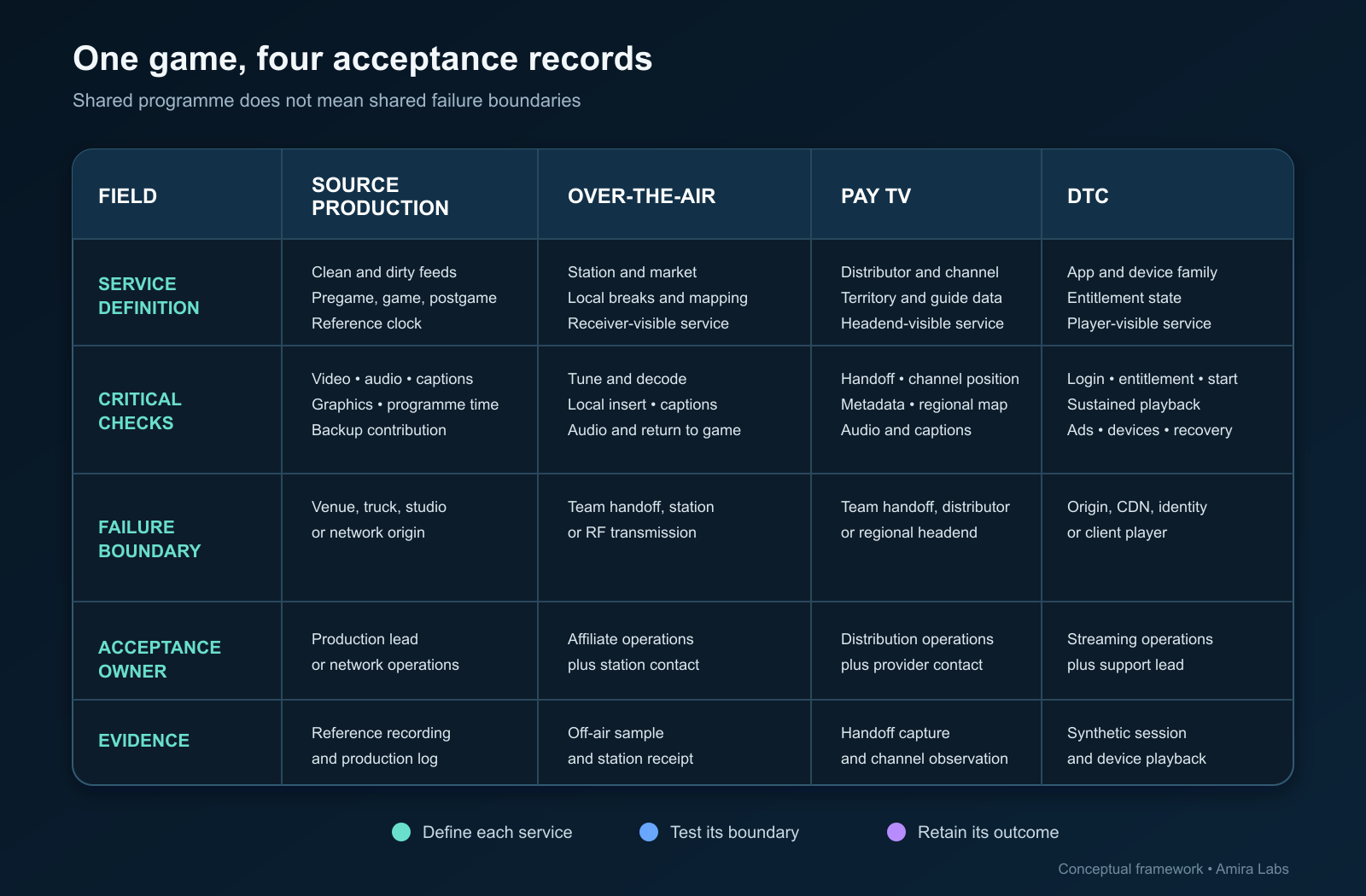
Why does one game need several acceptance definitions?
One game needs several acceptance definitions because each outlet changes the service in different ways.
An over-the-air station may insert local breaks, map captions and audio into its transmission chain and serve viewers through receivers the team does not control. A cable or satellite distributor may use a dedicated channel position, regional headends and its own guide metadata. A direct-to-consumer service adds authentication, entitlement, app behavior, content delivery and device-specific playback.
The Texas Rangers illustrated this separation in July 2026. Rangers Sports Network changed its direct-to-consumer distributor from Victory+ to BZZR during the season. The team said its cable, satellite and over-the-air distribution continued without change. Existing DTC subscribers had to transfer or authenticate their subscriptions on the new platform.
That episode should not be treated as evidence of a technical failure. It is evidence that a distribution partner can change while the core production and other outlets continue. The operating plan needs a modular service map so one transition does not become a false alarm across every path.
Define acceptance by outcome:
- OTA: the right programme, local station, caption service, audio and scheduled local insert are receivable in the intended market.
- Pay TV: the right service reaches the agreed handoff and appears on the correct channel position with expected guide data.
- DTC: an entitled test user in each authorized state can find, start and sustain the event on supported devices.
- Out-of-market service: the league or authorized platform applies the supplied availability rules and presents the expected telecast.
- Social or alternate production: the output carries the approved crop, graphics, audio and editorial delay for that platform.
The same source feed can pass while one audience service fails. Status must therefore roll up from outlets without hiding outlet-specific exceptions.
How should territory and entitlement rules be tested?
Territory and entitlement rules should be tested from an approved rules matrix supplied by the rights owner.
Do not reverse-engineer the policy from app behavior. Start with explicit cases: in-market subscriber, out-of-market subscriber, national-exclusive window, supported pay-TV authentication, unsupported distributor and approved promotional access. Add edge locations only when the rights team has defined the expected result.
For each case, record:
- rule version and approving owner;
- test account and consented location method;
- expected availability message;
- actual entitlement response;
- playback result, including which video and audio appeared;
- timestamp and application version;
- escalation owner when the rule and result disagree.
Keep identity and location data to the minimum needed for the test. Synthetic accounts are usually better than copying real subscriber records into an engineering worksheet.
National games complicate the schedule. MLB's 2026 viewing guide warns that national television can affect availability in some locations. The destination register should therefore be event-aware. A service that is correct on Tuesday may be intentionally unavailable on Friday under a different rights window.
How should advertising differ across outlets?
Advertising should differ only according to a declared break map, and every output should have an approved fallback.
Team-owned networks can combine national inventory, team-sold spots, distributor avails, station inserts, digital replacement and sponsorship elements. A correct programme feed can still produce a commercially wrong service if one outlet carries the wrong pod, cuts back late or displays an unapproved slate.
Create one break record that links:
- scheduled avail and duration;
- cue or trigger received by each insertion path;
- expected inventory owner for the outlet;
- intended creative sequence or approved fallback;
- observed media sequence;
- return-to-game time;
- traffic and measurement references;
- exception owner and disposition.
Keep media verification separate from billing. An observed spot proves that media appeared on a sampled output. It does not by itself establish an accredited impression, audience size, viewability or the amount owed under a commercial agreement.
The operational method is detailed in our SSAI and SGAI ad-break verification guide. A team launch should apply the same distinction among planned inventory, insertion events, observed playback and the chosen measurement method.
What should a launch rehearsal include?
A launch rehearsal should exercise a complete event across every destination and include known faults.
Run the programme window from pregame through postgame. Use the actual partner contacts, monitoring points, clocks, graphics packages, caption paths, ad rules and support procedures planned for launch. A five-minute test loop rarely reaches the junctions where sports broadcasts break.
Inject failures only in a staging or authorized rehearsal path:
- Remove one live contribution path and verify the approved backup.
- Delay a regional instruction so one affiliate remains on the prior version.
- Supply an incorrect audio map and confirm detection before distribution.
- Fail a local ad creative and verify slate or house-ad behavior.
- Deny an entitled synthetic DTC user and follow the support escalation.
- Change a game from local to national availability in the rules matrix.
- Interrupt one outlet while the source production remains healthy.
- Restore the outlet and confirm that every downstream service returns cleanly.
Measure detection, acknowledgement, time to a safe output and full restoration separately. A technically valid slate may protect air while the intended game remains missing.
The rehearsal ends when evidence is complete, not when everyone says the picture looked good. Retain the schedule version, service IDs, tickets, alarms, communications and timecoded output samples.
Who should command a multi-partner incident?
One named team role should command the incident even when a supplier owns the failing component.
The incident commander does not need to operate every system. The role maintains the shared chronology, establishes audience scope, assigns technical work and decides when the service is safe. Production can then concentrate on the game while distribution partners work their paths.
Use four scopes in the first incident message:
Scope | First question |
|---|---|
Source production | Is the correct clean and dirty feed leaving the venue or studio? |
Network output | Are the expected programme, audio, captions, graphics and breaks present? |
Distribution partner | Which handoff, market, station or platform first diverges? |
Viewer service | Which devices, entitlements or receivers reproduce the issue? |
Avoid declaring the entire network down because one app fails. Avoid the opposite mistake too. A healthy multiviewer at the production facility does not clear remote affiliates or DTC devices.
The closure record should name the last known correct output, first incorrect output, first alarm, mitigation, first restored output and stable recovery. Tie each time to an evidence source.
Where does centralized monitoring stop being enough?
Centralized monitoring stops being enough when it observes only one technical layer or one organization's telemetry.
A team may receive excellent production multiviewers, distributor dashboards, DTC analytics and station confirmations. Each source answers a narrow question. None alone proves the full audience path.
External media observation has boundaries as well. A probe can verify selected video, audio, captions, graphics and timing. It cannot determine whether a rights rule is legally correct, prove every household received the service, count an accredited audience or explain an internal partner component it cannot see.
Use complementary evidence:
- production and playout telemetry for component state;
- team-controlled intent records for schedule, rights input and commercial policy;
- handoff monitoring for the media exchanged with partners;
- representative endpoint checks for OTA, pay TV and DTC outcomes;
- human review for editorial and ambiguous cases.
Amira Labs fits at the live-media evidence layer. Comparing selected feeds and retaining timecoded evidence can help a team identify where an outlet diverged. It does not replace rights systems, subscriber entitlement, ad measurement or the distribution partners themselves.
What should teams ask vendors at IBC?
Teams should ask vendors to demonstrate one game across several outlets, including a controlled failure and the evidence package produced afterward.
- How does one event ID follow production, playout, OTA, pay TV and DTC?
- How are territory, national exclusives and entitlement rules versioned and approved?
- Which output attributes are checked at each partner handoff?
- How do local ads, captions, language feeds and graphics remain distinct by outlet?
- What happens when the DTC provider changes but linear distribution stays live?
- Who commands an incident spanning production, stations, distributors and an app?
- Which records can the team export for a joint service review?
- What can your system prove, and which viewer outcomes remain outside its observation?
If multiple language or alternate-audio services are part of the launch, pair the destination register with our multilingual live-sports feed validation guide. Each outlet needs the language promised to that audience, not merely a healthy audio carrier.
What can a team do this week?
First, list every place the next game can appear. Give each output a stable service ID, public name, partner, handoff and acceptance owner.
Second, choose three representative paths: one OTA station, one pay-TV distributor and one DTC device family. Write the expected video, audio, captions, graphics, advertising and availability behavior for each.
Third, draw the escalation chain across production, network operations, affiliate relations, streaming support and communications. Assign one incident commander.
Finally, rehearse a game window with one known failure. Compare the system logs with timecoded output evidence and a synthetic viewer result. Any disagreement is useful before launch.
A team-owned network can put the fan relationship closer to the club. That advantage survives only when every outlet is operated as a distinct, testable service.
Sources
- Sports Video Group: Taking Control: How Professional Sports Teams Are Building Their In-Market Future as the RSN Model Fractures, August 25, 2026
- Atlanta Braves Holdings: Quarterly report for the period ended June 30, 2026
- Atlanta Braves: How to Watch the Braves, accessed September 5, 2026
- Major League Baseball: How to watch every MLB team during the 2026 season, accessed September 5, 2026
- Texas Rangers and MLB: Rangers Sports Network announces BZZR as new direct-to-consumer distributor, July 15, 2026
- Texas Rangers: Rangers announce 2025 television broadcast viewing options, January 28, 2025
- Seattle Kraken: Kraken and TEGNA announce multi-year TV extension, February 19, 2026
- Chicago White Sox: Where to watch White Sox games on Chicago Sports Network, accessed September 5, 2026
- Monumental Sports Network: Viewing options, accessed September 5, 2026