
A monitoring probe can detect a black picture while the operator responsible for the channel never sees an alarm. The gap between detection and action is where broadcast observability often becomes an operational liability.
For master control, a fault is not fully monitored until the notification reaches the right destination, its state is visible, and its eventual clearance is verified.
Why alarm delivery is its own system
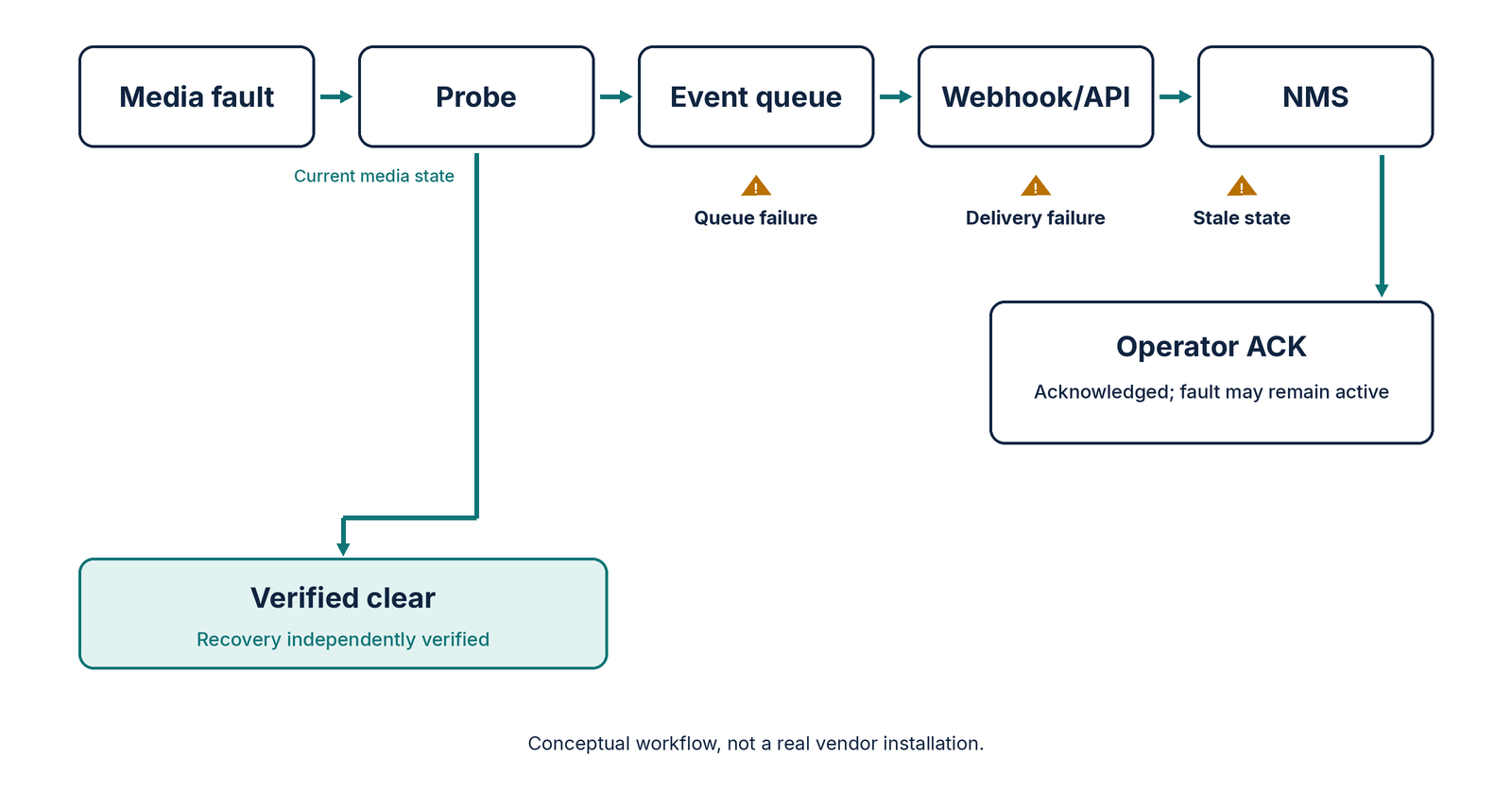
A typical workflow crosses several independent boundaries: media analysis, rule evaluation, event generation, queueing, an API or webhook, network transport, the network management system (NMS), and an operator display. Acknowledgment and correction add further state transitions.
Every boundary can fail independently. A probe may continue analyzing media while a webhook endpoint rejects requests. The NMS may display an old alarm after the source recovers. Acknowledgment may silence an alert without fixing the underlying fault.
The engineering mistake is treating detected, delivered, acknowledged and cleared as interchangeable states. They are not.
Seven tests to run before accepting an alarm integration
- Known-fault injection. In a controlled test feed, create a recognizable silence, freeze or incorrect-audio condition. Record when it starts, when the probe detects it, and when the NMS shows it. Use timestamps with documented clock synchronization.
- Destination unavailable. Temporarily reject or disconnect the receiving webhook in staging. Confirm that failed deliveries are visible, retries use bounded backoff, and events are not silently discarded.
- Duplicate delivery. Replay the same event identifier. Verify that the NMS updates one incident instead of creating multiple independent alarms. Design consumers to tolerate at-least-once delivery where applicable.
- Out-of-order transitions. Deliver a recovery event before a delayed active-alarm update. Confirm that stale events cannot incorrectly reopen or clear the current state. Include a source sequence or version where supported.
- Acknowledgment versus resolution. Acknowledge a still-active alarm. Confirm that the fault remains marked active until the media condition actually recovers, even if notification noise is suppressed.
- Silent probe failure. Stop the probe or its media input without producing a normal fault event. A separate heartbeat or freshness monitor should detect missing observations; no events is not proof of healthy media.
- Recovery and reconciliation. Restore connectivity after a prolonged outage. Compare the NMS state with the probe's authoritative current state, reconcile missing transitions, and verify the operator sees the correct final status.
What evidence should operations require?
For each test, keep the fault start time, detection time, event ID, delivery attempts, receiver response, NMS display time, acknowledgment, correction and final clear. Record the affected service and the team responsible for action.
A useful service-level objective distinguishes detection latency from notification latency. Set each target from the program's operational requirements; do not assume a single universal number. Track failed deliveries, event age, state disagreement and heartbeat gaps as separate indicators.
Standards help, but do not close the entire loop
AMWA's published NMOS BCP-008-01 defines receiver status monitoring; BCP-008-02 covers sender status monitoring. Both sit alongside supporting NMOS control and monitoring specifications. They help standardize visibility into IP media devices. They do not, by themselves, establish that an external NMS received an incident, an operator acknowledged it or the end-to-end service was restored.
These are proposed integration acceptance tests, not measured results from a broadcast plant or requirements imposed by BCP-008. Apply them in staging or a controlled maintenance window, with retry and recovery limits set for your system.
The acceptance decision
Ask for a live demonstration of a dropped notification, an acknowledged-but-active fault and a stale recovery event. A system that handles those cases predictably is more useful than one that only looks impressive when every component is online.
The practical standard is simple: detect the fault, deliver the evidence, maintain truthful state, and prove recovery.
Image credit: Original Amira Labs editorial diagram, November 3, 2026. Conceptual workflow, not a real vendor installation.