


Consider a hypothetical pilot that flags 27 caption problems in a month. Engineering calls it a success. Finance asks how many paid hours, service credits, complaints or overnight escalations changed. Nobody has a defensible answer.
Broadcast AI ROI starts with that answer, not with the number of detections. A pilot must connect technical evidence to an operating change that a CFO, COO and VP of Engineering can recognize. It must also show the full cost of creating that evidence.
The timing matters. IBC2026 runs September 11–14, and buyers will see polished demonstrations across monitoring, metadata, localization and production. A good demonstration proves that a capability can work. A finance-ready pilot proves whether it improves a defined workflow under your conditions.

Original conceptual illustration. No product interface, customer data or financial result is shown.
What does broadcast AI ROI actually measure?
Broadcast AI ROI measures recognized benefit against the full incremental cost of changing a specific workflow. It does not measure model activity, the number of alerts generated or the amount of content processed.
For a basic decision model, use:
ROI = (recognized benefit − total incremental cost) ÷ total incremental cost
The difficult part is not the arithmetic. It is deciding which benefits finance will recognize and proving that the pilot caused them.
Classify benefits before the pilot begins:
Value type | What can count | Evidence to retain | Common mistake |
|---|---|---|---|
Cash or revenue | Reduced overtime, avoided contractor spend, lower external processing cost, retained revenue or a changed hiring plan | Approved budget, invoices, payroll records or revenue attribution owned by finance | Treating all saved minutes as cash |
Released capacity | Operator or engineer time available for other assigned work | Before-and-after work sampling, queue records and an agreed fully loaded rate | Calling capacity a saving when staffing and spend do not change |
Risk reduction | A measured change in the frequency, duration or exposure of a defined failure | Incident history, contractual terms, complaints, recovery records and an approved valuation range | Inventing a universal cost for an incident that has not been measured |
Released capacity is still valuable. An operator may spend it reviewing more services, resolving faults earlier or completing deferred work. State that value accurately. If the operating plan remains unchanged, call it capacity released rather than cash saved.
Risk deserves the same restraint. A shorter time to detect a wrong-language feed may reduce exposure. The dollar value depends on the outlet's contracts, audience, recovery work and incident history. Use internal evidence and a range approved by the people who own that risk. Do not borrow a dramatic industry incident and assign its cost to every event.
The pressure to prove business impact is broad. PwC's August 2026 follow-up survey of 351 CEOs found that 39% reported maintained or improved positive AI impact while 16% reported negative impacts. About half said AI's revenue-and-cost impact had shifted over the preceding eight months. This is a cross-industry, self-reported snapshot, not a broadcast benchmark. It supports a narrower conclusion: AI value needs to be measured again as the workflow and operating conditions change. PwC: CEO Survey Snapshot, August 2026.
Which workflow makes a credible broadcast automation business case?
Choose one recurring workflow with a visible queue, an accountable owner and a baseline you can reconstruct. A broad “AI for operations” pilot makes attribution difficult because several processes, service levels and cost owners change at once.
Examples of bounded pilots include reviewing caption-quality alarms on a selected service group, checking language assignment on defined live outputs, triaging a known class of media exceptions or preparing first-pass metadata for a fixed archive collection. Each can be described as a flow of work with an input, a decision, an action and an outcome.
Write the boundary in operational terms:
- Which services, programs, languages or assets are included?
- Which shifts and event types are covered?
- What enters the queue, and what counts as completed work?
- Which human decisions remain mandatory?
- Which systems provide the authoritative record?
- What conditions force a fallback to the existing process?
Do not let the pilot quietly move its boundary after launch. A supplier might tune for a small set of cooperative feeds while the business case assumes every output. A newsroom trial might use clean recent media while the forecast assumes a mixed historical archive. Report what was actually tested.
The selected workflow also needs enough activity to produce evidence. A rare but severe failure can matter greatly, yet a short pilot may observe no examples. In that case, use approved historical cases or controlled fault injection to test detection and handling. Keep the financial claim separate. A synthetic test can establish behavior; it cannot prove the frequency or cost of real incidents.
Haivision's vendor-run 2026 Broadcast Transformation Report survey illustrates the adoption gap. Among more than 1,300 broadcast professionals surveyed from October through December 2025, 64% selected AI and machine learning as the technology most likely to transform production over five years, while reported current adoption was 27%. The sample is a vendor survey rather than a market census. It still gives buyers a useful reason to require operational proof before assuming that expected impact has already become routine value. Haivision: 2026 Broadcast Transformation Report highlights.
How should an AI pilot evaluation establish the baseline?
Establish the baseline with the same workflow boundary, definitions and evidence that you plan to use during the pilot. If the before and after periods are measured differently, the comparison will not survive review.
Capture normal operation and relevant peak conditions. For sports, election or breaking-news workflows, a quiet week may understate load. For master control, the overnight burden may differ from daytime work. Record the schedule and explain any material differences between periods rather than hiding them inside an average.
A practical baseline record can include:
Measure | Baseline definition | Pilot comparison |
|---|---|---|
Work volume | Items, services or media hours entering the defined workflow | Same unit and boundary |
Review effort | Human minutes from opening an item to a recorded decision | Same start and stop points |
Detection delay | Time from observable fault to first usable alert | Same clock source and event definition |
Triage delay | Time from alert to verified ownership or disposition | Same operational endpoint |
Quality | Verified misses, false alerts and incorrect classifications | Independent review of a fixed sample plus known cases |
Coverage | Scheduled service time when the check was actually available | Include gaps, restarts and degraded modes |
Escalation | After-hours pages, transfers and repeat handling | Apply the same escalation rule |
Cost | Labor, compute, storage, integration and support attributable to the workflow | Include every incremental pilot input |
Keep the event-level evidence. A weekly average cannot show whether one serious miss was hidden by many easy detections. For monitoring, retain the affected output, event time, observed media, expected condition, alert time, reviewer decision and action. Our AI broadcast monitoring buyer's checklist covers the technical acceptance path in more detail.
Test the model, the workflow and the field conditions. NIST's 2025 ARIA pilot evaluation used three testing levels: model testing, red teaming and field testing. Five organizations submitted seven applications, so it is an evaluation report rather than a universal standard or a broadcast ROI study. Its useful lesson is that application validity cannot be inferred from a model test alone. NIST: ARIA pilot evaluation report.
For a broadcast pilot, field testing means the actual signal path, event mix, operator queue, permissions, timing and failure handling. A detection score from an isolated file test is only one input to the business case.
Which costs belong in the AI pilot business case?
Include every incremental resource required to test, operate, verify and govern the workflow. The subscription or compute line is often only part of the cost.
Build the cost record with named owners:
- Integration and configuration: engineering time, vendor services, test feeds, connectors and change control.
- Data and infrastructure: compute, storage, network transfer, retention and any duplicated test environment.
- Human review: operator verification, exception handling, labeling, acceptance testing and supervisory review.
- Training and adoption: shift coverage, documentation, rehearsals and the time needed to reach competent use.
- Security and governance: access review, data handling, rights review, incident planning and evidence retention.
- Support and maintenance: monitoring the pilot itself, updates, failure recovery and recurring technical ownership.
- Exit or rollback: removing integrations, exporting records and returning the workflow to its prior state.
Separate one-time pilot cost from expected production run rate. Also separate existing capacity from incremental spend. An available GPU may have no new purchase cost for the pilot, but it still has power, support and opportunity costs that matter when comparing production options. Our broadcast AI inference placement guide explains why payload movement, concurrency and failure behavior affect that decision.
Avoid forecasts built from list prices alone. The production cost unit might be per service-hour, per media-hour, per completed case or per accepted output. Choose the unit that matches the workflow and include utilization. A powerful server sitting idle between peak events can produce a different result from the same hardware serving a steady archive queue.
Grant Thornton's 2026 AI Impact Survey covered 950 senior leaders, including 100 in media and entertainment. Its M&E analysis reports that 87% of sector boards had approved major AI investments and 54% of respondents said frontline employees needed the most adoption support. These are respondent findings, not proof that any individual investment returned value. They do show why training and operating adoption belong in the funded plan rather than being treated as free work after approval. Grant Thornton: M&E AI execution gap.
What does an honest hypothetical ROI example look like?
An honest example shows its assumptions, distinguishes capacity from cash and permits a negative result. The following numbers are entirely hypothetical. They are not Amira pricing, a customer outcome or a forecast for any facility.
Suppose a team reviews 100 candidate alarms per week. The baseline review takes five minutes per alarm, or 500 minutes. During a controlled pilot, the same service boundary sends 35 candidates to human review, again at five minutes each, while independent sampling checks for missed events. Review time falls to 175 minutes. The difference is 325 minutes, or about 5.42 hours per week.
Assume the organization uses a fully loaded labor value of $70 per hour and runs the pilot for 12 comparable weeks:
5.42 hours × $70 × 12 weeks = $4,552.80 of released capacity
If no overtime, contractor invoice, staffing plan or paid work changes, the finance-recognized cash saving is still $0. The $4,552.80 is a capacity value that operations should connect to specific reassigned work.
Now assume total incremental pilot cost is $22,000. If capacity is the only quantified benefit, an illustrative planning ratio would be:
($4,552.80 − $22,000) ÷ $22,000 = −79.3%
That negative result is informative. It says this narrow deployment does not recover the hypothetical pilot cost through review capacity alone. The team would need credible additional value, a lower run rate, more applicable volume or a different workflow. It should not fill the gap with an invented incident cost.
If the pilot reduces measured overtime or an external invoice, add only the approved difference. If it shortens verified fault exposure, model risk value as a range using the organization's own incident frequency and consequence data. Show the low, expected and high cases, along with the owner who approved each input.
Do not multiply the result across the enterprise without testing scale effects. More services may improve utilization. They may also add language variants, rights constraints, harder edge cases, storage, network traffic and operator load. A scale forecast should state which relationships are linear and which remain unknown.
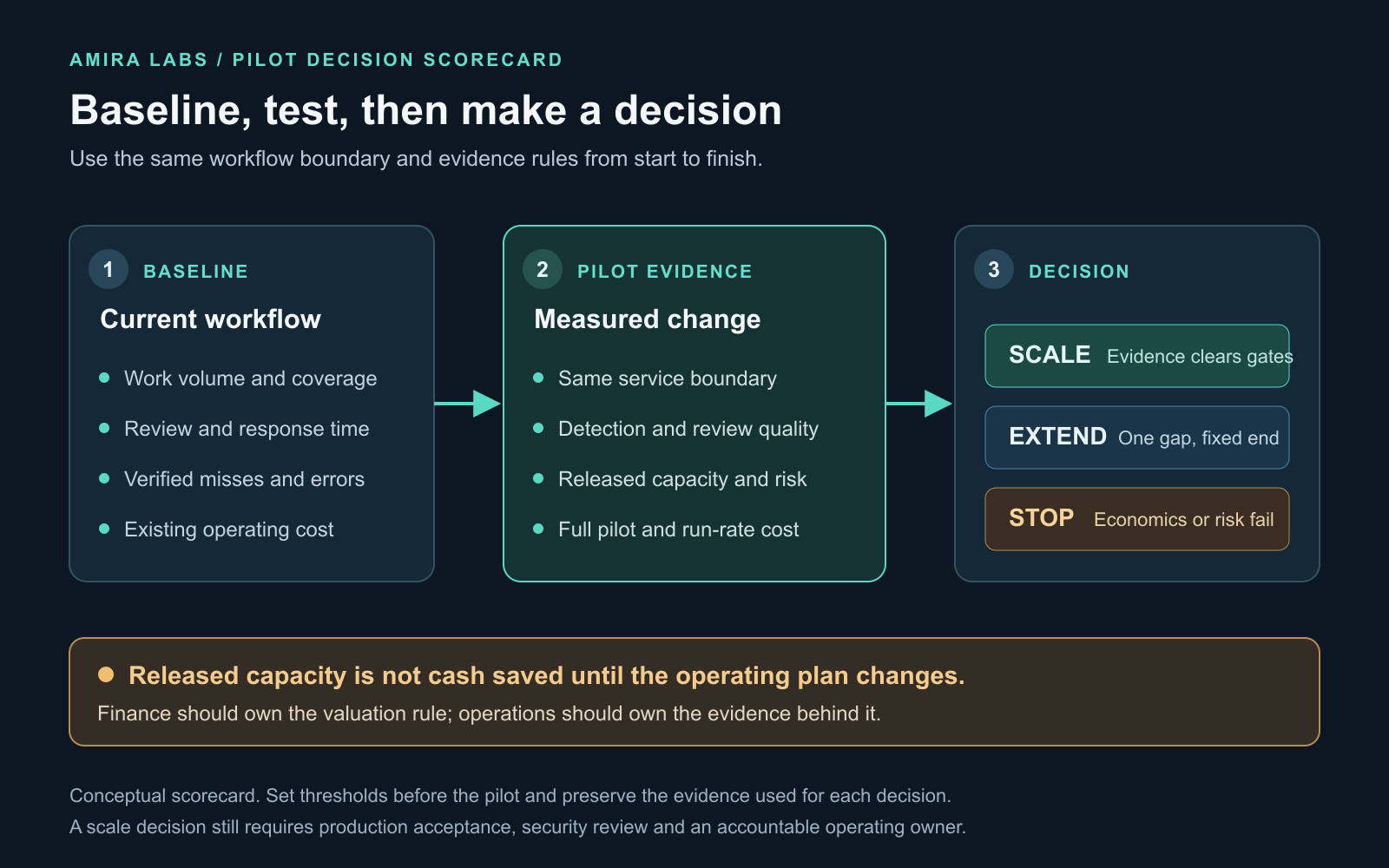
Original decision scorecard. It is a planning aid, not an accounting standard or product interface.
When should the team scale, extend or stop the pilot?
Make the decision against thresholds written before results are known. The acceptable answer may be scale, extend or stop. A pilot that ends cleanly after disproving its business case has protected capital.
Scale when the workflow meets its quality and coverage gates, the measured value clears the approved hurdle, the run-rate forecast includes operating support, and a named owner accepts production accountability. Confirm that security, rights, compliance and rollback requirements are also met.
Extend only when a specific evidence gap can be closed within a fixed period. Low event frequency, an incomplete peak test or one unresolved integration may justify more time. Record the missing evidence, the new end date and the condition that will prevent another extension.
Stop when the signal cannot be trusted, important misses remain unacceptable, operator burden moves rather than falls, data access is unsuitable, required evidence cannot be retained, or the economics depend on unsupported assumptions. Preserve the findings so the next team does not pay to discover the same limitation.
Grant Thornton's cross-industry survey found that 78% of respondents lacked strong confidence that they could pass an independent AI governance audit within 90 days. The same report associates fully integrated AI with stronger self-reported revenue outcomes, but it does not prove that integration caused them. For buyers, the defensible action is to retain the evidence, decision ownership and failure plan needed to explain why a pilot moved forward. Grant Thornton: 2026 AI Impact Survey.
Before approving production, ask the supplier and internal team to answer five questions with artifacts rather than assurances:
- What exact workflow and service boundary did we test?
- Which source records support each quality, time and cost measure?
- Which released hours become cash, assigned capacity or unvalued time?
- What fails at larger volume, peak concurrency or lost connectivity?
- Who owns production outcomes, recurring cost and the stop decision?
This week, choose one workflow and name its operational and financial owners. Export enough history to establish the baseline. Agree how misses, capacity, cash and risk will be valued. Then write the scale, extend and stop gates before anyone sees the first pilot result. That short document will do more for a broadcast automation business case than another impressive demonstration.
Sources
- IBC: IBC2026 dates, September 11–14, 2026
- PwC: CEO Survey Snapshot, August 2026
- Haivision: Top technology trends from the 2026 Broadcast Transformation Report
- NIST: Assessing Risks and Impacts of AI pilot evaluation report
- Grant Thornton: Agentic AI without rights-aware data is a liability
- Grant Thornton: 2026 AI Impact Survey Report