


A monitoring agent sees that the scheduled Spanish-language service is carrying English audio. It can collect evidence, open an incident and prepare a switch to backup. Should it also press the button?
That last step changes the problem. Agentic AI in broadcast can move work across connected systems, yet access to a tool does not grant authority to alter an on-air service. The operating policy must decide which actions can run unattended, which need a person and what evidence the person receives.
This question will be prominent at IBC2026. Avid's August 27 announcement says it will demonstrate agentic workflow intelligence and a new orchestration layer while keeping editorial control with editors. That is a vendor's announced direction, not evidence of unattended deployment. Buyers still need an action-permission model for their own facility. Avid: agentic editing plans for IBC2026.

Original conceptual illustration. It is not a product interface, deployment diagram or claim about an unattended broadcast system.
What does agentic AI in broadcast mean?
Agentic AI in broadcast means software that can interpret a goal, gather context, select tools and carry a task through several steps. The term describes a pattern of behavior. It does not define how much authority the software has.
A conventional classifier might label the language on an audio track. An agent could compare that observation with the schedule, inspect related signals, assemble evidence, create an incident and suggest a response. If it has an execution tool, it might also request or perform a change. Each step has a different operational consequence.
Recent vendor announcements show why buyers need to separate capability from permission. TV Tech reported on August 21 that Avid planned to demonstrate agentic automation within connected production workflows at IBC2026. Avid's August 27 press release describes a Ready to Edit capability, an orchestration layer and AI embedded in editorial workflows. Both establish planned demonstrations and product direction. Neither source supplies a measured case for giving an agent unrestricted control of a newsroom, edit, playout chain or distribution service. TV Tech: Avid brings agentic media production to IBC2026.
The practical unit of governance is the action. Reading a multiviewer, drafting metadata, paging an operator and switching an output should never inherit one shared autonomy setting merely because the same agent can call each tool.
Natural-language access changes nothing about this rule. A user can ask, “Fix the wrong-language feed,” but that sentence does not identify an approved source, a destination, a deadline or a rollback. The agent may translate the request into a proposed action. A separate authorization path must decide whether that action is allowed.
Which actions can run without human approval?
Read-only observation and non-executing recommendations can usually run unattended inside a defined scope. Writes and service-changing actions need progressively stronger boundaries, evidence and recovery controls.
Use these as starting defaults for evaluation rather than a universal standard:
Action class | Example | Starting default | Required boundary | Evidence or recovery |
|---|---|---|---|---|
Observe | Read signal status, media or schedule data | Unattended | Named sources, services, fields and time window; no write permission | Source identity, timestamps, coverage and gaps |
Recommend | Suggest a fault classification or next step | Unattended | Proposal cannot execute; expires after a short period | Supporting media, reference data, uncertainty and proposal time |
Annotate | Add draft metadata or an incident note | Limited write | Draft or versioned fields; no silent overwrite of an authoritative record | Agent identity, source, previous value and revert history |
Escalate | Open a ticket or page a defined role | Bounded automation | Allowlisted routes, severity rules, deduplication and rate limits | Reason, recipient, delivery result and acknowledgement |
Change service | Switch a feed, publish media, alter rights state or delete an asset | Human approval | Specific action, object and target; short approval lifetime | Approver, command result, output verification and tested rollback |
The lowest two classes do not mean low consequence. A recommendation can bias a hurried operator. An escalation can flood the on-call queue and hide a real fault. Unattended means the action can occur without a fresh approval, within controls that were approved earlier.
Annotation needs special care. Draft metadata can be useful when its origin is visible and a reviewer can correct it. A silent update to a canonical title, rights field, language code or version relationship can change later searches and automation. Store the proposed value separately or preserve the old value and author so the change remains reviewable.
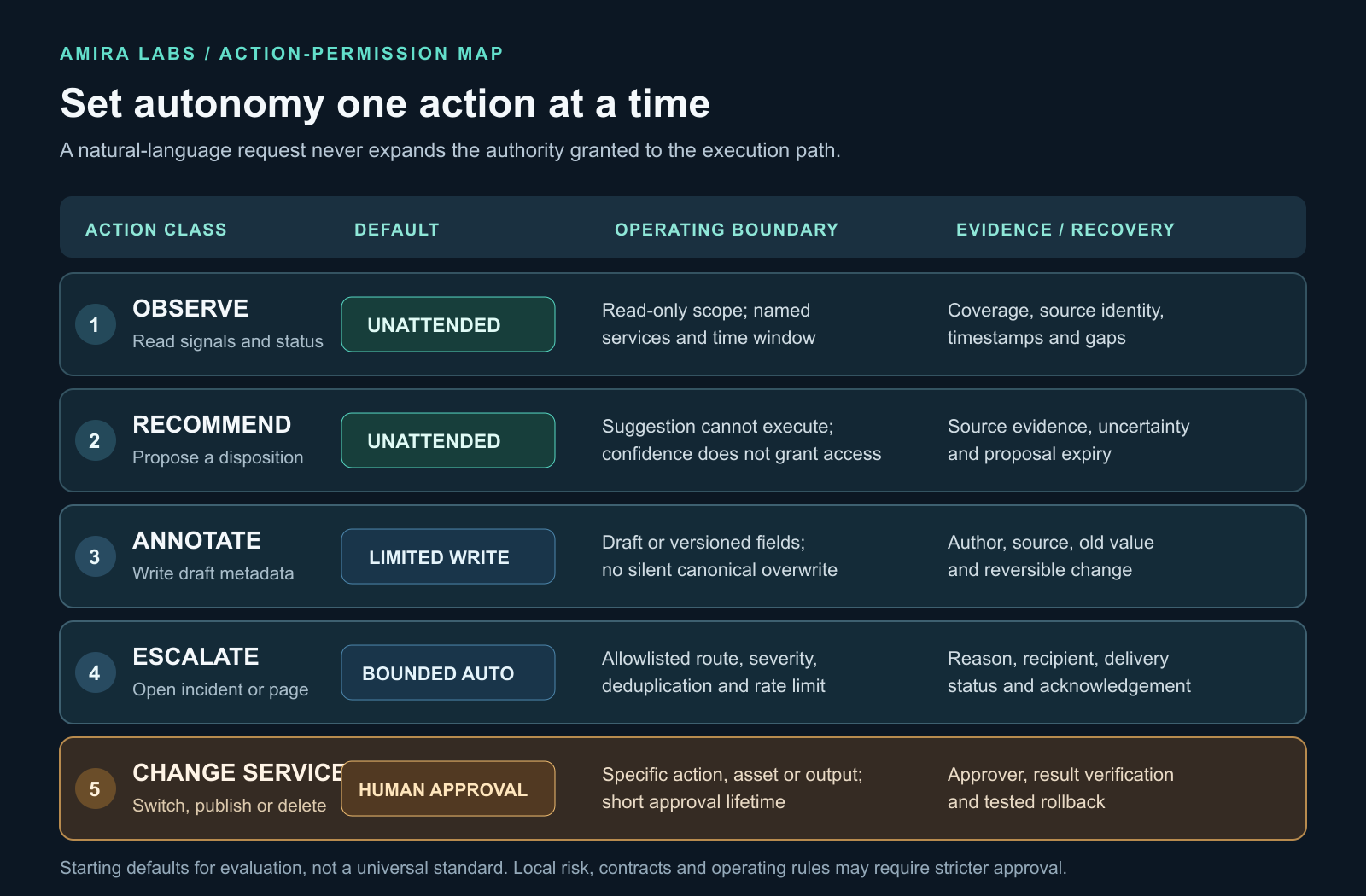
Original evaluation matrix. Local contracts, risk tolerance and operating rules may require stricter approval.
This action-based view complements our AI broadcast monitoring buyer's checklist. Detection quality answers whether the system found the right event. Permission design answers what the system may do next.
How do you define the agent's permission envelope?
Define the permission envelope as a machine-enforced record of scope, action, conditions, lifetime and recovery. A prompt, system description or model confidence score is not an access-control policy.
For every tool the agent can request, record:
- Objects: the services, assets, incidents, metadata fields or destinations it may touch.
- Actions: the exact read, propose, create, update, switch or delete operations allowed.
- Preconditions: the schedule state, evidence sources, system health and human role required before execution.
- Identity: the service account or delegated user whose authority is being exercised.
- Lifetime: when a proposal, approval or credential expires.
- Volume: concurrency, rate limits and duplicate suppression.
- Result check: the independent signal that confirms the intended change occurred.
- Recovery: the rollback command, safe state and person responsible if recovery fails.
This is least privilege applied to an agent. NIST Special Publication 800-53 Rev. 5 defines least privilege in AC-6 as allowing users or processes only the access needed for assigned tasks. AC-5 addresses separation of duties. The publication is a general security-control catalog. It is not an AI or broadcast standard. Its principles still fit connected automation: the component that recommends a service change should not silently expand its own execution rights or erase its audit trail. NIST: SP 800-53 Rev. 5.
Separate reasoning from enforcement. The model can assemble a proposed action in a fixed schema. A deterministic policy layer should check the target, permitted operation, current state, approval and expiry before passing anything to the execution system. A denied request stays denied even if the agent rephrases it convincingly.
The NIST AI RMF Playbook is voluntary and is being updated after the revision of AI RMF 1.0. Its current Govern guidance nevertheless gives buyers useful documentation prompts: clarify delegated authority, connect AI controls to existing governance, establish change-management requirements and test incident-response plans. Turn those prompts into artifacts for the workflow under review. NIST AI RMF Playbook: Govern.
The same separation applies to Model Context Protocol in broadcast workflows. A connection can expose context or a tool. It does not decide that every caller is allowed to use every operation. Authentication says who or what is calling. Authorization says what that identity may do here and now.
NIST's AI Risk Management Framework Appendix C makes the broader point. Human-AI arrangements can range from fully manual to fully autonomous, and human roles and responsibilities should be clearly defined and differentiated. NIST also notes that some systems may not require human oversight, giving video compression as an example, while others may require it. The consequence and context of the action should drive the arrangement. NIST AI RMF: human-AI interaction.
What should an operator see before approving an action?
An operator should see the affected service, observed problem, authoritative reference, proposed command, expected result, expiry and rollback in one decision record. The screen should make denial easy and missing evidence obvious.
Return to the wrong-language example. The agent observes English speech on an output scheduled for Spanish. A useful approval record would show:
Decision field | Example content |
|---|---|
Affected output | Stable service and destination identifiers, with the current on-air source |
Observation | Timecoded audio sample and detected-language result, including uncertainty |
Expected state | Scheduled language and the source of that schedule fact |
Cross-checks | Caption language, audio-track labels and any approved exception |
Proposed action | Switch the named output from current source A to approved backup B |
Blast radius | One output; no other regional or platform versions included |
Validity window | Approval expires if the schedule, source or evidence changes |
Verification | Recheck delivered audio and signal health after the command |
Rollback | Restore source A or enter the documented safe state |
The record must distinguish facts from inference. “Schedule says Spanish” is a sourced fact. “Current source is wrong” is a conclusion supported by the captured media and checks. “Backup B will fix it” remains a hypothesis until the backup is inspected or switched and verified.
Do not show confidence as a substitute for evidence. A 99% score says nothing about whether the agent examined the right output, read the current schedule or used a stale exception. The operator needs the source identifiers and timestamps that support the decision.
The approval should bind to one immutable proposal. If the target or command changes, ask again. A general “approve” button for a conversation invites a race in which the agent updates its plan after the person has reviewed it.
Record the human disposition too. Approve, deny, modify or defer are operational events. NIST AI RMF Appendix C suggests collecting the frequency and rationale for human overrides because that evidence can help evaluate deployed human-AI configurations. Override patterns may reveal a poor threshold, missing context or an action class that belongs at a lower autonomy level.
When can a service change run without a live approval?
A service change can run without a live approval only when the organization has already approved a narrow, deterministic operating playbook with tested entry conditions and recovery. The exception should be smaller than the general rule.
Existing broadcast automation already performs unattended actions. A health-based failover can be appropriate when both paths are engineered for the purpose, the trigger is deterministic, the safe state is known and the result is independently monitored. An AI agent may supply evidence or request that playbook. It should not invent new switch logic during the incident.
A pre-approved action needs at least:
- A specific service set and permitted source pair.
- Observable entry conditions that do not depend on a persuasive explanation.
- Independent checks that reduce single-sensor failure.
- A maximum action rate and protection against repeated switching.
- Verification of the delivered output after the command.
- A safe fallback when the agent, reference data or execution system is unavailable.
- A tested route to human control.
This is where “human in the loop” can give false comfort. A person who receives an unexplained prompt during a three-second deadline may simply confirm the machine. Approval quality depends on time, evidence, training and real authority to refuse. If the operating deadline does not permit meaningful review, design a pre-approved deterministic response or keep the action out of the agent's hands.
The limit also applies outside master control. A draft summary can be reversible, while publishing it to an audience is a different action. A suggested archive clip can be useful, while transferring rights-sensitive media to a new destination may need separate review. Grant Thornton's 2026 media-and-entertainment analysis asks who may approve, pause or reverse an agent's action and what evidence explains it. The underlying survey included 100 M&E respondents, so its figures describe that sample rather than every broadcaster. It reports that only 28.8% had tested an AI incident-response playbook. Grant Thornton: agentic AI and rights-aware media data.
How should you test broadcast AI automation before enabling action?
Test each action class in shadow mode, with historical incidents and controlled failures, before granting its production permission. Success at observation does not prove safe execution.
Start with the agent watching the live workflow without writing or escalating. Compare its observations and recommendations with independently reviewed events. Then enable one bounded write, such as a draft incident note, and verify authorship, correction and rollback. Escalation comes later, with duplicate suppression and on-call load measured.
Build cases that challenge the permission boundary:
- Give the agent a valid observation and an unauthorized target. The policy layer should deny the action.
- Provide conflicting schedule and metadata records. The agent should expose the conflict rather than select the convenient source.
- Let an approval expire, then change the proposed target. The old approval must not execute.
- Make the execution system return an ambiguous result. The workflow should verify the output and escalate instead of assuming success.
- Remove the agent, reference source or network path. The documented safe behavior should still work.
- Repeat the same event rapidly. Deduplication and action-rate controls should prevent a switch loop or alert storm.
For every run, retain the input evidence, proposed action, policy decision, approver where applicable, command result, observed output and recovery. Test the evidence trail with the same seriousness as the action. An audit record that exists only inside the failed component will disappear when it is needed most.
Before the next vendor demonstration, choose one operator workflow and list every action it contains. Place each action in the matrix above. Write the permission envelope for the highest-consequence tool, then rehearse a denied request, an expired approval and a failed rollback. You will learn more about operational readiness from those three failures than from another fluent conversation with an agent.
Sources
- Avid: Agentic editing and Media Composer plans for IBC2026, August 27, 2026
- TV Tech: Avid brings agentic media production to IBC2026, August 21, 2026
- Avid and Google Cloud: Agentic AI partnership announcement, April 16, 2026
- NIST: AI Risk Management Framework Appendix C, Human-AI Interaction
- NIST: Special Publication 800-53 Rev. 5, Security and Privacy Controls
- NIST: AI Risk Management Framework Playbook, Govern
- Grant Thornton: Agentic AI without rights-aware data is a liability